Clear Sky Science · en
Portable geosmin detection system based on sensor cells expressing insect odorant receptors
Why the smell of your tap water matters
Most people first notice a problem with their drinking water not by looking at it, but by smelling it. A musty, earthy odor can make perfectly clear water seem unsafe, and in some cases signals real trouble in lakes and reservoirs. One of the main culprits is geosmin, a natural compound produced by certain microbes. Detecting geosmin at extremely low levels is vital for water utilities, but today it usually requires bulky lab instruments or human sniff tests. This study describes a new pocket-sized system that uses living cells engineered with insect smell receptors to spot geosmin quickly and on-site.
A new way to “smell” with living cells
The researchers set out to build a simple, highly sensitive geosmin sensor that could be used directly at rivers, lakes, and dams. Instead of relying on metal or plastic detectors, they turned to biology. Fruit flies, like many insects, have remarkable noses: specialized receptors on their antennae can recognize tiny amounts of specific odors. The team borrowed one such receptor, known for its strong response to geosmin, along with a helper protein and a light-emitting calcium indicator. They inserted the three components into Sf21 insect cells in culture, creating “sensor cells” that light up when they encounter geosmin.
To ensure the cells responded strongly and reliably, the scientists generated many individual cell lines and screened them. They selected clones that showed large, repeatable jumps in fluorescence when exposed to geosmin but not to other musty compounds. A control cell line with a different insect receptor was tuned to respond to another mold-related odor, 1-octen-3-ol, but not to geosmin. These comparisons confirmed that each engineered receptor could give a highly selective signal, much like a lock that opens only for one key.
From microscope dish to portable cartridge
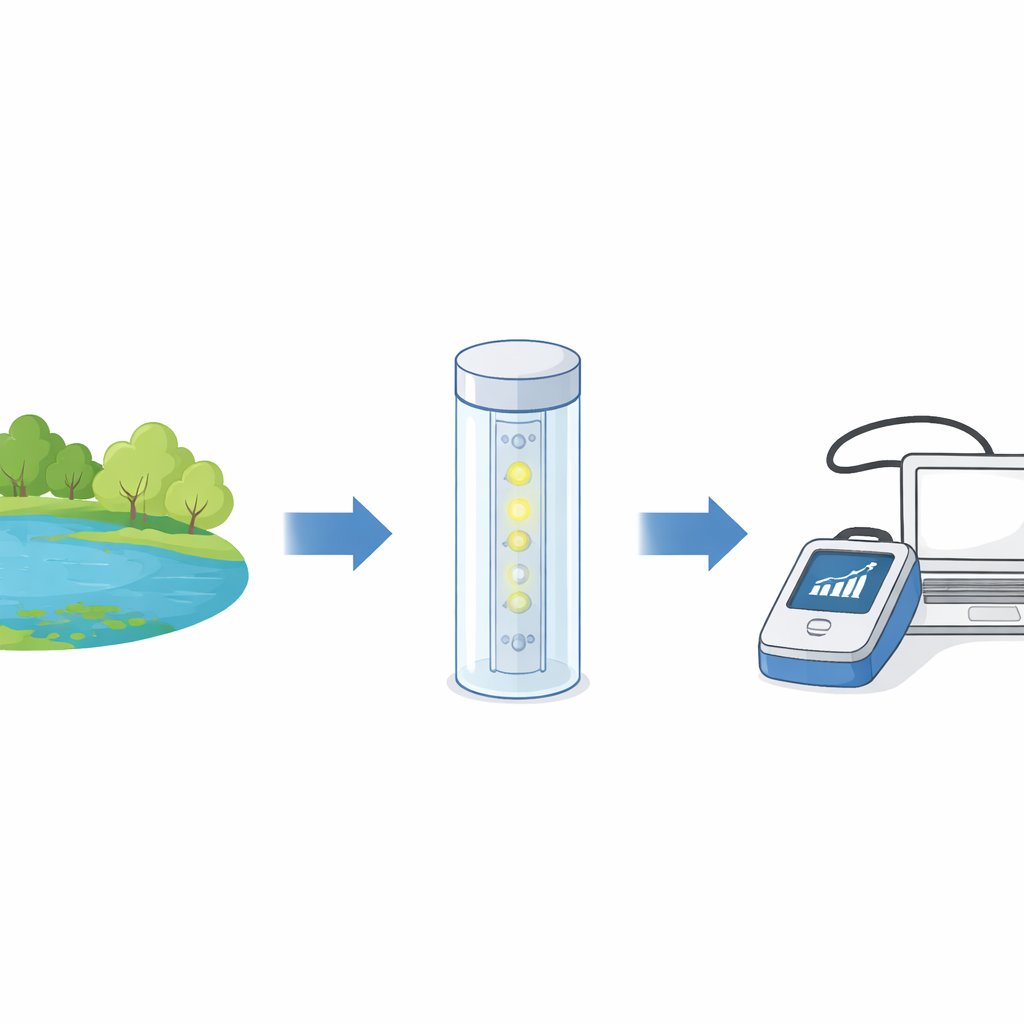
Having proven the concept under a microscope, the team needed to package the cells into a portable format. They coated narrow glass strips with a special surface that helps cells stick firmly without losing viability. The sensor cells were then attached as a thin layer and the glass strip was placed inside a small plastic tube containing buffer solution, forming a “cell-immobilized cartridge.” This cartridge fits into a handheld fluorometer, a compact device that shines light on the cells and measures how brightly they glow. When a water sample containing geosmin is added, the geosmin diffuses to the cells, binds the receptors, and triggers a measurable rise in fluorescence within a couple of minutes.
The cartridges proved stable from batch to batch: cartridges prepared from separate cell cultures gave similar responses to the same geosmin concentration. The sensor’s selectivity also held up in this format. At high test doses, geosmin caused a clear fluorescence increase, while 2-methyl-isoborneol (a related musty compound) produced no detectable change. By gradually lowering the geosmin concentration, the team found that the portable system could reliably detect as little as 100 picomolar geosmin—about 18 parts per trillion—without any pre-concentration of the sample. That performance is comparable to advanced gas chromatography–mass spectrometry (GC/MS), the current gold standard, but with far less time, cost, and equipment.

Putting the sensor to work at a real lake
To test whether the technology could handle the complexity of natural water, the researchers brought their setup to a lakeside dam used as a drinking water source. They prepared cartridges and buffers in the field, inserted the cartridges into the portable fluorometer, and added samples of lake water, with and without added geosmin. The fluorescence signals rose with geosmin concentration in much the same way as in clean laboratory water, indicating that other dissolved substances and background odors did not seriously interfere. Independent GC/MS measurements by a waterworks laboratory confirmed that the lake water contained geosmin at low but measurable levels, and the sensor system successfully detected this contamination on-site.
What this means for everyday water safety
In plain terms, this work shows that tiny living sensors built from insect smell receptors can be packaged into cartridges and used with a small reader to “sniff out” musty off-flavors in drinking water. The system reaches the ultra-low levels that matter for taste and consumer confidence, yet is light enough to be carried to a reservoir shoreline and fast enough to give results in minutes. Because insect odor receptors can be tuned to many different smells—from other water contaminants to disease-related body odors and even explosives—the same strategy could be adapted to a wide range of real-world problems. For now, the study demonstrates a practical new tool for helping water utilities keep the musty tang of geosmin out of the tap, protecting both safety and public trust.
Citation: Mitsuno, H., Araki, S., Sukekawa, Y. et al. Portable geosmin detection system based on sensor cells expressing insect odorant receptors. Sci Rep 16, 12577 (2026). https://doi.org/10.1038/s41598-026-41786-8
Keywords: geosmin, drinking water, biosensor, odor detection, insect receptors