Clear Sky Science · en
A non-conventional biodiesel process route from waste palm fatty acid distillate and ethyl acetate via esterification
Turning Waste into Clean Fuel
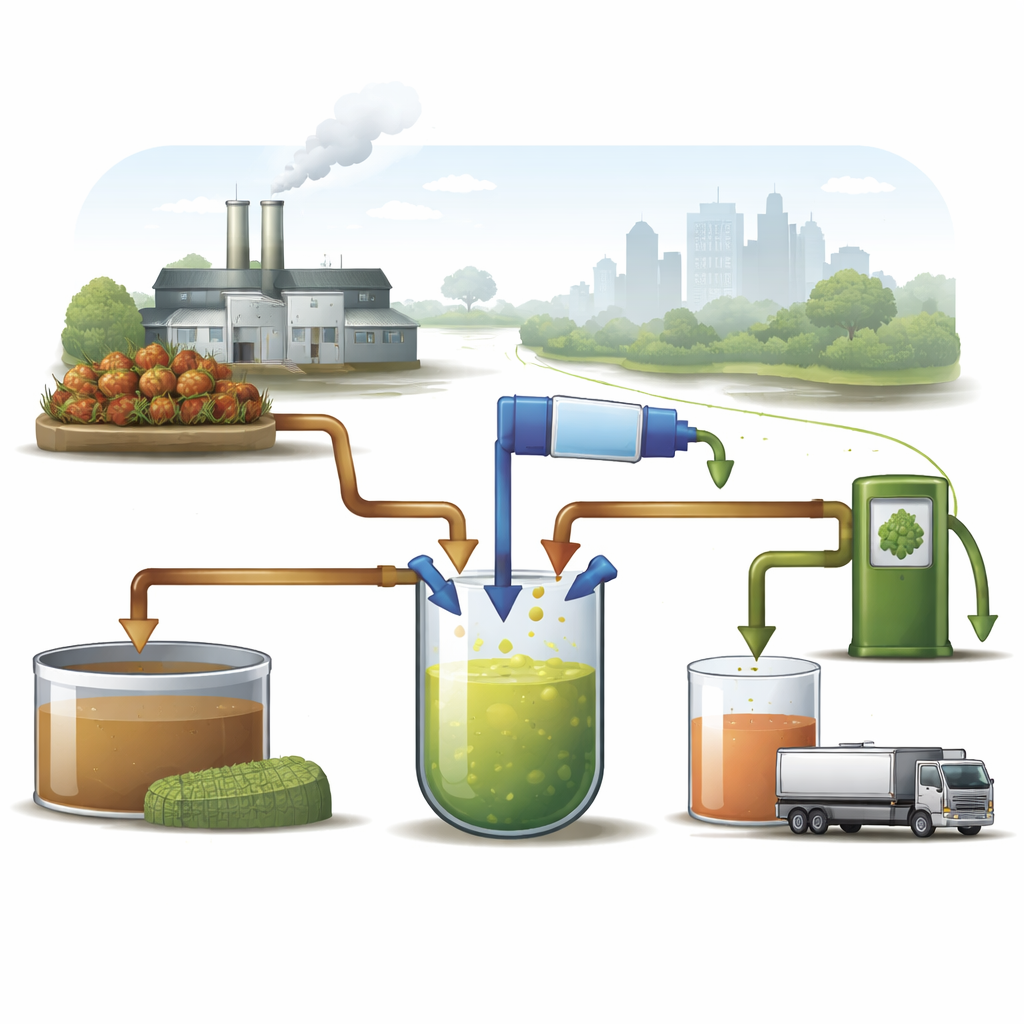
Modern life depends on energy, but the fuels we burn today come with steep costs for the climate and the economy. This study explores a way to turn a little-known waste from the palm oil industry into a cleaner diesel-like fuel, using a process that avoids some of the major drawbacks of current biodiesel technology. For readers, it offers a glimpse of how careful chemistry and smart process design can transform an unwanted by-product into a valuable energy source, while reducing waste and greenhouse gas emissions.
A Hidden Resource in Palm Oil Waste
Palm fatty acid distillate, or PFAD, is a by-product skimmed off during palm oil refining. It is cheap, abundant in palm-oil-producing regions, and mostly made of free fatty acids—greasy molecules that can be turned into fuel. Because PFAD is a residue rather than a primary food oil, using it for energy avoids the food-versus-fuel debate that plagues many biofuels. The researchers first measured PFAD’s basic properties, confirming that it contains an extremely high level of free fatty acids and characteristics that make it well suited as a starting point for biodiesel. At the same time, these same features make it difficult to process using standard industry methods, which are designed for cleaner, more refined oils.
A New Route that Skips the Glycerol Problem
Conventional biodiesel production usually relies on methanol reacting with fats or oils, producing fuel plus large amounts of glycerol as a by-product. In the early days this glycerol was useful, but as biodiesel output grew, the market for glycerol became saturated, turning it into a disposal problem. In this work, the team replaces methanol with ethyl acetate, a common solvent that is less toxic and more environmentally friendly. When ethyl acetate reacts with the free fatty acids in PFAD in the presence of sulfuric acid, it forms fuel molecules called fatty acid ethyl esters and acetic acid—a widely used chemical in food, pharmaceutical, and cosmetic industries—instead of glycerol. This creates a cleaner, glycerol-free route that can generate two valuable products rather than one fuel and one waste stream.
Finding the Sweet Spot in the Reaction
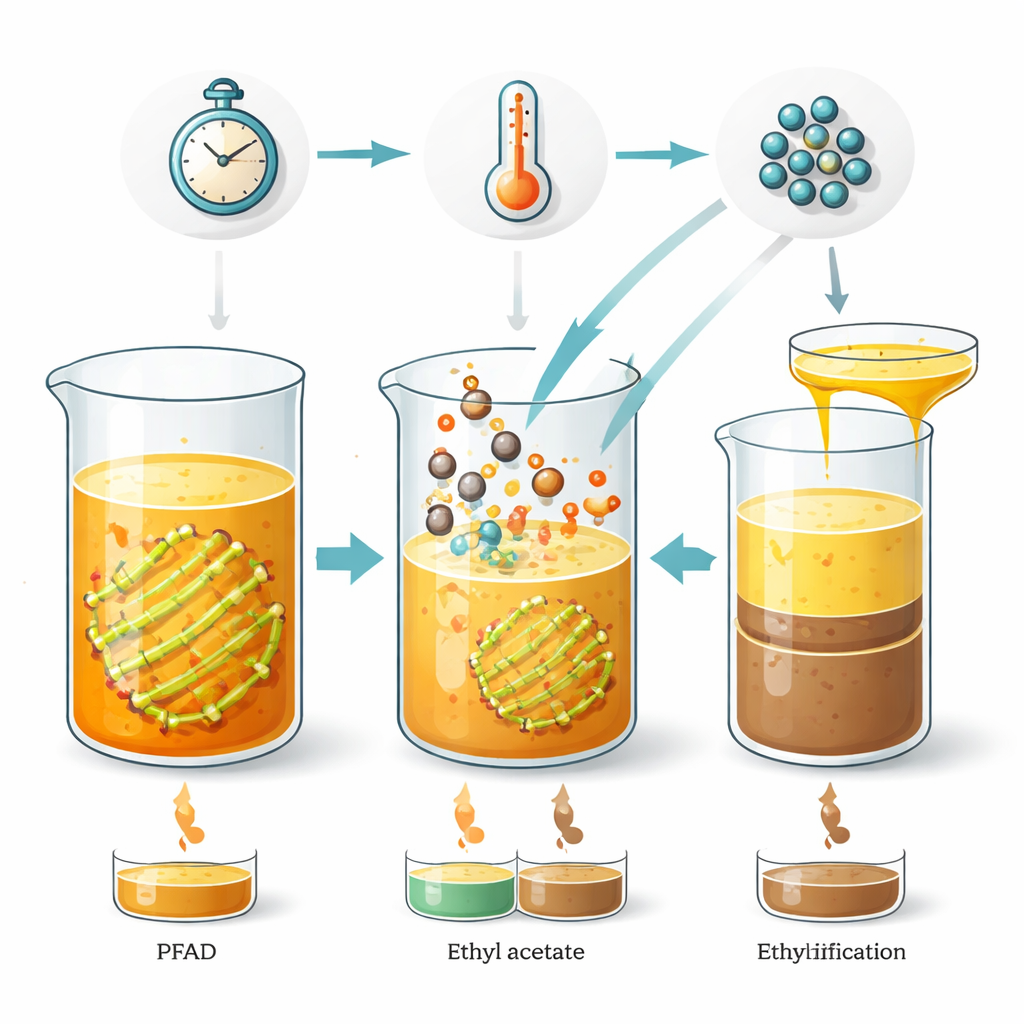
Getting the most fuel out of PFAD requires balancing several knobs at once: how long the reaction runs, how hot it is, how much acid catalyst is used, and how much ethyl acetate is mixed with the PFAD. Rather than exploring every possible combination in a trial-and-error way, the researchers used a structured statistical approach called Taguchi design. This method allows them to learn the influence of each factor with only nine key experiments instead of dozens. Their analysis showed that the ratio of ethyl acetate to PFAD was the most important factor for converting free fatty acids into fuel, while reaction time mattered least within the studied range. The optimal set of conditions—about four hours at a moderate temperature, with a modest catalyst dose and a high excess of ethyl acetate—gave a predicted conversion of roughly 88 percent of the free fatty acids into fuel molecules.
Testing and Understanding the Process
To see whether the optimization really worked, the team repeated the reaction three times under the best conditions suggested by the Taguchi method. They achieved an average conversion of just over 86 percent, in close agreement with the prediction, showing that the model is reliable. They also examined how pairs of factors interact—for example, how temperature and catalyst amount work together—to understand why too high a temperature or too much catalyst can actually reduce yields by breaking down sensitive molecules. Alongside this, they proposed a step-by-step reaction pathway: the acid first activates the free fatty acids, ethyl acetate then attacks the activated site, a short-lived intermediate forms, and finally the mixture reorganizes into the desired fuel molecules and acetic acid. This mechanistic picture helps explain how to further fine-tune the process.
What This Means for Future Fuels
In everyday terms, this study shows that a problematic industrial leftover can be turned into a useful cleaner fuel using a carefully designed, glycerol-free process. By swapping in ethyl acetate and optimizing the reaction conditions with a lean experimental strategy, the researchers demonstrated a high level of fuel conversion, produced a valuable co-product, and reduced the need for food-grade oils. The work suggests that PFAD-based biodiesel could support waste reduction, lower greenhouse gas emissions, and fit into a circular economy model where by-products are continuously reused. With further work on reusable catalysts, detailed economics, and scale-up, this route could become a practical way for refineries to turn waste into low-carbon diesel substitutes.
Citation: Esan, A.O., Olafimihan, B.A., Olawoore, I.T. et al. A non-conventional biodiesel process route from waste palm fatty acid distillate and ethyl acetate via esterification. Sci Rep 16, 11204 (2026). https://doi.org/10.1038/s41598-026-41785-9
Keywords: biodiesel, palm fatty acid distillate, waste-to-energy, green chemistry, renewable fuels