Clear Sky Science · en
Hydrostructural and dynamic characteristics of compacted Nanning red clay considering wetting-drying impacts
Why Cracking Red Soils Matter for Everyday Roads
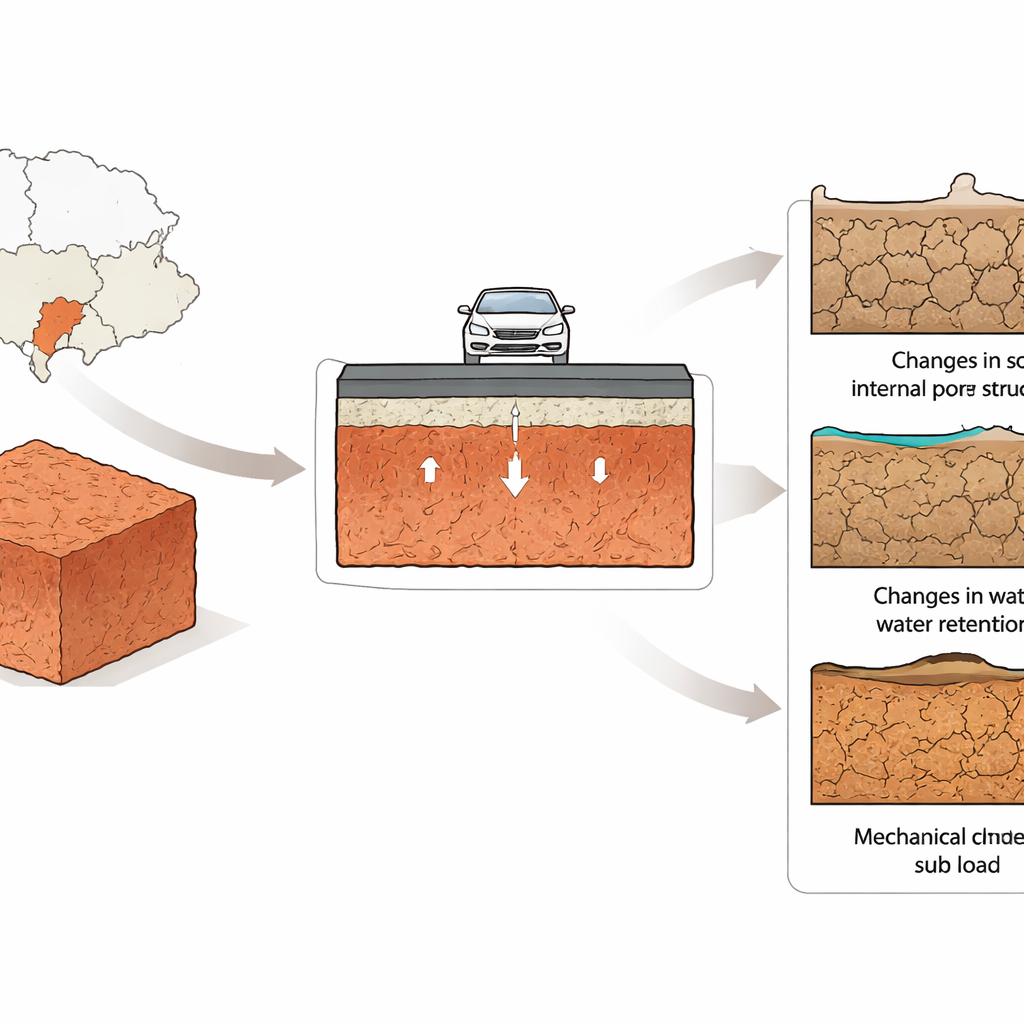
Across much of southern China, highways and local roads are built on a distinctive rust-colored earth known as red clay. These lateritic soils are strong enough to carry traffic, but they live in a harsh environment: long seasons of heat, humidity, and repeated soaking and drying. Over years of use, this natural “breathing” of the ground can quietly weaken the soil beneath the pavement, leading to ruts, cracks, and costly repairs. This study looks deep inside one common red clay from Nanning to see how its tiny pores, its ability to hold water, and its response to traffic loads evolve after many wet–dry cycles, and how engineers can better predict its long-term behavior.
Where the Red Clay Comes From
The researchers focused on a red clay collected about one meter below the surface along a ring road construction site in Nanning, a subtropical city in southern China. Like many red soils, it formed as limestone and other rocks slowly broke down in a hot, humid climate, leaving behind a clay rich in iron oxides that give it its color and natural strength. In practice, this kind of soil is often compacted to form the supporting layer, or subgrade, under thinner pavements for lower-level roads. Those subgrades experience low sideways pressure from the surrounding ground but relatively high up-and-down stresses from vehicles. They are also usually partly unsaturated, meaning their properties depend strongly on how much water they contain and how that water moves in and out over time.
How the Team Tested the Soil
To mimic real construction, the clay was compacted in the laboratory to its standard maximum density and optimum water content—the condition engineers usually aim for in the field. Some samples were left in this “as-compacted” state, while others were pushed through ten full wetting–drying cycles, from nearly saturated to almost air-dry and back again, to represent years of seasonal change. The team then used several tools. Mercury intrusion tests mapped the sizes of pores inside the soil. Special equipment measured how tightly the soil held water at different moisture levels. Finally, cylindrical specimens were subjected to 20,000 cycles of simulated traffic loading in a triaxial device, allowing measurement of both the elastic response (resilient modulus, a measure of stiffness) and the permanent deformation that accumulates with each load.
What Happens Inside the Soil During Wet and Dry Seasons
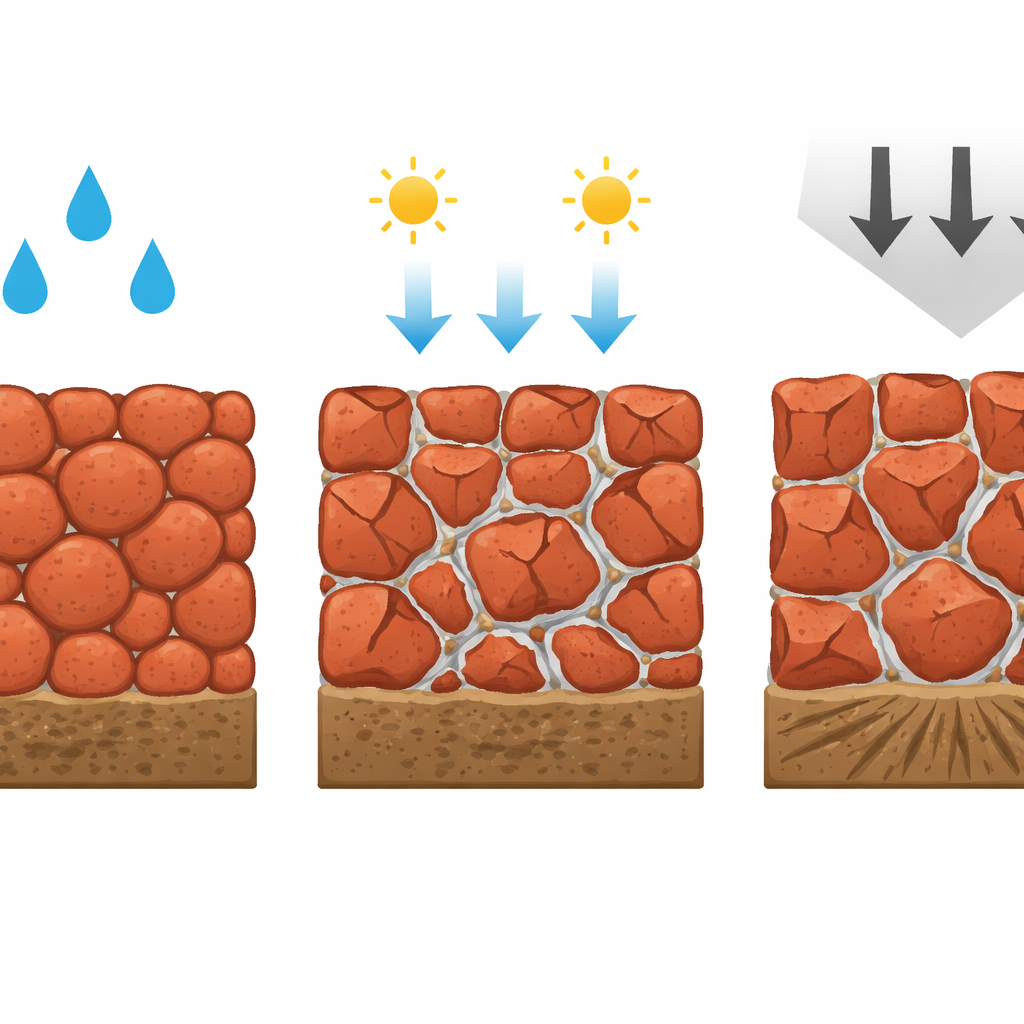
Freshly compacted, the red clay behaves like a structure built from small clumps of particles. There are tiny pores inside each clump and larger pores between clumps, giving the soil a “dual” pore system. This arrangement shows up clearly in how the soil holds water: its water–suction curve has two stages where air first enters the large pores and then the smaller ones. After ten wet–dry cycles, this internal architecture changes. The pores inside the clumps shrink, while the spaces between clumps and cracks between blocks grow. Overall void space increases, and the once distinct two-step water–suction curve smooths out. The soil now takes up more water at saturation but loses it more easily at low suction, meaning it holds on to moisture less effectively in the range most important for pavement performance.
How Traffic Loads Change as the Soil Ages
The loading tests reveal how these microscopic changes translate into road performance. Under repeated loading, the clay shows two key behaviors: a recoverable elastic strain and a permanent strain that accumulates with each cycle. As water content rises and the internal suction drops, the soil becomes softer (its resilient modulus falls) and accumulates more permanent deformation. After wet–dry cycling, this sensitivity to moisture becomes stronger. For the same stress, a wet, cycled sample can accumulate permanent strain many times larger than a drier, uncycled one, and can reach failure-level deformations at lower stress levels. At the same time, the soil’s stiffness falls and becomes less responsive to changes in loading once the structure has been damaged by cycles. Using a simple equation based on the soil’s suction and degree of saturation, the authors were able to capture these highly curved trends for both stiffness and permanent strain, before and after cycling, with a single fitting parameter that increases as the structure degrades.
A Hidden Link Between Elastic and Plastic Behavior
One striking finding is that, despite varying stress levels, moisture states, and wet–dry histories, the relationship between the clay’s stiffness and its accumulated permanent strain follows a single, smooth curve. Stiffer states consistently correspond to very small permanent deformations, while softer states align with much larger ones. This suggests an underlying connection between how the soil springs back under each load and how much it creeps and settles over time, potentially offering a way to estimate long-term rutting from simpler stiffness measurements in design.
What This Means for Roads on Red Clay
For non-specialists, the message is that the seemingly solid red ground beneath many roads is far from static. Seasonal wetting and drying rewire the soil from the inside out, creating more cracks and larger pores, reducing its grip on water, and making it both softer and more prone to permanent ruts under traffic—especially when wet. By tying these changes to simple measures of soil moisture and suction, and by revealing a stable link between stiffness and long-term deformation, this work offers engineers better tools to predict how red-clay subgrades will age and to design pavements that stay safer and smoother over their lifetime.
Citation: Deng, S., Zhang, H., Wei, J. et al. Hydrostructural and dynamic characteristics of compacted Nanning red clay considering wetting-drying impacts. Sci Rep 16, 11483 (2026). https://doi.org/10.1038/s41598-026-41777-9
Keywords: red clay subgrade, wetting drying cycles, soil pore structure, resilient modulus, pavement performance