Clear Sky Science · en
Mechanistic elucidation of a terpenoid nano-bionematicide for the management of root-knot nematodes, Meloidogyne incognita infecting tomato
Why tiny worms threaten your tomatoes
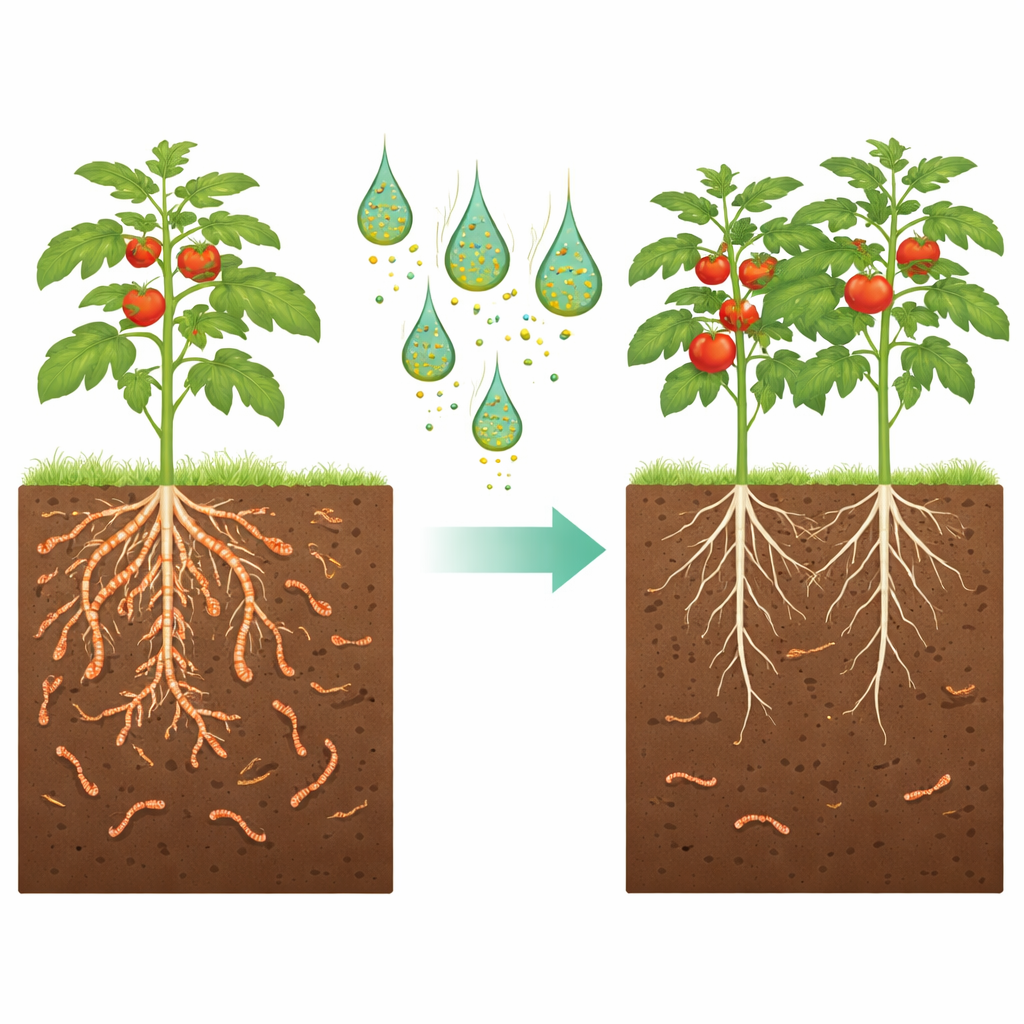
For many vegetable growers, wilting plants and knotted, swollen roots are a familiar and costly sight. These problems are often caused by root-knot nematodes—microscopic worms that invade roots, steal nutrients, and quietly drain yields. Farmers usually fight them with synthetic chemicals that can harm the environment and beneficial soil life. This study explores a different route: a neem-based "nano" product that aims to stop these worms efficiently while remaining safer for soils, crops, and people.
A natural weapon made smaller
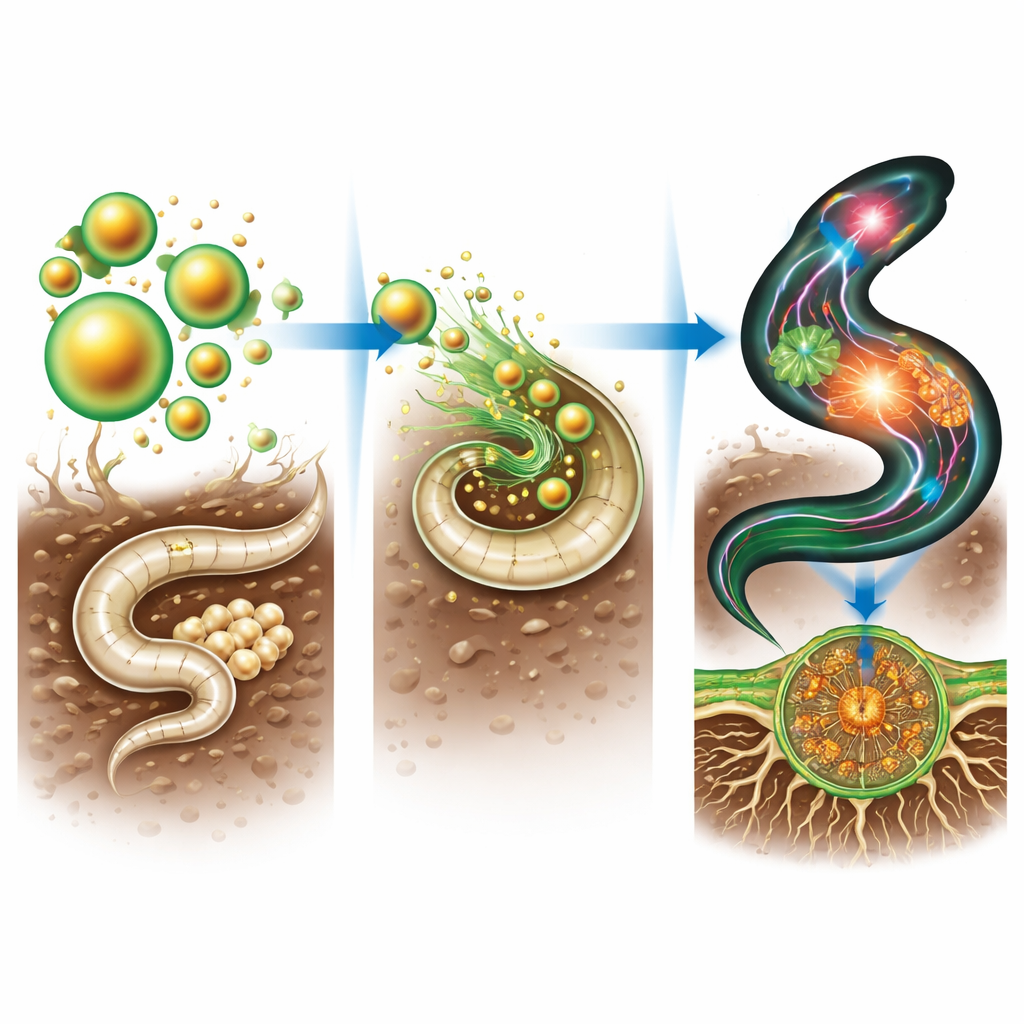
The heart of this work is a product called Terpaz, a nano-formulation built around azadirachtin, a well-known natural compound extracted from neem seeds. Azadirachtin is already used in some biopesticides, but it breaks down quickly in sunlight and heat, which limits its impact in real fields. By packaging azadirachtin inside tiny, uniform oil droplets—tens of nanometers across—the researchers created a stable, slow-release form that disperses easily in water. Microscopy confirmed that these droplets are smooth, spherical, and evenly sized, a structure designed to protect the active ingredient and deliver it more effectively to nematodes in soil.
Putting the nano-formulation to the test
The team first challenged the new formulation in controlled laboratory tests. They exposed nematode eggs and the infectious juvenile stage to a range of doses. As the amount of product increased, far fewer eggs hatched and many more juveniles died. At higher field-like rates, the neem nano-formulation matched or surpassed a modern synthetic nematicide, fluopyram, in both killing young worms and preventing new ones from emerging. Importantly, a version of the nano-carrier without azadirachtin had almost no effect, showing that it is the natural ingredient—not the carrier alone—that does the damage.
How the nano-formulation disables the worms
To understand how this natural product works from the inside out, the researchers combined computer modeling with enzyme tests. They focused on two key proteins inside nematodes: acetylcholinesterase, which helps control nerve signals, and ATPase, which helps manage energy supply. Computer docking and molecular dynamics simulations showed azadirachtin fitting snugly into the active pockets of both proteins and remaining stably bound over time. In parallel, biochemical assays on treated worms confirmed that both enzymes were strongly inhibited in a dose-dependent fashion. Together, these results point to a dual attack on the worms’ nervous system and energy metabolism, making it harder for them to move, feed, and survive.
Protecting roots and boosting harvests
The researchers then moved from lab dishes to living tomato plants. In root-dip experiments, young tomato roots treated with the nano-formulation at practical doses became much harder for juveniles to invade. At the highest tested rate, worms were largely confined to the outer root surface and could not reach the inner tissues where they normally feed and form galls. In field trials on nematode-infested soil, plots treated with the neem nano-formulation had the lowest nematode counts at harvest, the fewest and smallest root galls, and the highest tomato yields—outperforming the synthetic nematicide. Just as crucially, when common beneficial soil fungi and bacteria were grown on media containing the formulation, their growth was not suppressed, suggesting that the product is gentle on helpful microbes.
A step toward gentler pest control
Altogether, this study shows that shrinking a natural neem compound into nano-sized droplets can turn it into a powerful, multi-target treatment against root-knot nematodes in tomatoes. The formulation not only kills eggs and juveniles in laboratory tests but also interferes with their nerve and energy systems, blocks their entry into roots, and ultimately protects yield in real fields, without obvious harm to friendly soil organisms. While more seasons and locations must be tested to confirm long-term safety and reliability, this work points to a future in which farmers can manage damaging soil pests using smarter, plant-based technologies rather than relying solely on conventional chemicals.
Citation: Arunachalam, L., Lakshmanan, S. & Ganeshan, S. Mechanistic elucidation of a terpenoid nano-bionematicide for the management of root-knot nematodes, Meloidogyne incognita infecting tomato. Sci Rep 16, 11925 (2026). https://doi.org/10.1038/s41598-026-41775-x
Keywords: root-knot nematodes, neem-based biopesticide, nano-formulation, tomato yield, sustainable pest control