Clear Sky Science · en
Cloud assisted blockchain-enabled split federated learning framework for security and privacy-preserving of IoMT in healthcare 5.0
Why safer smart healthcare matters
Modern medical gadgets, from fitness watches to connected hospital sensors, constantly stream data that can help doctors spot illness earlier and respond faster. But sending all of this sensitive information to distant clouds raises hard questions: How do we protect patient privacy, stop hackers, and still react in real time when something goes wrong? This study explores a new way to train smart security systems for healthcare networks so they can learn from many devices without exposing private data or relying on a single, fragile control point.
Smart devices that learn close to the patient
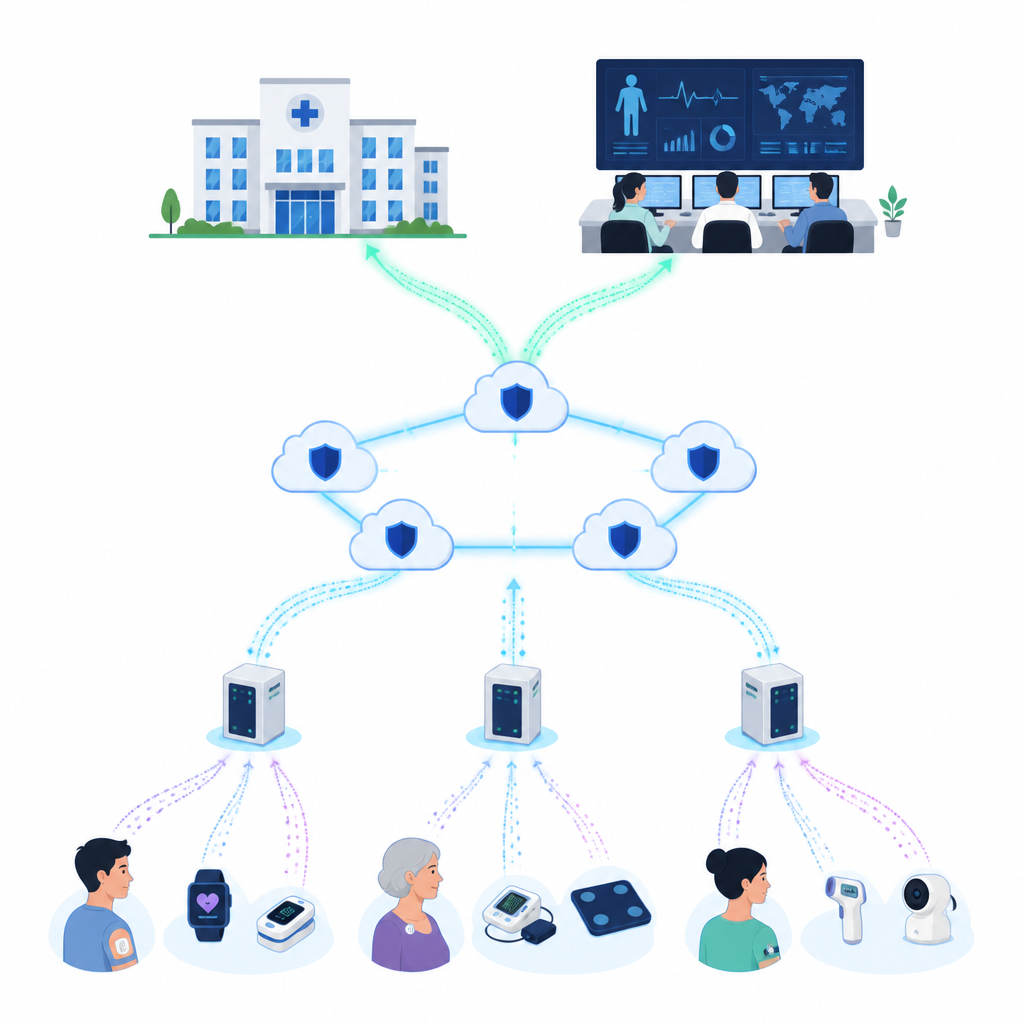
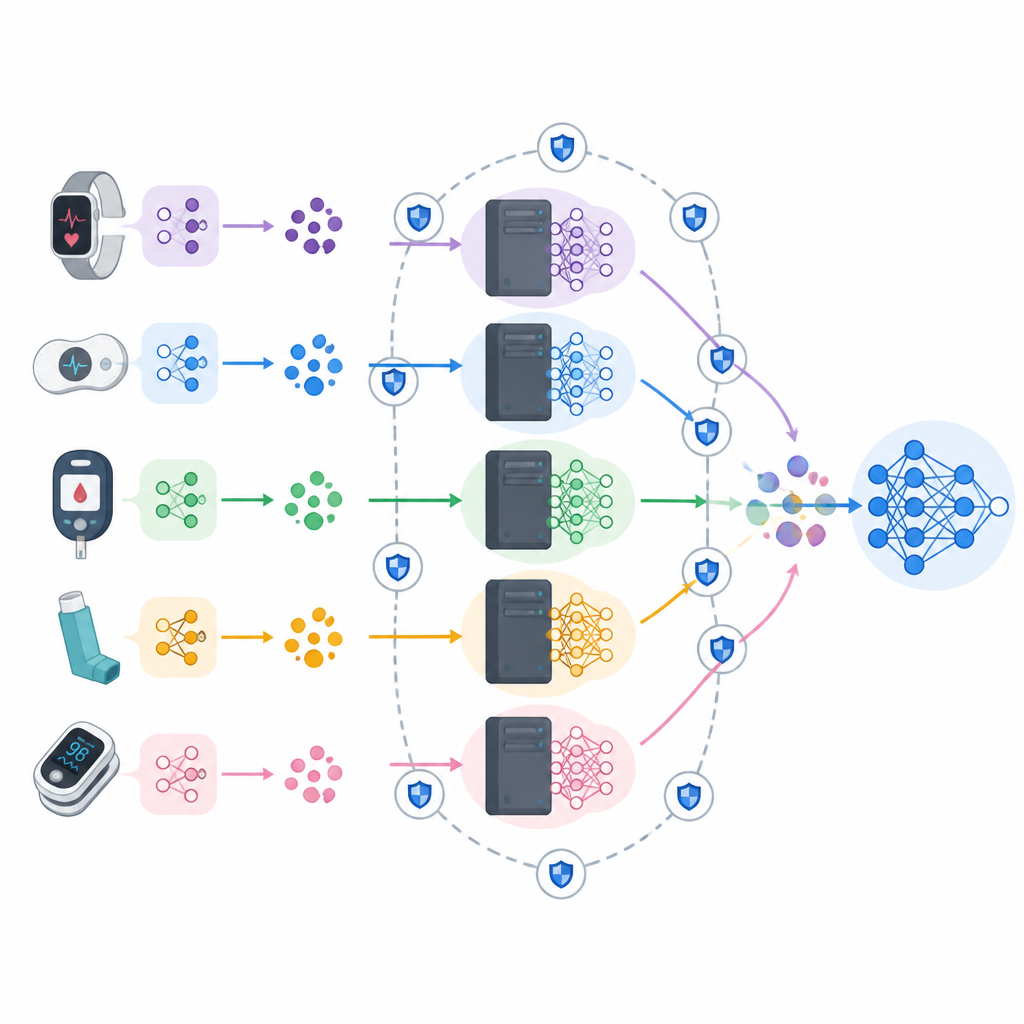
In tomorrow’s hospitals and homes, countless Internet of Medical Things devices collect heart rates, blood oxygen levels, and other readings. Instead of shipping raw data to a central server, the authors use a technique where part of the learning model runs directly on each device. A small, efficient pattern finder looks at the local measurements and turns them into compact signals that hide the original details. These signals, not the raw health records, are passed onward for further analysis, helping to keep individual patient information private.
Sharing the workload between edge and cloud
Once the compact signals leave the devices, they are processed by more powerful computers located at the network edge, closer than a distant cloud. Here, a second, deeper part of the learning model studies how the signals change over time to detect unusual behavior that may indicate cyberattacks or faults. This split design means small gadgets only handle light calculations, while edge machines take on the heavy lifting. The result is faster reactions and lower network delays, which are crucial when medical alarms or treatment decisions depend on timely, accurate information.
Building trust with a shared digital ledger
A key weakness of many learning systems is that they depend on a central server to combine updates from all devices. If that server is hacked or fails, the whole system is at risk. To avoid this, the authors layer a blockchain system on top of the learning process. Instead of trusting one server, several validator nodes jointly check each batch of model updates. Using an agreement method designed for speed and reliability, they decide which updates are honest enough to be added to a shared digital ledger. Devices that contribute good information can be rewarded, while suspicious ones can be flagged, creating a form of automatic reputation and accountability across the network.
How well the new approach performs
The team tested their framework on two large collections of network traffic from healthcare and other connected devices, each labeled as normal or attack. They compared their method with a common approach where each device trains a full model and sends only its parameters to a central server. In repeated training rounds, the new split and blockchain-assisted system reached very high accuracy, close to perfect in some cases, even as the number of participating devices grew. It also reduced the rate of false warnings and showed greater resilience to a variety of attack strategies, while the chosen blockchain method confirmed updates quickly and allowed many secure blocks to be added per second.
What this means for future care
For a lay reader, the main takeaway is that this work offers a way for smart healthcare networks to learn from many devices without pooling all sensitive data in one place or relying on a single, vulnerable server. By dividing the learning task between simple code on devices, stronger analysis at the edge, and a shared ledger that tracks and approves changes, the framework can spot threats more reliably and with less risk of data leaks. If further refined and hardened against advanced attacks, such designs could help make connected hospitals and home monitoring systems both smarter and safer for patients.
Citation: Baihan, A., Kryvinska, N., Amoon, M. et al. Cloud assisted blockchain-enabled split federated learning framework for security and privacy-preserving of IoMT in healthcare 5.0. Sci Rep 16, 15599 (2026). https://doi.org/10.1038/s41598-026-41771-1
Keywords: smart healthcare, Internet of Medical Things, federated learning, blockchain security, intrusion detection