Clear Sky Science · en
Restoring productivity of degraded mined soils using legume leaf residues as organic amendments
Turning Mine Scars Back into Fields
Across many tropical countries, gold mining leaves behind vast scars of bare, compacted ground where fertile topsoil once supported farms and forests. These damaged sites are usually written off as lost land, too poor to grow anything without expensive inputs. This study from Ghana asks a hopeful question: can the leaves of common legume plants, already growing near abandoned mines, help rebuild these dead subsoils and bring them back into production?
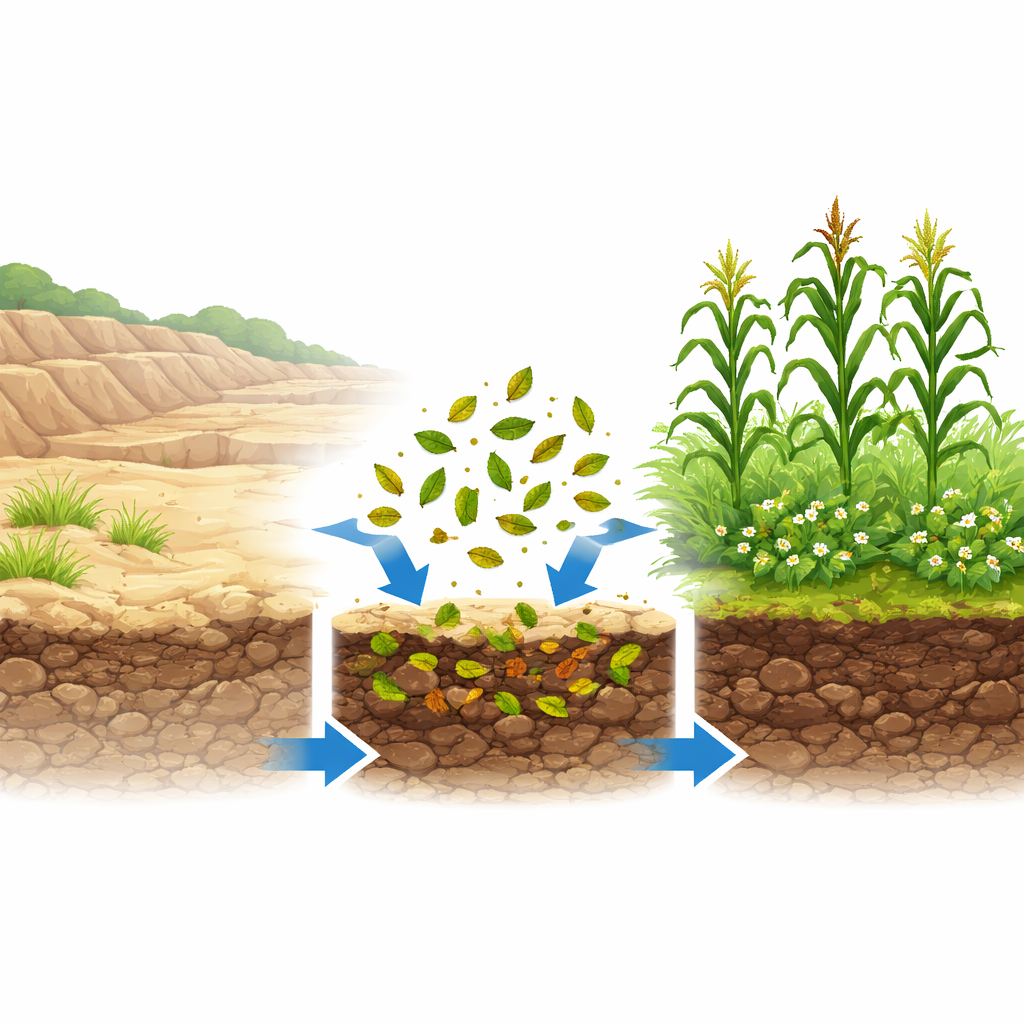
Why Mined Lands Are So Hard to Heal
Open-pit mining strips away the rich top layer of soil and leaves exposed subsoil that contains little organic matter, few nutrients, and greatly reduced life belowground. In Ghana, small-scale and often illegal gold mining has converted tens of thousands of hectares of forest and farmland into such wastelands. Conventional ways to repair soils—such as trucking in compost, manure, or topsoil—are costly, logistically difficult in remote areas, and can bring contaminants. The authors explored a simpler, local alternative: using leafy residues from legume species that already thrive on or near degraded sites as organic “medicine” for sick soils.
Testing Leafy Help in a Controlled Setting
The team collected subsoil from an abandoned small-scale mine and filled pots under controlled shelter conditions. They then added different types and amounts of dried leaves from four legume species—Leucaena, Gliricidia, Mucuna, and Pueraria—and a local grass, Panicum, which served as a non-legume comparison. The leaf residues were mixed into the soil at rates comparable to field applications ranging from none up to the equivalent of 30 tons per hectare. Over a year, the researchers grew maize and cowpea in sequence, tracking how the leaf additions changed soil carbon and nitrogen and how well the crops grew.
How Leaf Quality Shapes Soil Recovery
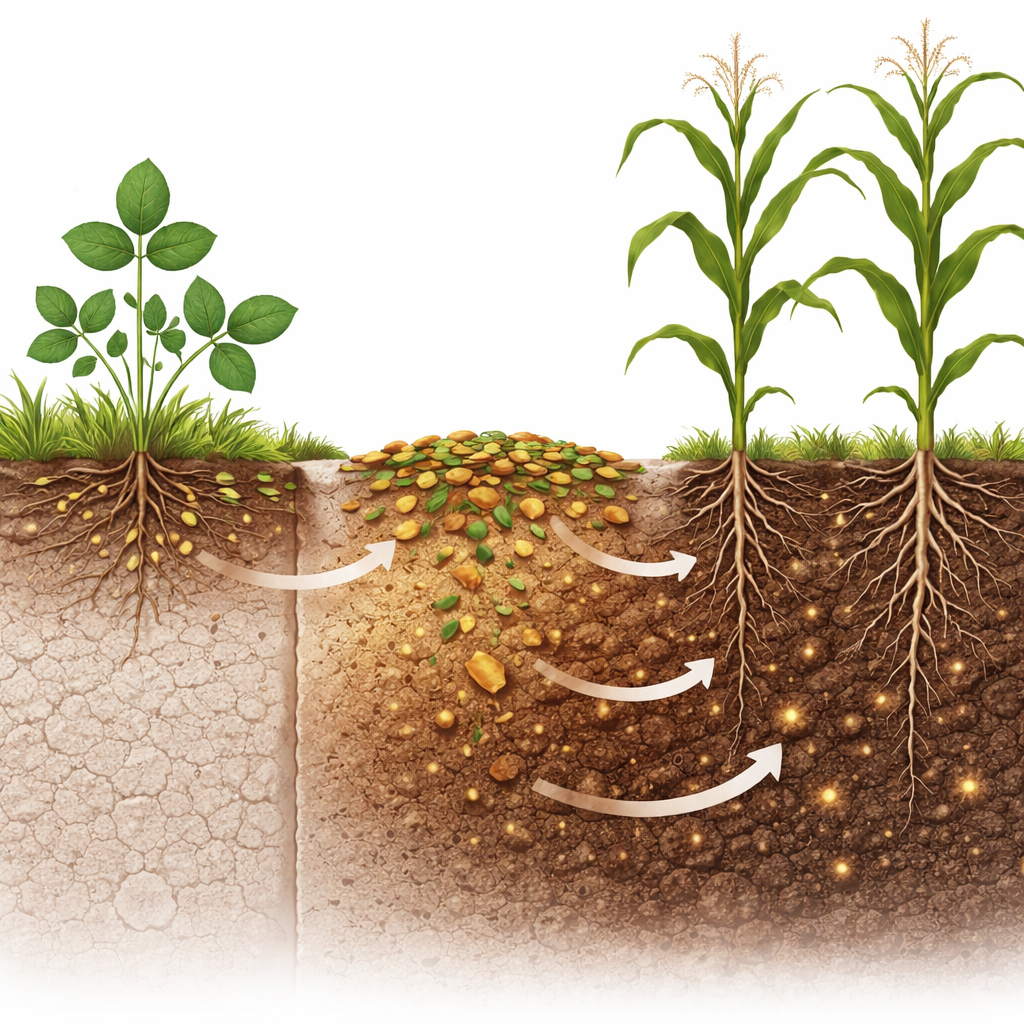
Not all plant residues behaved the same. The legume leaves contained far more nitrogen and generally less tough woody material than the grass, making them “richer” inputs. After residue incorporation and one maize crop, soils amended with legume leaves showed striking gains in organic carbon and nitrogen—up to about five times more carbon and more than eight times more nitrogen than the starting mined subsoil. Yet decomposition was surprisingly slow, especially at higher application rates, which may actually help keep nutrients from being lost too quickly. The study found that simple leaf traits, such as their nitrogen content and how much lignin and polyphenols they contained, were closely linked to how much nitrogen eventually accumulated in the soil.
What Happened to the Crops
Maize, a nutrient-hungry cereal, responded strongly to legume residues. Plants grown in amended soils were far taller, greener, and heavier than those in unamended subsoil, which produced barely any biomass. Leucaena leaves, especially at the higher rate, tended to give the best maize growth, and mixtures of legume species often gave intermediate but still substantial benefits. In contrast, cowpea—a legume crop that can obtain much of its nitrogen from the air through partnerships with soil bacteria—showed smaller differences among residue types. In some cases, the grass residue performed as well as or slightly better for cowpea grain yield, likely because the crop’s own nitrogen-fixing ability reduced its dependence on added nitrogen from leaves.
From Pot Experiments to Real Landscapes
Overall, the study shows that leaf residues from common tropical legumes can dramatically improve the carbon and nitrogen status of severely degraded mined subsoils and support much better crop growth, even without returning topsoil. Among the tested plants, Leucaena stood out as a particularly promising “green amendment.” For land managers and communities facing extensive mine damage, this offers a low-cost, locally sourced tool that works with natural plant–soil processes rather than against them. The results come from pot trials, so field experiments are still needed to confirm how well this approach scales up, but the message is clear: with the right plants and management, even the most exhausted mined soils can begin a journey back toward productive farmland.
Citation: Opoku, E., Dzomeku, B.M., Opata, J. et al. Restoring productivity of degraded mined soils using legume leaf residues as organic amendments. Sci Rep 16, 12429 (2026). https://doi.org/10.1038/s41598-026-41755-1
Keywords: mined land restoration, legume residues, soil fertility, organic amendments, Ghana agriculture