Clear Sky Science · en
Motor cortex activity during sleep and wake movements sharpens across development but continues to lag the red nucleus
How Babies Learn to Move
Anyone who has watched a newborn sleep has seen tiny, jerky twitches of the paws or fingers. These seemingly random movements turn out to be crucial practice for the brain. This study in young rats asks a simple but deep question: as the brain grows, how does control of movement shift from primitive deep-brain centers to the more sophisticated outer layer known as the cortex? By tracking brain activity during both sleep and wakefulness, the authors uncover how this handoff unfolds — and why sleep twitches may be essential for learning to move smoothly.
Two Movement Centers in a Growing Brain
Early in life, the main structure that actually drives limb movements is a deep-brain hub called the red nucleus, while the motor cortex sits “upstream,” not yet in charge. Yet the cortex is buzzing with activity whenever the limbs move, especially during rapid-eye-movement (REM) sleep twitches. The researchers wanted to know which specific movements are linked to this activity, how precisely the cortex tracks them over time, and whether the cortex ever fires before movement begins — a key sign that it is starting to send commands rather than just listen.
To answer these questions, they recorded electrical activity from individual brain cells in the forelimb area of motor cortex in rat pups from 12 to 24 days old. The animals were head-fixed but free to walk, groom, and sleep in a floating “Mobile HomeCage,” while cameras captured tiny limb twitches and larger wake movements. At the oldest age, the team also recorded simultaneously from the red nucleus, allowing a direct comparison between this subcortical driver and the still-developing cortex. 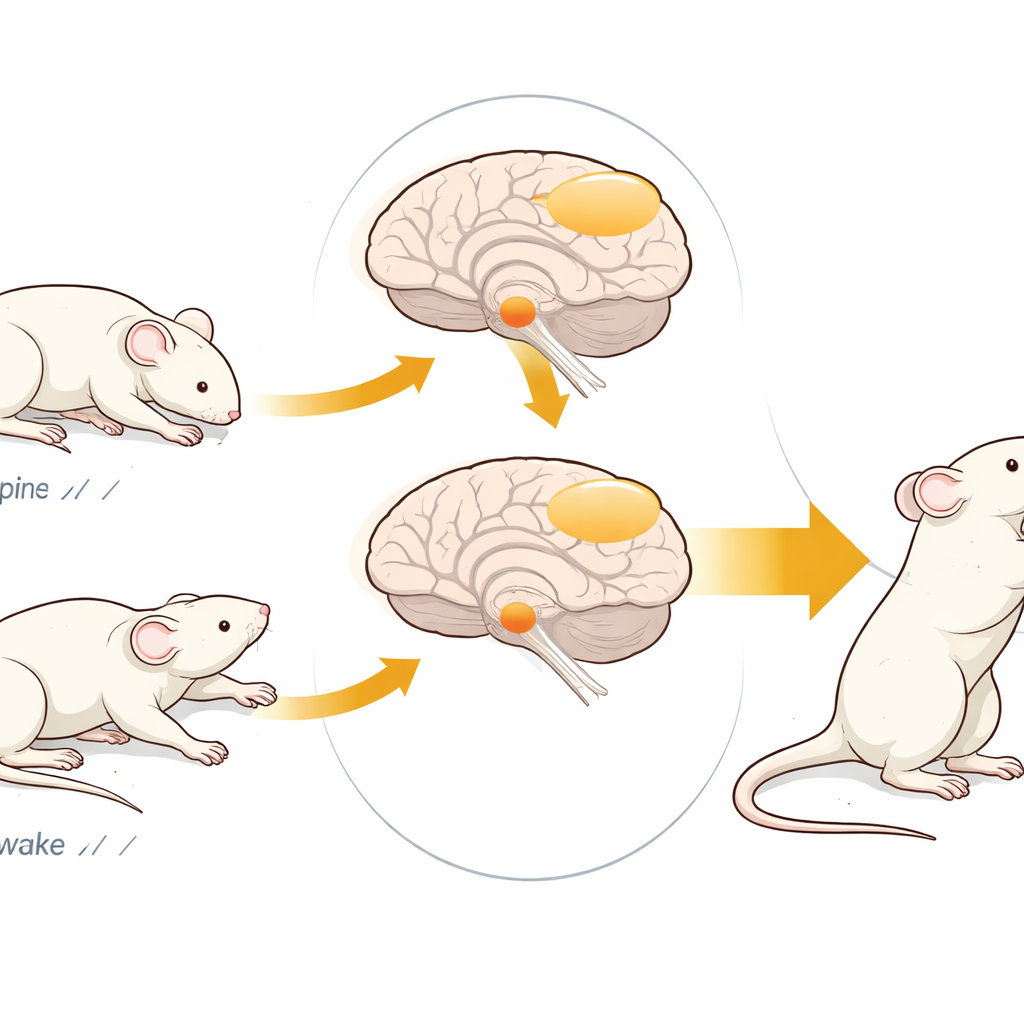
What the Cortex Knows — and When It Knows It
Across all ages, more than half of the recorded motor cortex neurons fired during both REM-sleep twitches and voluntary wake movements of the forelimb. By taking advantage of the fact that twitches are brief and often involve only one body part, the team could test how specifically the cortex responds. They found that cells in the forelimb region responded strongly to forelimb twitches but not to twitches of the hindlimb, whiskers, or tail. This precise body mapping — essentially, a “map of the paw” — was already present by day 12 of life.
As the pups matured, the timing of cortex responses became sharper. The bursts of activity linked to each twitch grew briefer and shifted closer to the moment of movement, indicating more refined processing. Importantly, the fraction of cortex spikes that occurred just before the twitch gradually increased to about one fifth by day 20–24. That premovement activity hints that the cortex is starting to participate in planning or initiating movement, not just registering sensory feedback after the limb has moved.
The Red Nucleus Still Leads the Dance
When the researchers compared motor cortex with the red nucleus at day 24, a different picture emerged. Neurons in the red nucleus fired earlier than cortical neurons around both sleep twitches and wake movements, and a much larger share of their activity came before the movement began. Red nucleus activity also tended to last longer, suggesting a stronger, more sustained command signal. Some red nucleus neurons were highly selective, firing mainly during particular wake behaviors such as grooming-like movements toward the face, and scaling their firing with both the direction and size of the movement. In contrast, cortex neurons were generally less picky: most simply fired more when movements were larger, regardless of precise direction or specific action. 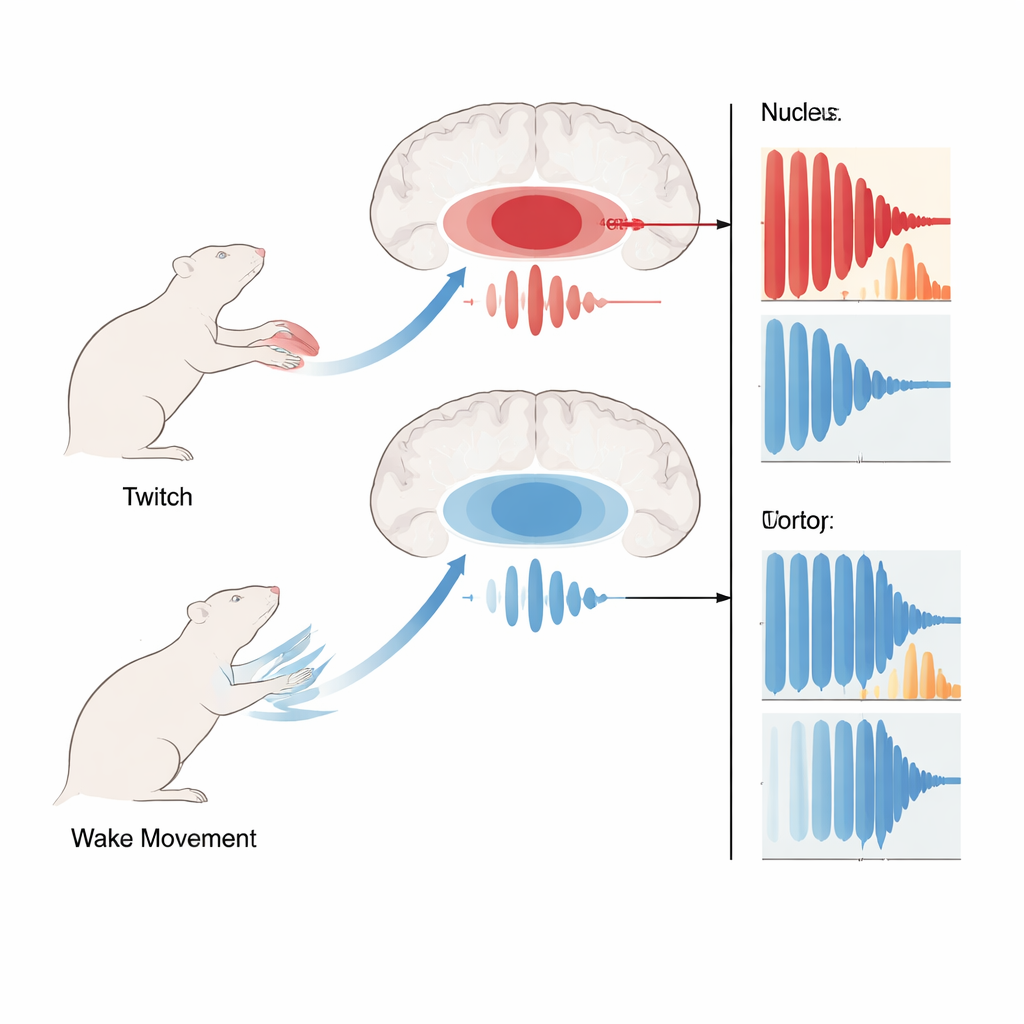
Why Sleep Twitches Still Matter
Interestingly, although the proportion of cortex cells driven by sleep twitches declined with age, a meaningful subset remained twitch-responsive even at day 24. This suggests that twitches continue to feed valuable information to the cortex well into the period just before it gains direct control of the limbs. The authors propose that the red nucleus generates structured movement patterns, during both sleep and wake, that are then “seen” by the cortex through incoming sensory signals. Over time, this repeated pairing allows cortical circuits to tune themselves to the detailed kinematics of the limbs.
A Brain in Training, Not Yet in Charge
In everyday terms, this work shows that in young animals the deep-brain red nucleus acts like a driving instructor at the wheel, while the motor cortex rides along in the passenger seat, watching every turn. By about three weeks of age, the cortex is paying closer attention and occasionally reaching for the wheel — as seen in its growing premovement activity — but it still lags behind the red nucleus in timing and precision. Continuous feedback from both sleep twitches and waking movements appears to train the cortex until it can eventually take over more of the driving. Understanding this developmental handoff helps explain why early-life sleep and spontaneous movements are so vital for building the brain’s control of skilled actions.
Citation: Reid, M.R., Sattler, N.J. & Dooley, J.C. Motor cortex activity during sleep and wake movements sharpens across development but continues to lag the red nucleus. Sci Rep 16, 12872 (2026). https://doi.org/10.1038/s41598-026-41754-2
Keywords: motor cortex development, sleep twitches, red nucleus, infant motor control, sensorimotor maturation