Clear Sky Science · en
Sustainable stabilization of sandy soil using alkali-activated construction waste binders
Turning Building Rubble into Stronger Ground
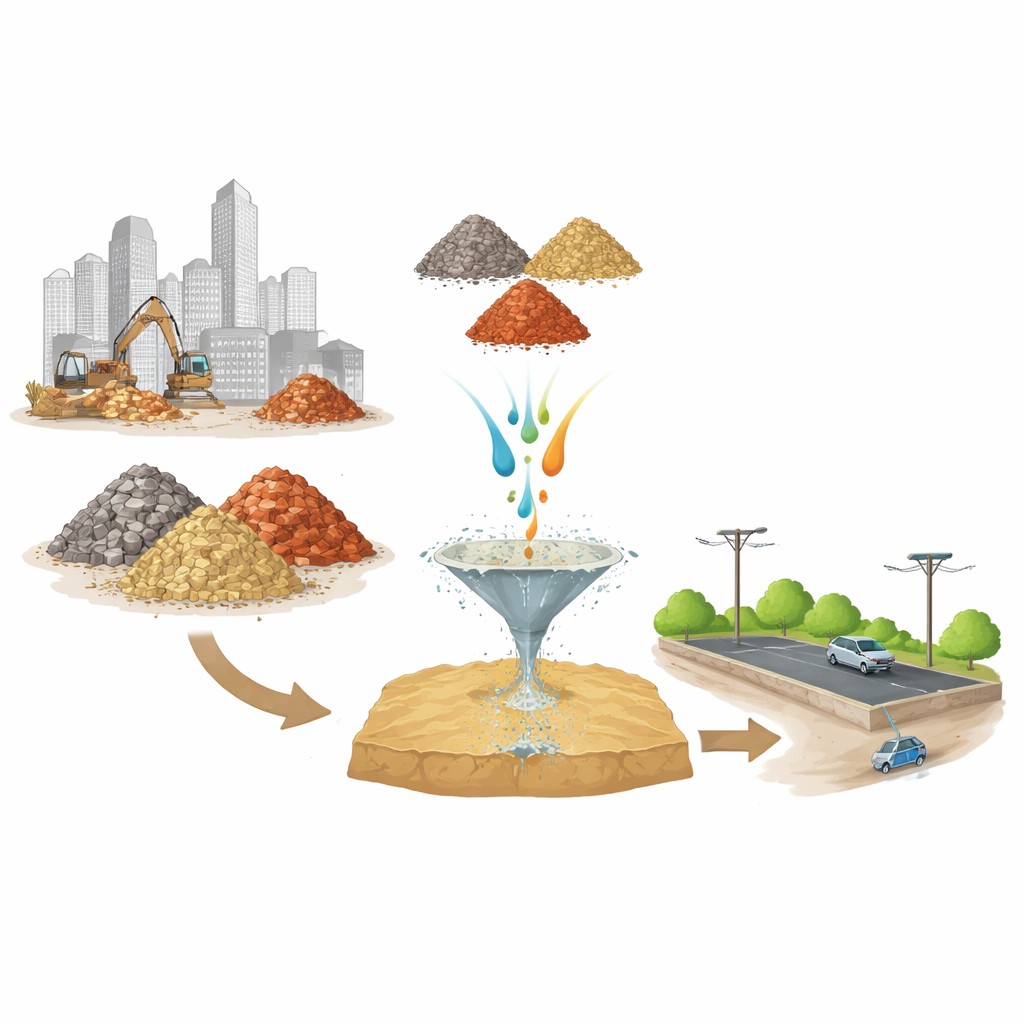
Every new road, bridge, or housing project generates mountains of broken concrete, bricks, and tiles. Much of this rubble is dumped in landfills, even as cities keep expanding over weak sandy ground that is costly to stabilize. This study asks a simple but powerful question: can we grind up that construction waste, activate it with simple chemicals, and use it to turn loose sand into a solid, long‑lasting foundation—while cutting climate‑warming emissions compared with ordinary cement?
Why Sandy Ground Needs Help
Sandy soils are common beneath highways and buildings, but on their own they are too loose and fragile to carry heavy loads or survive harsh weather. Engineers usually mix sand with ordinary Portland cement to stiffen it, much like adding glue to a pile of marbles. This works mechanically, but comes at a steep environmental cost: cement production is responsible for a sizeable share of global carbon dioxide emissions and consumes large amounts of rock and fuel. Finding a way to strengthen sand without relying on so much cement could both support new infrastructure and ease pressure on the climate.
From Demolition Waste to Soil Binder
The researchers focused on three common types of building rubble: crushed concrete, broken bricks, and ceramic tiles. They ground each waste stream into a fine powder and combined it with a liquid mixture based on sodium hydroxide and sodium silicate—an "activator" that encourages the powders to react and form a hard binding gel. Small amounts of these activated powders (5–20 percent by weight) were then mixed into a typical construction sand and compacted into cylindrical specimens. Over several weeks, the team tracked how strong the treated sand became, how stiff it was, and how well it survived repeated cycles of wetting and drying, as well as freezing and thawing, conditions that mimic real‑world weather.
How the New Mixes Hold Up
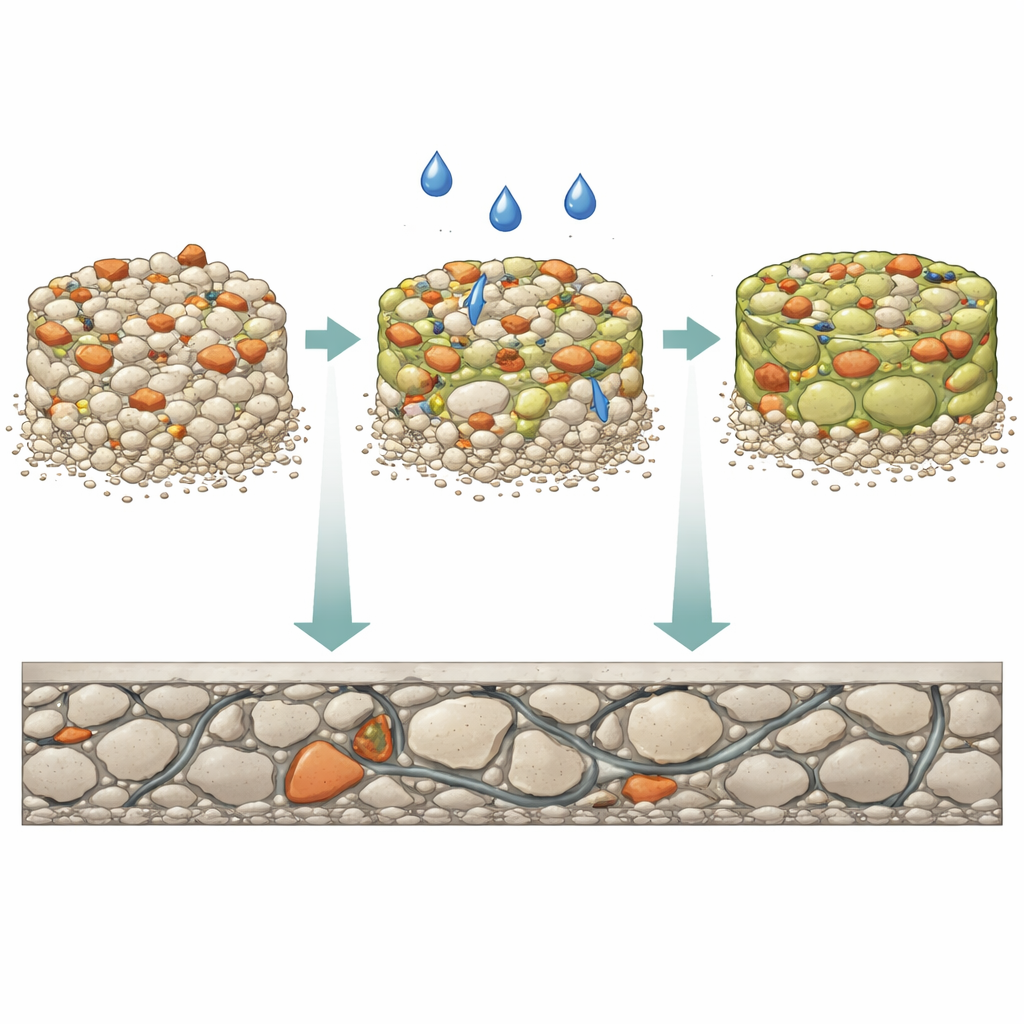
The performance gap between the three waste types was striking. Powders made from ceramic tiles produced the strongest sand, reaching compressive strengths similar to or better than many road base materials. Brick powders came close behind, while concrete powder lagged far, giving only modest gains in strength. When the samples were soaked and dried ten times, tile‑based mixtures retained almost all of their strength, whereas brick and especially concrete mixtures gradually weakened. Under freeze–thaw cycling, all mixtures lost strength, but tile‑based binders still outperformed the others. Microscopic imaging and chemical analyses revealed why: tile powders formed a dense, continuous gel that wrapped and glued sand grains together, leaving few pores or weak spots. Brick powders formed a reasonably connected network, while concrete powders left many unreacted particles and voids, creating a patchy internal structure.
Weighing Environmental Costs and Benefits
Strength alone is not enough; a truly sustainable solution must also lower environmental impacts. Using life‑cycle assessment, the authors compared one cubic meter of sand stabilized with ordinary cement to sand stabilized with their best-performing waste‑based binder. For the same target strength, the cement route required roughly twice as much binder by weight and generated around five to six times more climate‑warming emissions. Most of the remaining footprint of the new system came from making sodium hydroxide, the key activator chemical, while the construction waste itself was treated as burden‑free once collected. The analysis suggests that if cleaner methods of producing these activators are adopted, the advantage of waste‑based binders over cement could grow even larger.
What This Means for Future Roads and Cities
The findings show that carefully activated brick and especially tile waste can turn loose sand into a strong, stiff, and reasonably durable material suitable for layers beneath pavements and other structures, all while sharply cutting greenhouse gas emissions compared with conventional cement stabilization. Although the chemistry is complex, the takeaway for non‑specialists is clear: what we currently treat as useless rubble can become a high‑value ingredient that both improves the ground under our feet and helps close material loops in a circular economy. Further work is still needed to boost resistance to freezing and to green the activator chemicals, but this approach points toward future roads and foundations that are literally built on yesterday’s broken buildings.
Citation: Fattahi, S.M., Zamani, S., Imani, M. et al. Sustainable stabilization of sandy soil using alkali-activated construction waste binders. Sci Rep 16, 12012 (2026). https://doi.org/10.1038/s41598-026-41753-3
Keywords: soil stabilization, construction waste recycling, geopolymer binders, sustainable infrastructure, life cycle assessment