Clear Sky Science · en
Self-propelled platinum based magnetite Janus nanomotors prepared from PCL and PHEMA graft copolymer with physicochemical properties motility and peroxidase-like activity
Tiny Machines on a Mission
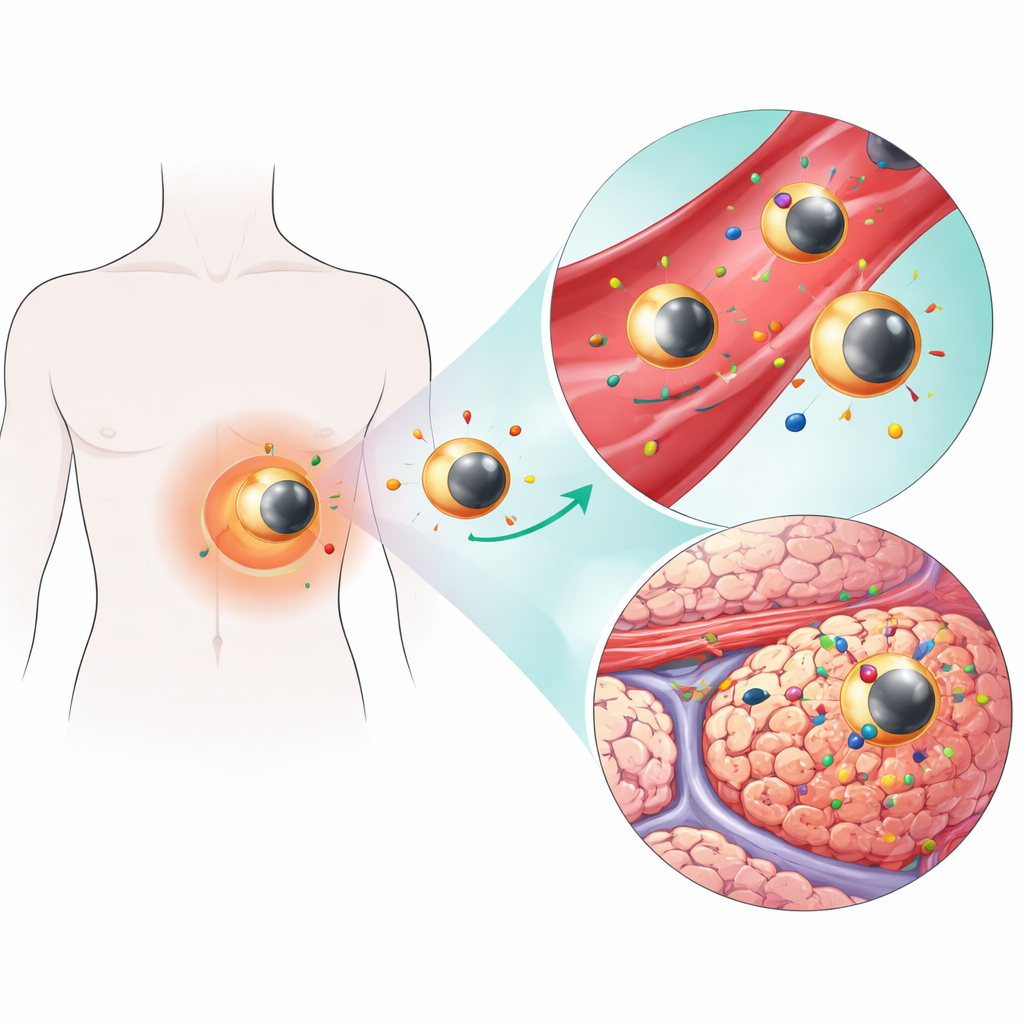
Chemotherapy drugs often flood the whole body, damaging healthy tissue while still struggling to reach the deepest parts of a solid tumor. This study explores a new kind of "nanomotor"—a microscopic, self-propelled particle—that can both find cancer cells and attack them, while also showing doctors where it has gone using MRI scans. These twin-purpose particles are designed to swim through the tumor’s harsh environment, carry a powerful drug, and generate helpful chemical reactions along the way.
Designing Two-Faced Nanomotors
The researchers built special particles called Janus nanomotors, named after the two-faced Roman god. Each nanomotor has a magnetic iron oxide core that responds to magnetic fields and darkens T2-weighted MRI images, paired with a cap of platinum metal that acts as a tiny chemical engine. Around the core, they attached a soft shell made from two biodegradable plastics commonly used in medicine, creating a stable carrier for the chemotherapy drug doxorubicin. They also added folic acid molecules to the surface, which act like homing beacons for cancer cells that display abundant folate receptors, especially certain brain tumor cells.
How the Nanomotors Move and Release Their Cargo
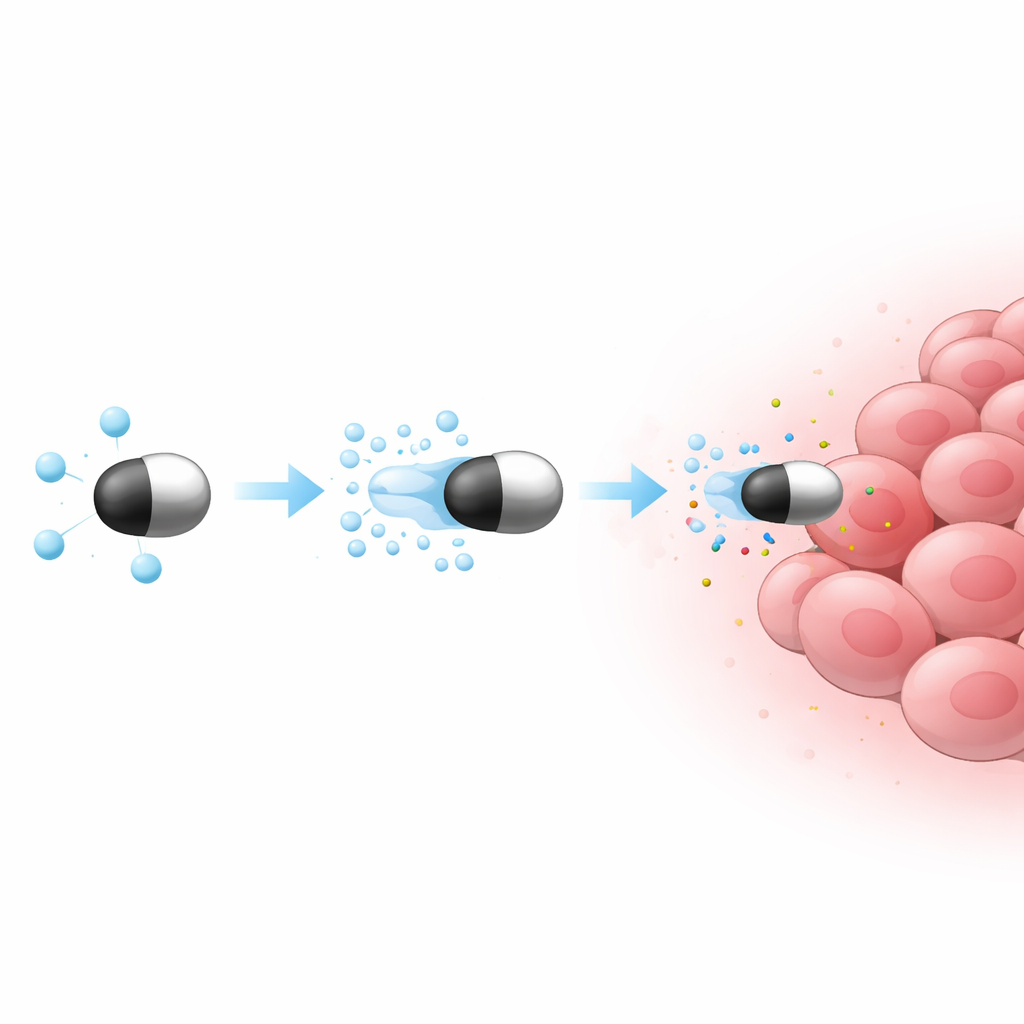
In the body, tumors tend to be more acidic and to contain higher levels of hydrogen peroxide than healthy tissue. The platinum side of the nanomotor taps into this chemical environment by breaking down hydrogen peroxide into water and oxygen bubbles. As bubbles form and leave the particle, they push it forward like a microscopic rocket. In lab tests, adding more hydrogen peroxide made the nanomotors move faster, and acidic conditions—similar to those in tumors—boosted their speed even further. Meanwhile, the surrounding polymer shell slowly released doxorubicin, with faster release at lower pH and higher temperature, mimicking tumor acidity and mild hyperthermia. Even under these conditions, drug liberation remained controlled rather than explosive, limiting unwanted spillover.
Seeing and Measuring Their Impact on Cells
Because the core contains iron oxide, the nanomotors act as contrast agents for MRI. In a simple water phantom test, samples containing the particles produced a much darker T2-weighted signal than pure water, confirming their potential for imaging-guided therapy. The team also examined how the nanomotors interact with cells. Cancerous glioma cells, which have many folate receptors, took up significantly more of the folic-acid-decorated nanomotors than normal glial cells, as shown by iron measurements and iron-specific staining. In toxicity tests, doxorubicin-loaded nanomotors killed tumor cells more effectively than the same dose of free drug, while maintaining acceptable effects on normal cells. Blood compatibility experiments showed very low damage to red blood cells across a wide concentration range, suggesting the particles could be safely introduced into the bloodstream.
Acting Like Enzymes Inside Tumors
Beyond movement and drug delivery, the nanomotors also behave like simple enzymes. Both iron oxide and platinum are known to mimic peroxidase, an enzyme that uses hydrogen peroxide to drive chemical reactions. The researchers showed that their combined Janus design strongly accelerated the conversion of a colorless test molecule into a colored product in the presence of hydrogen peroxide, even at levels similar to those found in solid tumors. This peroxidase-like activity could, in principle, help generate reactive species that further stress cancer cells or reshape the tumor microenvironment, adding a second line of attack alongside the chemotherapy payload.
Promise and Next Steps for Cancer Care
Overall, this work introduces a compact, twin-engine nanomotor that unites targeted drug delivery, MRI visibility, self-propulsion in tumor-like conditions, and enzyme-mimicking chemistry in a single platform. For a patient in the future, such particles could be infused into the bloodstream, steered and tracked by MRI toward a tumor, and then left to actively swim, penetrate, and slowly release their cargo deep inside the cancer. While key questions remain—such as how these nanomotors behave in living animals, how long they persist, and how safely they are cleared—the study marks a significant step toward smarter, self-directed cancer treatments that can both diagnose and destroy disease from within.
Citation: Nikfar, B., Soleymani, M., Shirvalilou, S. et al. Self-propelled platinum based magnetite Janus nanomotors prepared from PCL and PHEMA graft copolymer with physicochemical properties motility and peroxidase-like activity. Sci Rep 16, 12852 (2026). https://doi.org/10.1038/s41598-026-41746-2
Keywords: nanomotors, targeted chemotherapy, MRI contrast, glioma, nanomedicine