Clear Sky Science · en
Integrating attractor dynamics and connectivity features for EEG-based dementia classification
Why brain waves matter for everyday memory
Dementia is not just about forgetting names or misplacing keys; it can gradually erode a person’s independence and personality. Doctors especially struggle to tell apart Alzheimer’s disease and frontotemporal dementia, two major forms that call for different care plans. This study asks a simple but powerful question: can a quick, affordable brain-wave test help doctors distinguish these conditions more reliably by looking not only at how strong the signals are, but at how they flow and connect over time?
Looking beyond standard brain scans
Today, dementia diagnosis leans heavily on memory tests and brain scans such as MRI or PET. Although these tools are valuable, they are expensive, not always available, and often detect changes only after significant brain damage has occurred. Electroencephalography, or EEG, offers another window: it records the brain’s electrical activity from electrodes placed on the scalp. EEG is safe, low-cost, and captures rapid millisecond-by-millisecond changes in brain activity. The catch is that EEG signals look messy and complex. Instead of simply measuring how strong certain rhythms are, the authors explored whether tracking the detailed patterns and coordination of these brain waves could reveal hidden signatures of Alzheimer’s disease and frontotemporal dementia.
Following the hidden paths of brain activity
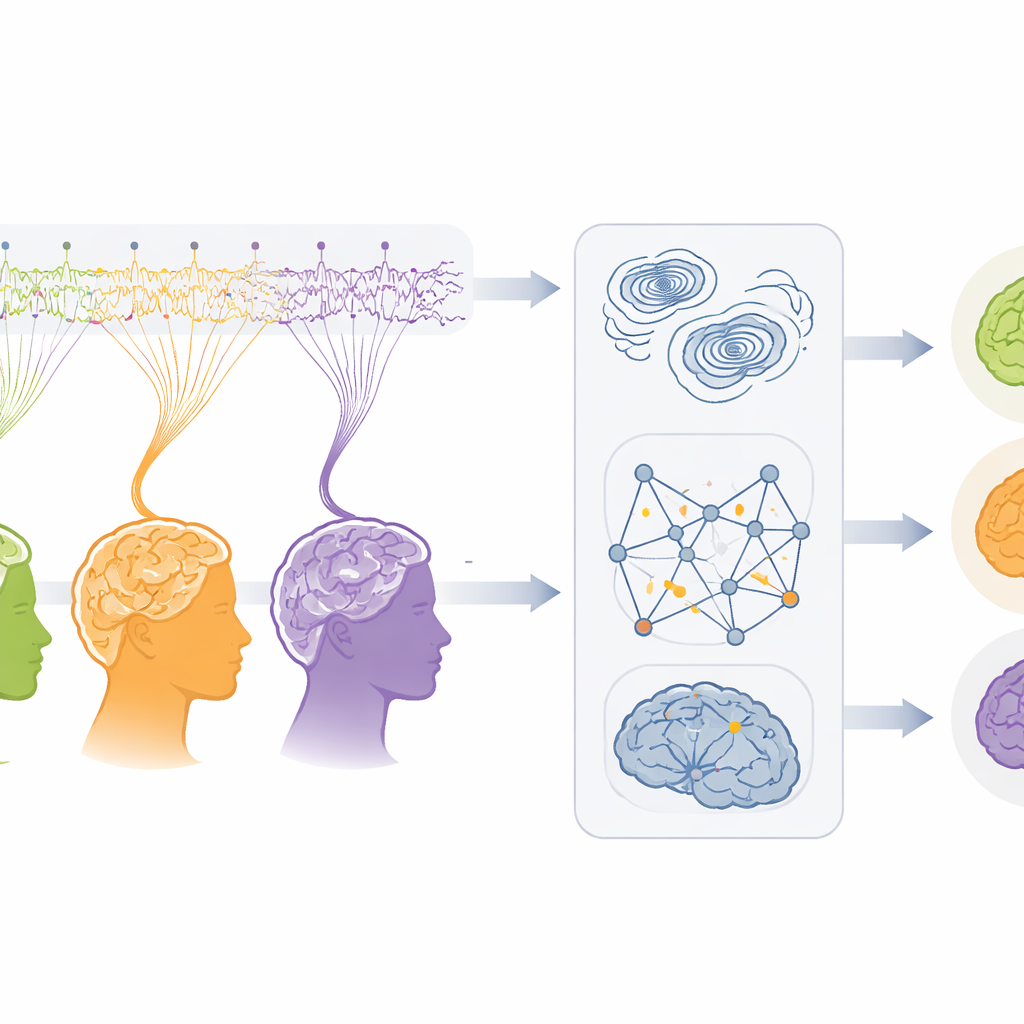
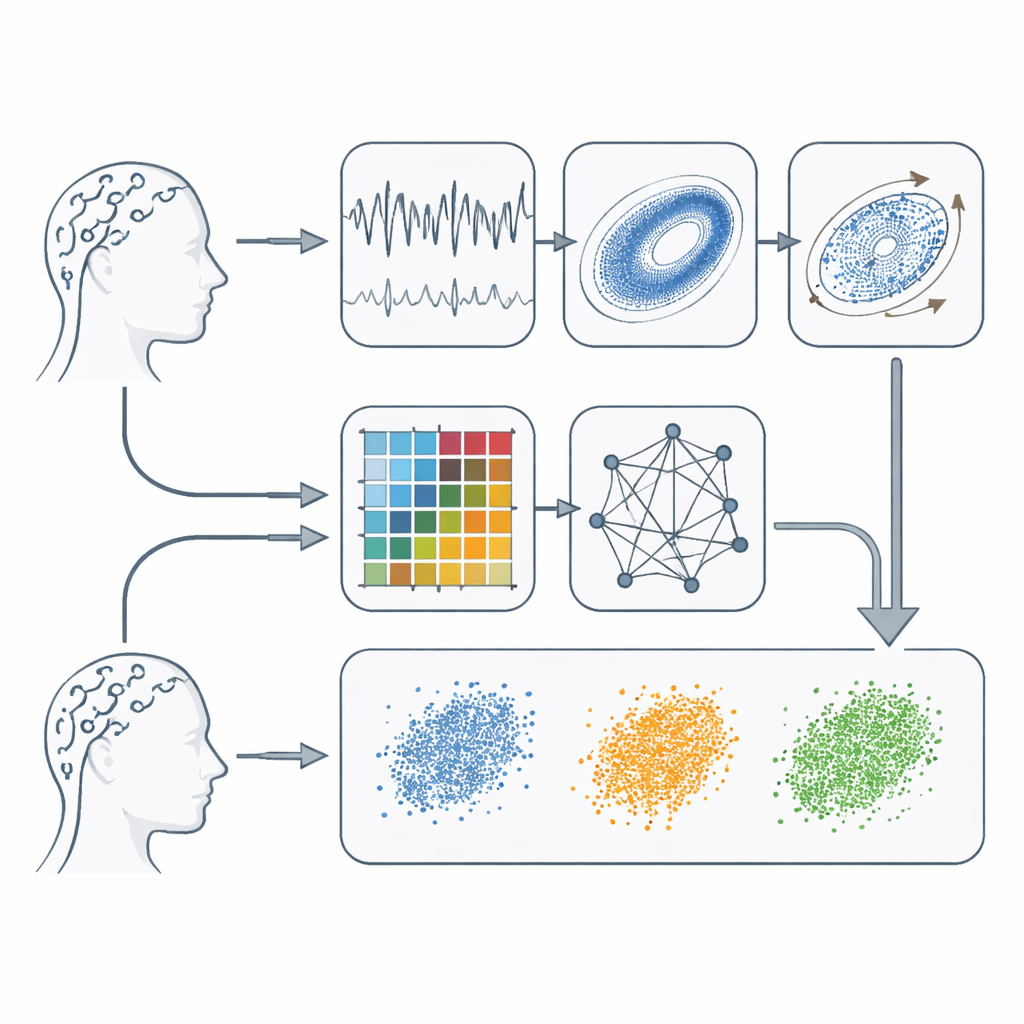
The researchers analyzed resting-state EEG recordings from three groups: people with Alzheimer’s disease, people with frontotemporal dementia, and healthy older adults. Rather than focusing only on traditional measures like average power in different frequency bands, they borrowed ideas from the study of complex systems. First, they reconstructed the "path" that each brain signal traces in an abstract space as it evolves over time, known as an attractor. They then described the shape and motion of these paths using features such as how widely the trajectories spread out, how fast they move, and how abruptly they change direction. These measures capture how rich, stable, or erratic the underlying brain dynamics are, providing a fine-grained view of local activity in each EEG channel.
Measuring how brain regions talk to each other
Brain function also depends on communication between distant regions. To capture this, the team calculated how consistently different EEG channels kept their rhythms in step with one another, a property called phase synchronization. For each participant, they built a connectivity map summarizing how strongly various electrode pairs were linked. From these maps, they extracted simple network measures that describe, in broad strokes, how strongly connected the overall brain network is and how tightly local clusters of channels are grouped. These connectivity features complement the attractor-based measures: while attractors describe local signal patterns, connectivity summarizes the brain’s large-scale coordination.
Teaching machines to spot dementia patterns
All these features—133 describing attractor dynamics plus 2 summarizing connectivity—were fed into several machine-learning models trained to distinguish between pairs of groups: Alzheimer’s vs. healthy controls, frontotemporal dementia vs. healthy controls, and Alzheimer’s vs. frontotemporal dementia. Across tasks, the models performed far better than chance, with the best accuracies around 83% for separating Alzheimer’s from healthy participants, 81% for frontotemporal dementia vs. healthy, and about 82% for distinguishing the two dementia types from each other. In most cases, the attractor-based features carried the strongest signal, while the connectivity measures added modest but useful extra information for some models. Different algorithms worked best for different comparisons, suggesting that the choice of classifier matters as much as the choice of EEG features.
What this could mean for patients and clinics
The study demonstrates that relatively short, resting EEG recordings can capture subtle differences in brain dynamics between Alzheimer’s disease, frontotemporal dementia, and healthy aging when analyzed with modern mathematical tools. This approach will not replace brain scans or clinical judgment, and the work was done in a modest-sized group of patients who already had established diagnoses. Still, it points toward a future in which a simple EEG test, processed through automated pipelines, might help clinicians flag dementia earlier and tell its subtypes apart more confidently, guiding more tailored treatment and support.
Citation: Zolfaghari, S., Gholizadeh, E. & Garehdaghi, F. Integrating attractor dynamics and connectivity features for EEG-based dementia classification. Sci Rep 16, 11573 (2026). https://doi.org/10.1038/s41598-026-41745-3
Keywords: EEG dementia, Alzheimer’s disease, frontotemporal dementia, brain connectivity, machine learning diagnosis