Clear Sky Science · en
Design and characterization of sustainable mortars incorporating industrial waste–derived materials
Building with Waste Instead of Fresh Rock
Concrete and mortar quietly shape our cities, but making the cement that holds them together is a major source of climate‑warming carbon dioxide. This study explores a different path: mortars made largely from industrial waste, such as fly ash from power plants and slag from steel production. By carefully activating these powders with alkaline solutions, the authors show it is possible to create strong, durable building materials while cutting the climate footprint and reducing the need for new raw materials.
Why Rethinking Cement Matters
Traditional Portland cement is produced in giant kilns that heat limestone and clay to around 1450 °C, a process that consumes a great deal of energy and releases CO₂ from both fuel and the limestone itself. As global demand for buildings and infrastructure grows, cement alone accounts for roughly 7% of worldwide CO₂ emissions. Many countries are therefore seeking cleaner building materials that will still deliver the strength and durability engineers rely on, but with lower emissions and better use of industrial by‑products that would otherwise head to landfills.
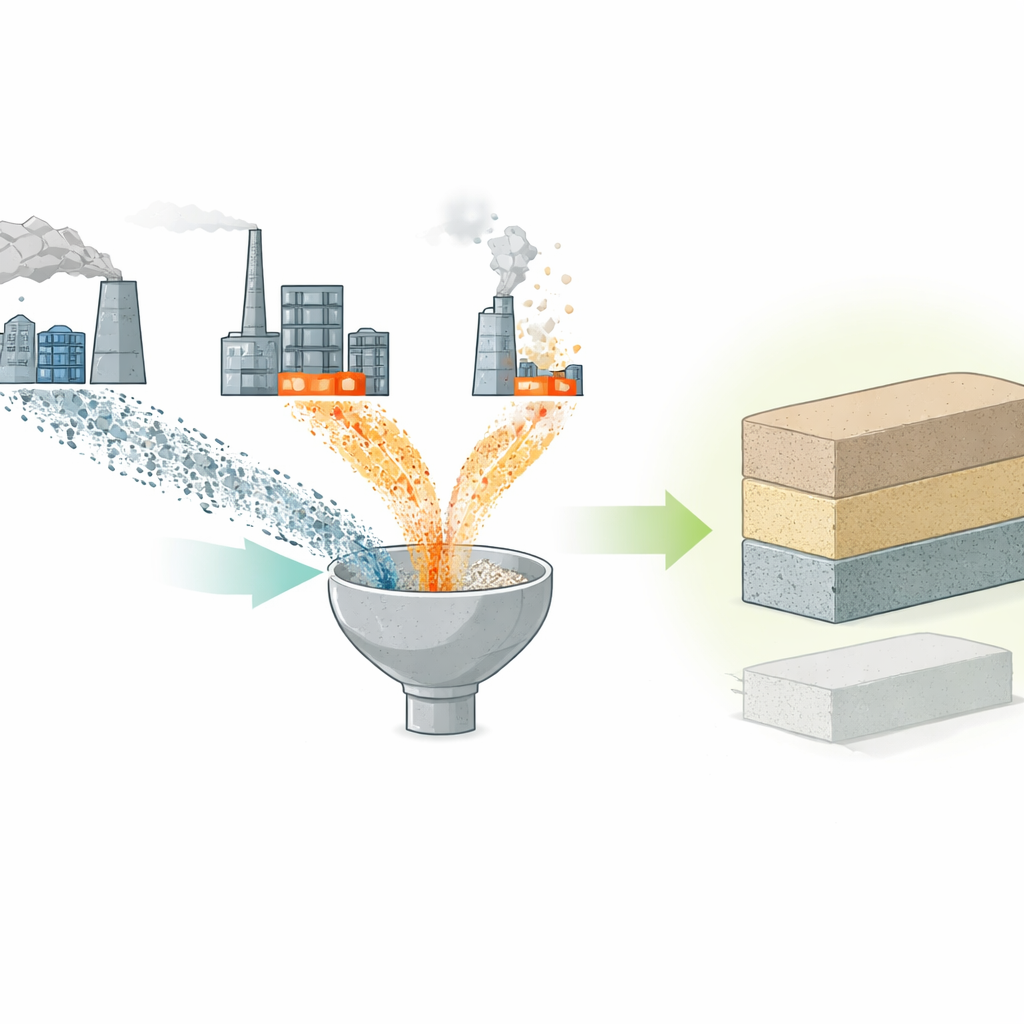
Turning Ash and Slag into New Mortar
The researchers designed three mortar recipes that replace Portland cement with mixtures of fly ash (a fine powder from coal combustion), ground blast furnace slag from steelmaking, and silica fume, all combined with sand. These powders were “activated” not by high‑temperature firing, but by mixing them with a potassium hydroxide solution and liquid sodium silicate, then curing the mortars at ordinary room temperature and moderate humidity. One mix used fly ash from a Romanian power plant, another used fly ash from Canada, and a third combined the Canadian fly ash with slag. For comparison, the team also prepared a standard cement‑based mortar as a control.
How Strong Are These Waste‑Based Mortars?
Over 28 days, the mortars were tested for compressive strength (how much load they can bear before crushing) and flexural strength (resistance to bending). The type of fly ash and the exact proportions of liquid activator turned out to matter a great deal. Mortar made with Romanian fly ash reached only about 8 MPa in compression, while the Canadian fly ash nearly tripled that performance to around 26 MPa. Adjusting the liquid‑to‑powder ratio showed that too much activator leaves the material porous and weak, whereas a balanced amount creates a denser, stronger matrix. Increasing the concentration of the potassium hydroxide solution from 3.8 to 5.1 molar further boosted strength, likely because it dissolved and reorganized the ash particles more effectively.
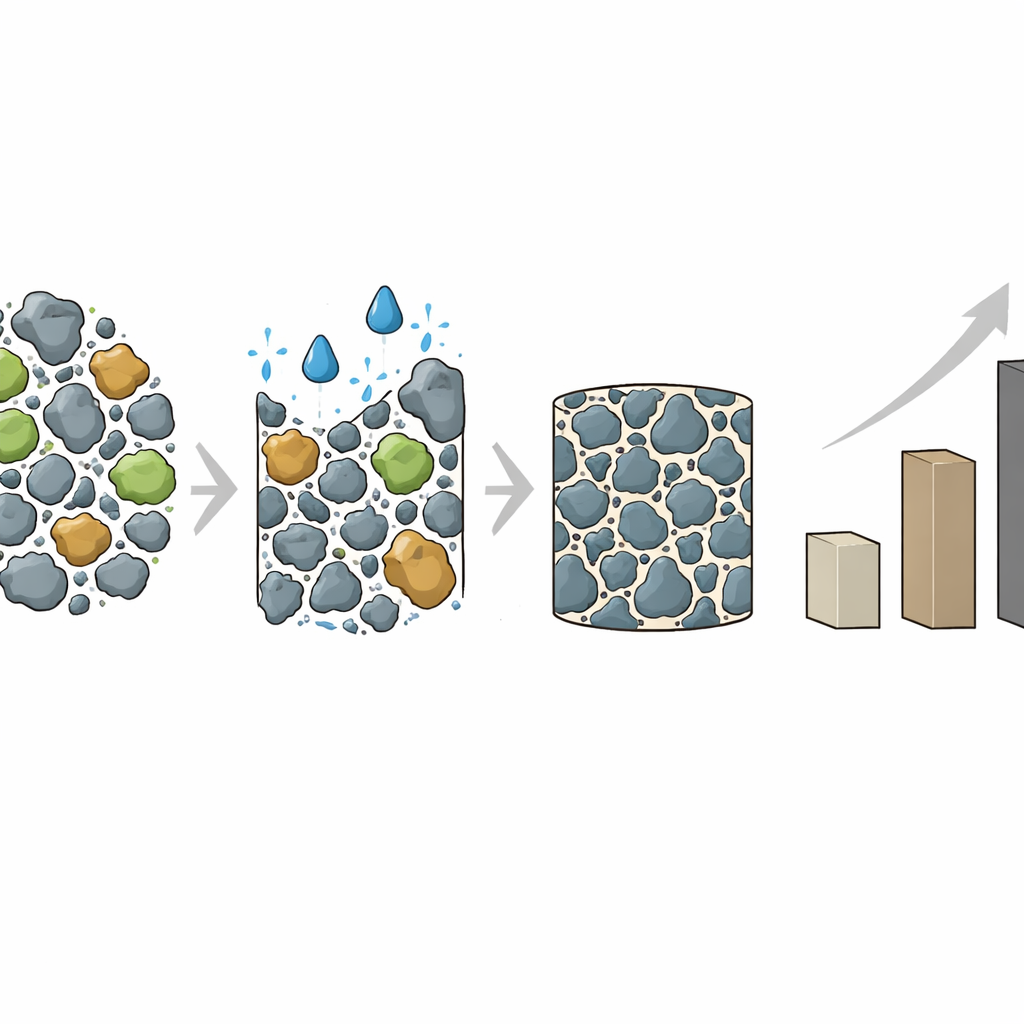
Boosting Performance with Steelmaking Slag
The standout result came from the mix that blended Canadian fly ash with blast furnace slag and a small amount of silica fume. This recipe achieved compressive strength of about 44 MPa and flexural strength of 7.4 MPa after 28 days—values comparable to or better than the control mortar based on Portland cement. Microscopic imaging showed that the best‑performing mix formed a dense, continuous network of gel that wrapped around remaining particles and sand, with fewer cracks and voids. Thermal tests indicated that these mortars lose very little mass when heated to high temperatures, suggesting good stability under fire or heat exposure.
Climate Impact and Practical Promise
Beyond mechanical performance, the team estimated the carbon footprint of their waste‑based mortars. Because the fly ash, slag and silica fume are by‑products of other industries, they require no new high‑temperature processing to be used in mortar. When activator production is included but transport is excluded, the resulting mortars emit about 220 kilograms of CO₂ per cubic meter. That is roughly 30% lower than typical concretes made with only Portland cement and about 45% lower than some cement‑slag mortars reported in the literature. In other words, these mixes can deliver high strength while meaningfully cutting emissions.
What This Means for Future Buildings
Put simply, the study shows that properly designed mortars made from industrial waste powders, activated at room temperature with modest alkaline solutions, can rival or surpass conventional cement mortars in strength while substantially reducing CO₂ emissions. If scaled up, such materials could allow builders to turn ash and slag into valuable ingredients instead of costly waste, easing pressure on quarries and kilns alike. While long‑term durability and large‑scale production still need to be tested, the work points toward a future where buildings literally stand on recycled foundations.
Citation: Caftanachi, M., Vrabie, M., Harja, M. et al. Design and characterization of sustainable mortars incorporating industrial waste–derived materials. Sci Rep 16, 12145 (2026). https://doi.org/10.1038/s41598-026-41743-5
Keywords: sustainable mortar, alkali-activated materials, fly ash, blast furnace slag, low-carbon construction