Clear Sky Science · en
Dynamic fog node placement optimization using adaptive dynamic pufferfish optimization for real-time IoT networks
Why smarter networks matter to everyday life
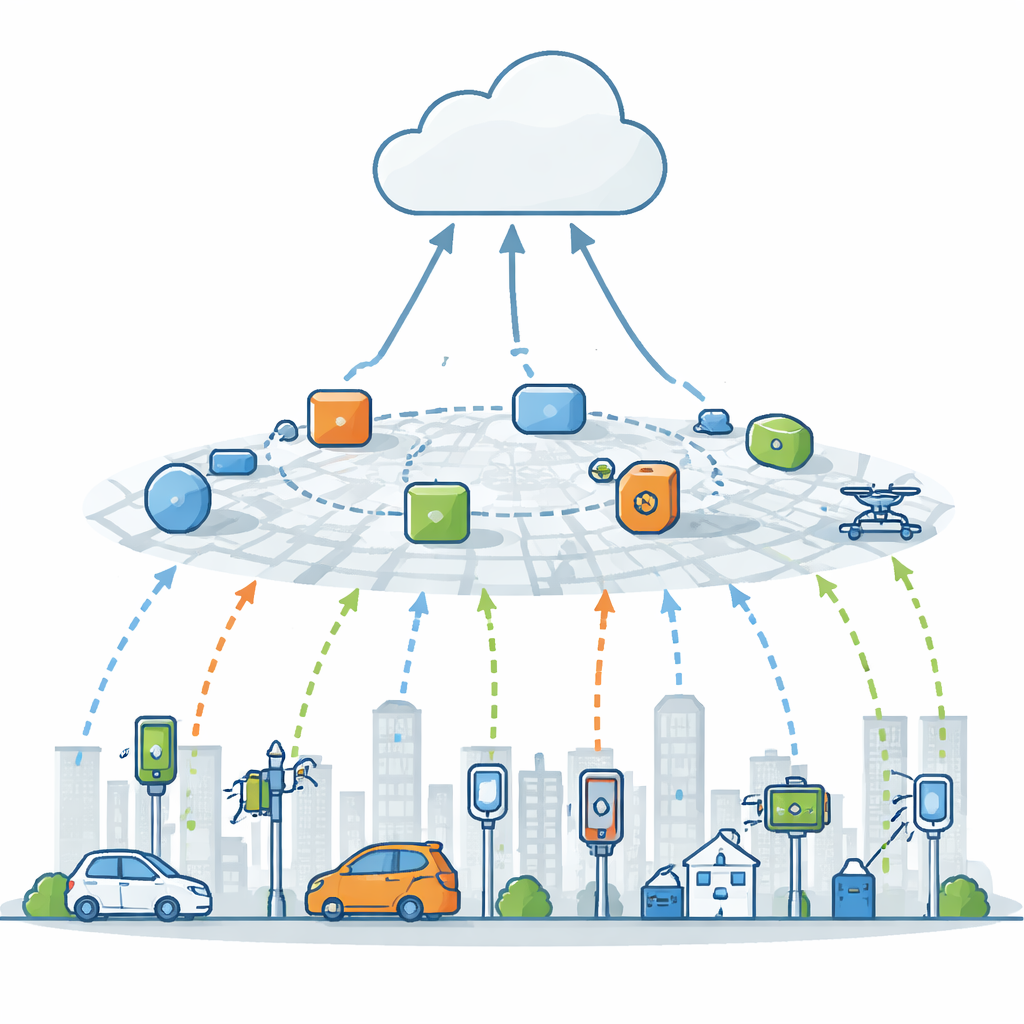
From self-driving cars to remote medical monitoring, many modern gadgets rely on instant decisions from faraway computers. If the connection is slow or breaks, a car might react late, or a health alert might arrive too late to help. This article explores a new way to place and move small computers, called fog nodes, closer to where data is created so that connected devices get faster, more reliable responses, even as the network around them constantly changes.
Bringing computing power closer to the action
The authors start by explaining the growing gap between billions of Internet of Things (IoT) devices and distant cloud data centers. While the cloud is powerful, sending every piece of data there and back takes time. Fog computing fills this gap by scattering smaller computers near sensors, cameras, cars, and factory machines. These fog nodes can process information locally, cutting delays and easing pressure on long-distance links. But deciding where to place these nodes, and when to move or add them as devices appear, vanish, or move, is a difficult puzzle with many competing goals: keep delays low, cover as many devices as possible, save energy, and avoid constant reshuffling of equipment.
A living, changing map of the network
To capture this reality, the paper models the network as a living system that changes over time. Fog nodes can be fixed or mounted on vehicles and drones; they can fail temporarily or permanently; and the density of IoT devices rises and falls with daily patterns. The model tracks where each node and device is, how far they can communicate, how often failures occur, and how much it “costs” to move equipment. Performance is judged by how well the network stays connected, how many devices are within reach of at least one fog node, and how much physical movement is required to keep things running smoothly. The challenge is not just to find a good arrangement once, but to keep updating it whenever coverage drops, connections weaken, or equipment changes.
Learning from the behavior of pufferfish
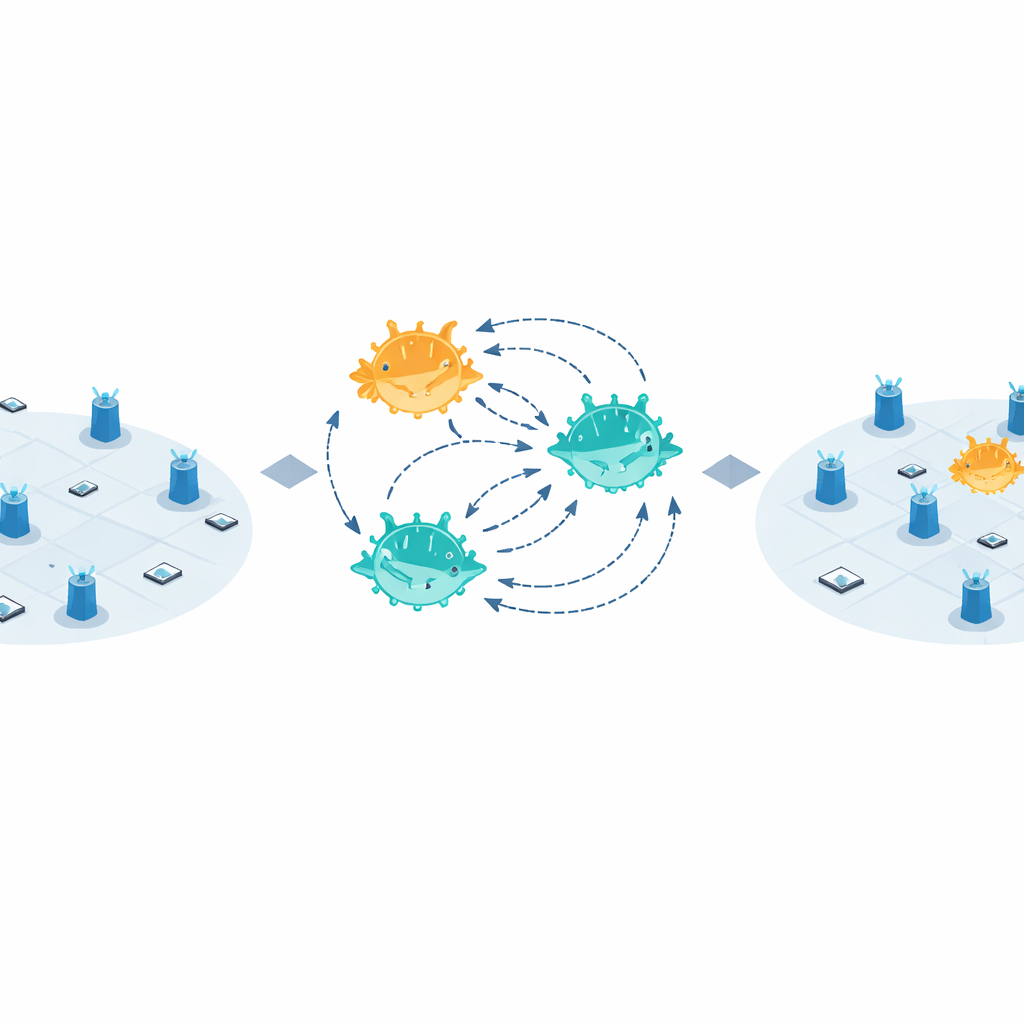
The core of the study is a new method called the Dynamic Pufferfish Optimization Algorithm (D-POA). Inspired by how pufferfish behave when threatened, the algorithm alternates between two strategies. In a “global search” mode, like a fish quickly changing position to avoid predators, it explores very different layouts of fog nodes to find promising regions of the solution space. In a “defense” mode, echoing the fish’s fine adjustments when it puffs up, it makes smaller, local tweaks to refine a good arrangement. Unlike earlier versions, D-POA also remembers what worked well in the past and starts new adjustment cycles from these earlier good layouts, adding just enough randomness to avoid getting stuck in a poor pattern.
Changing just enough, just in time
A key innovation is that D-POA does not run at full power all the time. The algorithm constantly watches the network and only triggers a reconfiguration when important measures such as connectivity or coverage drop below chosen thresholds, or when nodes fail or are added. When conditions change only slightly, it uses fewer adjustment steps to save computation; when a major disruption occurs, it allocates more effort to search for a strong new layout. Through this adaptive control, the system balances two needs: keeping service quality high and avoiding needless movement or overuse of computing resources. The authors also analyze how the algorithm scales as the network grows, showing that its running time and memory use increase roughly in proportion to the number of nodes and devices.
What the experiments reveal in practice
The team tests D-POA on simulated networks with up to 1000 fog nodes and many changing IoT devices, and compares it with three established algorithms. Across five demanding scenarios—general dynamics, moving fog nodes, random equipment failures, fluctuating traffic, and gradual network expansion—the new method delivers higher connectivity (around 97–98%) and coverage (around 98%), while cutting movement costs by roughly 38–57% relative to competitors. It also restores service faster after failures and maintains stable performance as demand rises and falls during the day. Against exact mathematical solvers it comes very close to the best possible layouts but in a tiny fraction of the time, and it clearly outperforms simple greedy rules that react quickly but waste energy and leave gaps in coverage.
What this means for future connected systems
In everyday terms, the study shows a way to keep the “local brains” of smart cities, factories, and hospitals in the right places as conditions shift minute by minute. By watching the network, reacting only when needed, and adjusting fog node positions in a controlled, efficient way, D-POA keeps more devices connected with shorter delays and less wasted motion. While real-world tests and added features such as detailed energy and security models are still needed, the work outlines a practical path toward more dependable, low-latency networks that can support safety-critical applications without constant human tuning.
Citation: Abu-Ein, A.A., Al-Hazaimeh, O.M., Tawfik, M. et al. Dynamic fog node placement optimization using adaptive dynamic pufferfish optimization for real-time IoT networks. Sci Rep 16, 11624 (2026). https://doi.org/10.1038/s41598-026-41740-8
Keywords: fog computing, IoT networks, edge computing, metaheuristic optimization, real-time systems