Clear Sky Science · en
Long-term organic nutrient management in tomato enhances yield, quality, profitability, and soil health in a semi-arid conditions
Feeding the Soil to Feed the Tomato
For many households, tomatoes are a daily staple, yet the way they are grown can make a big difference to both our health and the planet’s. In parts of the world where fields are hot and dry, farmers often rely heavily on chemical fertilizers to keep harvests high, but this can quietly wear down the soil and pollute water. This study asks a simple but powerful question: if farmers switch to well-managed organic manures instead, can they still harvest plenty of tasty tomatoes while keeping their soil alive and profitable over the long haul?
A Seven-Year Test in a Tough Climate
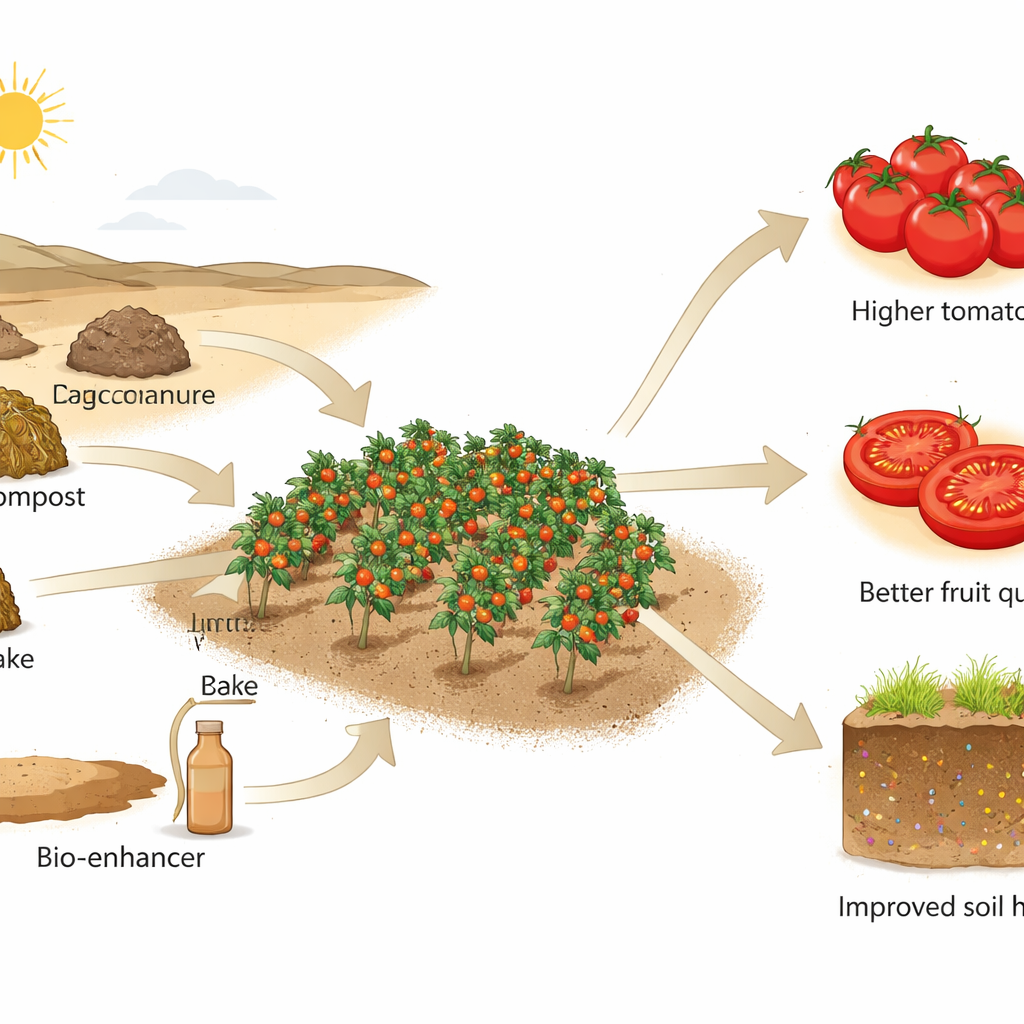
Researchers in Parbhani, a semi-arid region of India, followed the same tomato fields for seven consecutive years. They compared ten different organic nutrient plans, all using a popular tomato variety but differing in how they supplied plant food. Some plots received traditional cattle manure (farmyard manure), some got worm-worked compost known as vermicompost, others combined these with neem seed leftovers or a fermented liquid called Jivamrut, and one plot was left unfertilized as a control. The goal was not just to chase high yields in a single season, but to track how these strategies affected harvests, soil nutrients, fruit quality, and farm income over time in a realistic, farmer-like setting.
Worm Compost Comes Out on Top
Across the seven years, one approach clearly led the pack: giving tomatoes all their nitrogen from vermicompost. These plots produced the highest average yields, about twice as much as the unfertilized control, and slightly more than plots fed only with farmyard manure. A mixture of half vermicompost and half manure performed almost as well, suggesting that even partial replacement with worm compost delivers big benefits. Vermicompost-fed plants bore more fruits per plant, heavier individual fruits, and the richest red color, reflecting higher levels of lycopene, a health-promoting antioxidant. Importantly, the best organic treatments yielded about as much as typical chemically fertilized fields in the same region, showing that well-planned organic tomato farming can keep up with conventional practice in productivity.
Profits and Risk for Farmers
The researchers also counted rupees, not just tomatoes. Vermicompost again came out ahead, giving the highest gross and net returns and the most favorable benefit–cost ratio across most years. The half-manure, half-vermicompost strategy ranked second, offering a good compromise: strong yields with less dependence on what can be a relatively expensive input. While the price of vermicompost can fluctuate, its strong payback leaves farmers a buffer against rising costs—especially if they produce it on-farm, which reduces market risk. In contrast, plots without added nutrients or relying mainly on the liquid bio-enhancer alone brought in the lowest returns, underscoring that such additives cannot replace solid organic manures as the main source of plant food.
How the Soil Changes Under Organic Care
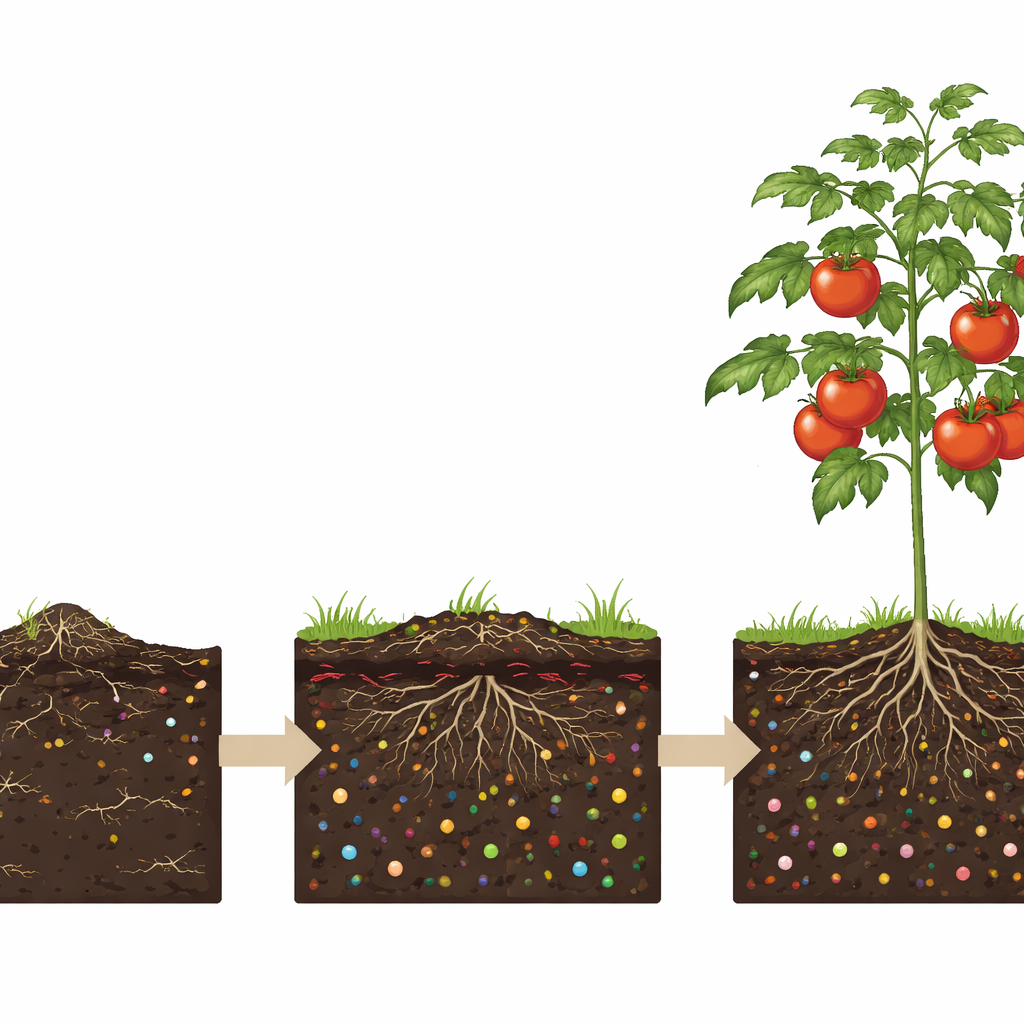
Below ground, the long-term picture was equally revealing. Repeated vermicompost applications gradually enriched the soil with nitrogen, phosphorus, potassium, and key trace elements like iron and zinc, while an integrated mix that included rock phosphate was also very effective. Farmyard manure tended to build more potassium, vermicompost more phosphorus, and all solid manures helped maintain nitrogen levels better than the unfertilized control. In this hot, semi-arid environment, the overall soil carbon level did not rise much; organic matter breaks down quickly under such conditions. Still, the steady input of compost and manure created a more active, nutrient-rich zone around roots, which improved nutrient uptake and made yields more stable in bad weather years, such as during unusually heavy rains.
Fine-Tuning Organic Nutrition
A central lesson from the study is that organic manures come with fixed internal nutrient ratios that rarely match what crops ideally need. If farmers spread manure mainly to satisfy nitrogen needs, they may unknowingly over- or under-supply phosphorus and potassium. Here, vermicompost happened to align better with tomato demand in the test soil, which helped explain its advantage. The authors argue that truly sustainable organic farming will require blending different organic materials—such as pairing manure with rock phosphate or other potassium-rich inputs—guided by regular soil testing. Liquid boosters like Jivamrut work best as helpers that stimulate soil life, not as stand-alone fertilizers.
What This Means for Tomato Lovers and Farmers
For consumers, the findings are encouraging: tomatoes grown with well-managed organic inputs can be just as abundant as those from chemically fertilized fields, and may offer richer nutritional value thanks to higher lycopene levels. For farmers in semi-arid regions, the study highlights vermicompost—used alone or mixed with farmyard manure—as a cornerstone practice that can simultaneously raise yields, improve profits, and rebuild soil nutrients over time. While the work was done at a single site and with one tomato variety, it provides strong evidence that carefully chosen and combined organic manures can make vegetable production both productive and kinder to the land.
Citation: Gourkhede, P.H., Gore, A.K., Patil, M.G. et al. Long-term organic nutrient management in tomato enhances yield, quality, profitability, and soil health in a semi-arid conditions. Sci Rep 16, 11133 (2026). https://doi.org/10.1038/s41598-026-41738-2
Keywords: organic tomato farming, vermicompost, soil fertility, semi-arid agriculture, sustainable nutrient management