Clear Sky Science · en
Experimental study on the disintegration characteristics of rare earth tailings improved by BF-MICP
Why turning mine waste into building ground matters
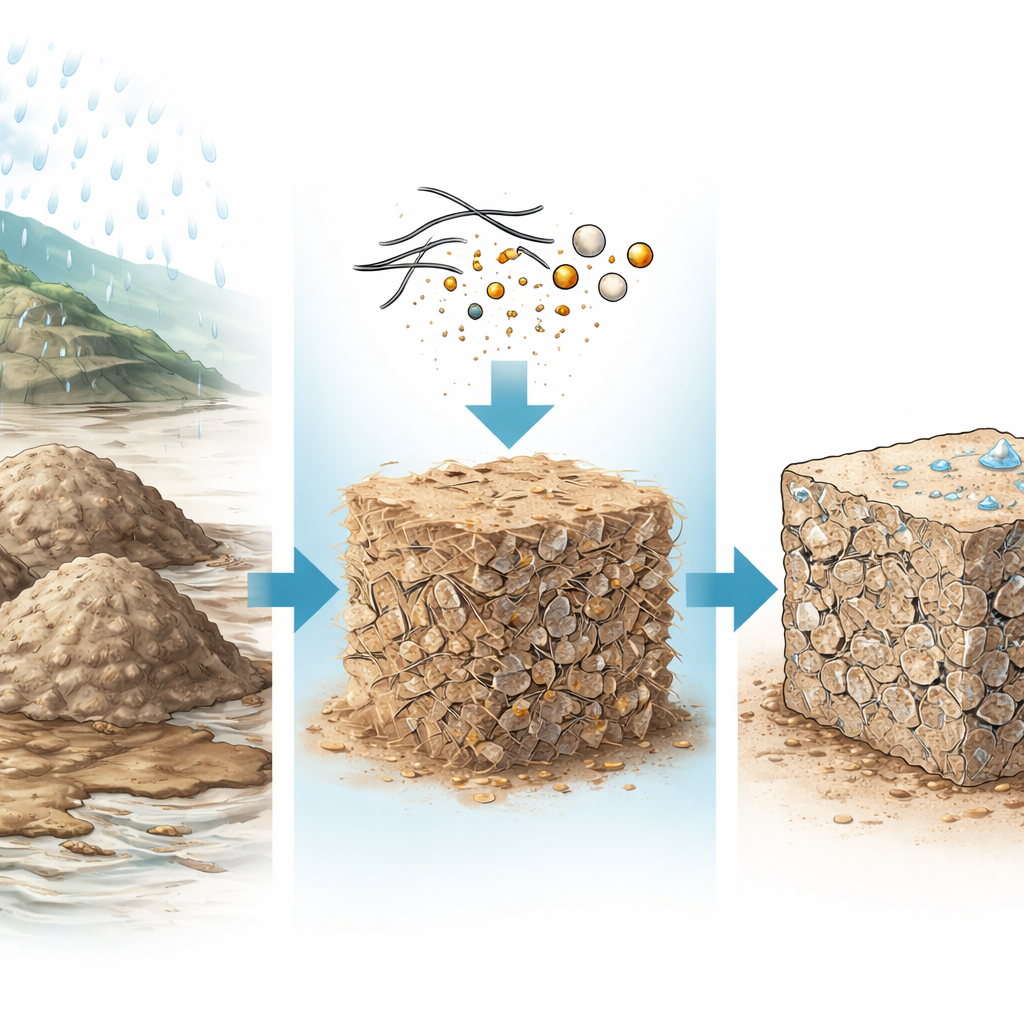
Across southern China, huge mounds of waste sand and mud left over from rare earth mining sit exposed to sun and rain. These “tailings” not only take up land and leak heavy metals but also fall apart quickly when soaked, making them unsafe to build on. The study behind this article explores a promising way to turn this troublesome waste into a strong, stable material for roadbeds and foundations by combining tiny rock fibers with helpful microbes that grow natural cement between the grains.
The problem with crumbling mine leftovers
Rare earth elements power smartphones, wind turbines, and electric cars, but their mining leaves behind enormous piles of fine, loose tailings. In the humid, rain‑soaked climate of southern China, these piles repeatedly wet and dry. Water seeps in, clay minerals swell, and the material breaks down into mud. If used directly as foundation fill, this rapid disintegration would cause roads and buildings to sink or crack. Common treatments like cement or chemical binders can work at first but often lose strength under many wet–dry cycles, cost a lot, and may add new environmental burdens.
Two helpers: rock fibers and living cement
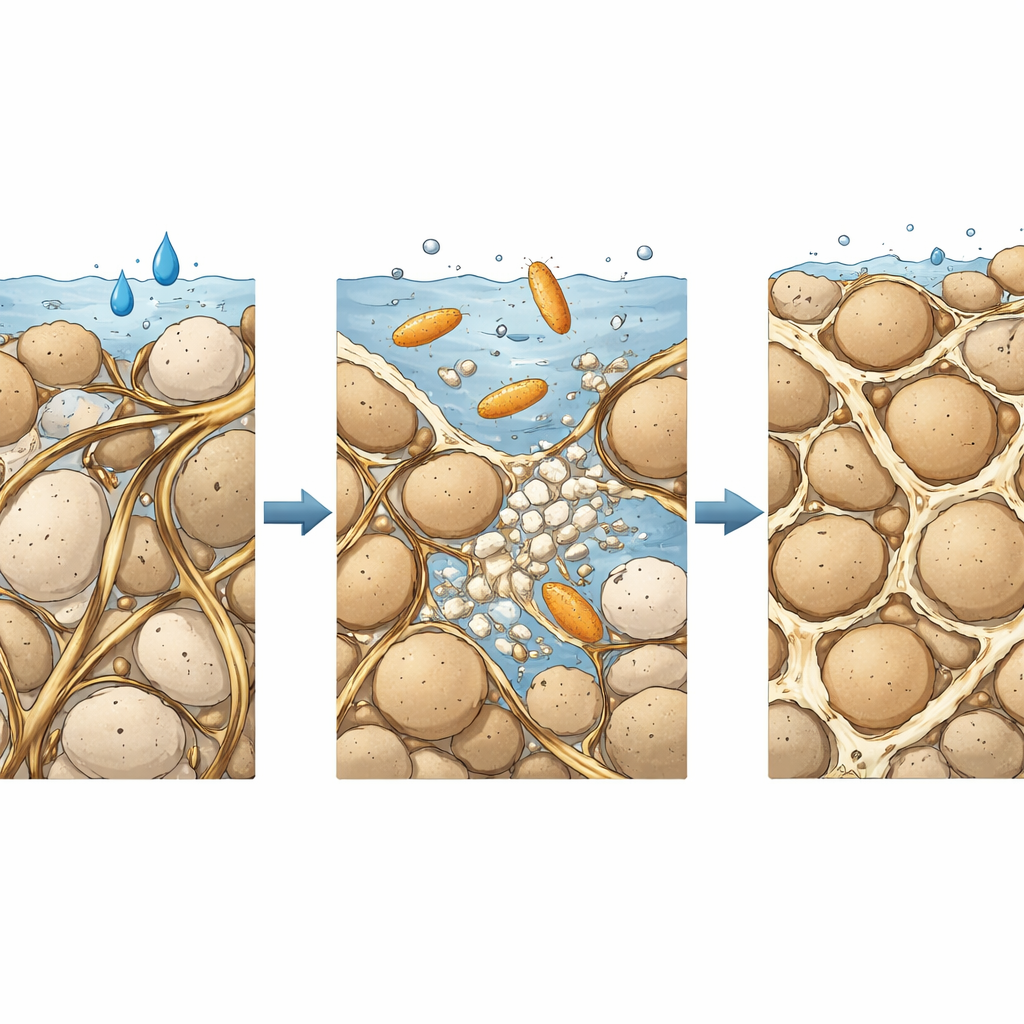
The researchers tested a combined approach based on two tools. The first is basalt fiber, a strong, hair‑thin thread drawn from melted volcanic rock. When mixed into soil, these fibers act like tiny reinforcing bars, tying grains together and helping resist cracking. The second is microbially induced carbonate precipitation, or MICP. Special bacteria are added along with a solution containing urea and dissolved calcium. As the microbes feed, they turn the chemicals into calcium carbonate—the same mineral found in limestone and seashells—which grows as microscopic bridges between soil particles, gluing them into a more solid mass and trapping some heavy metals in harmless mineral form.
Putting the new mix through water torture
To see how well these tools protect rare earth tailings from falling apart, the team prepared two types of test samples: one with only basalt fibers and another with both fibers and bacteria‑driven mineral growth. Cylindrical blocks of treated tailings were submerged in water on a sensitive balance while cameras watched them over time. For some samples, this soaking was repeated several times with drying in between to mimic months or years of monsoon seasons. The scientists tracked how fast each block lost mass, how cloudy the water became, and how the surface and interior structure changed.
What happened to the treated tailings
Adding fibers alone helped only a little. The blocks held together slightly longer and shed fewer grains, but eventually they still collapsed completely into loose particles. The real change came when fibers were combined with the microbial cement. In those samples, even after 80 minutes under water, the blocks largely kept their shape and lost only about one‑third to half of their mass rather than crumbling entirely. After several wet–dry cycles, the total amount of material washed away actually decreased, especially in mixtures with more fiber. Under the microscope, untreated tailings looked loose and porous, while the combined treatment produced dense clumps where fibers, soil grains, and newly formed calcium carbonate wove together into a three‑dimensional framework that filled pores, wrapped swelling clay particles, and tied everything into a tougher whole.
From waste piles to useful ground
In plain terms, this study shows that rare earth tailings, usually too fragile to build on, can be turned into a much more durable foundation material when reinforced with rock fibers and “grown” mineral glue from bacteria. The fibers provide toughness, and the microbial limestone locks grains and fibers into a stable skeleton that stands up to repeated soaking and drying. If scaled up, this approach could help shrink mine‑waste piles, cut demand for natural sand and gravel, and create safer, longer‑lasting roadbeds and foundations in rainy regions—all while relying on abundant rock and living microbes instead of heavy doses of traditional cement.
Citation: Guo, Z., Cao, X., Wu, J. et al. Experimental study on the disintegration characteristics of rare earth tailings improved by BF-MICP. Sci Rep 16, 11064 (2026). https://doi.org/10.1038/s41598-026-41736-4
Keywords: rare earth tailings, basalt fiber, microbial cementation, soil stabilization, wet-dry cycles