Clear Sky Science · en
Supervised information gain-based feature selection for multimodal physiological signals in stress prediction
Why Your Wrist Can Reveal Your Stress
Many of us now wear smartwatches or fitness bands that quietly track our heart rate, movement, and even how much we sweat. This paper explores how to turn those everyday signals into reliable early warnings about stress. Instead of building huge, opaque artificial-intelligence models, the author focuses on choosing just the most informative pieces of data from a wrist device so that stress can be detected accurately, efficiently, and fairly across different people.
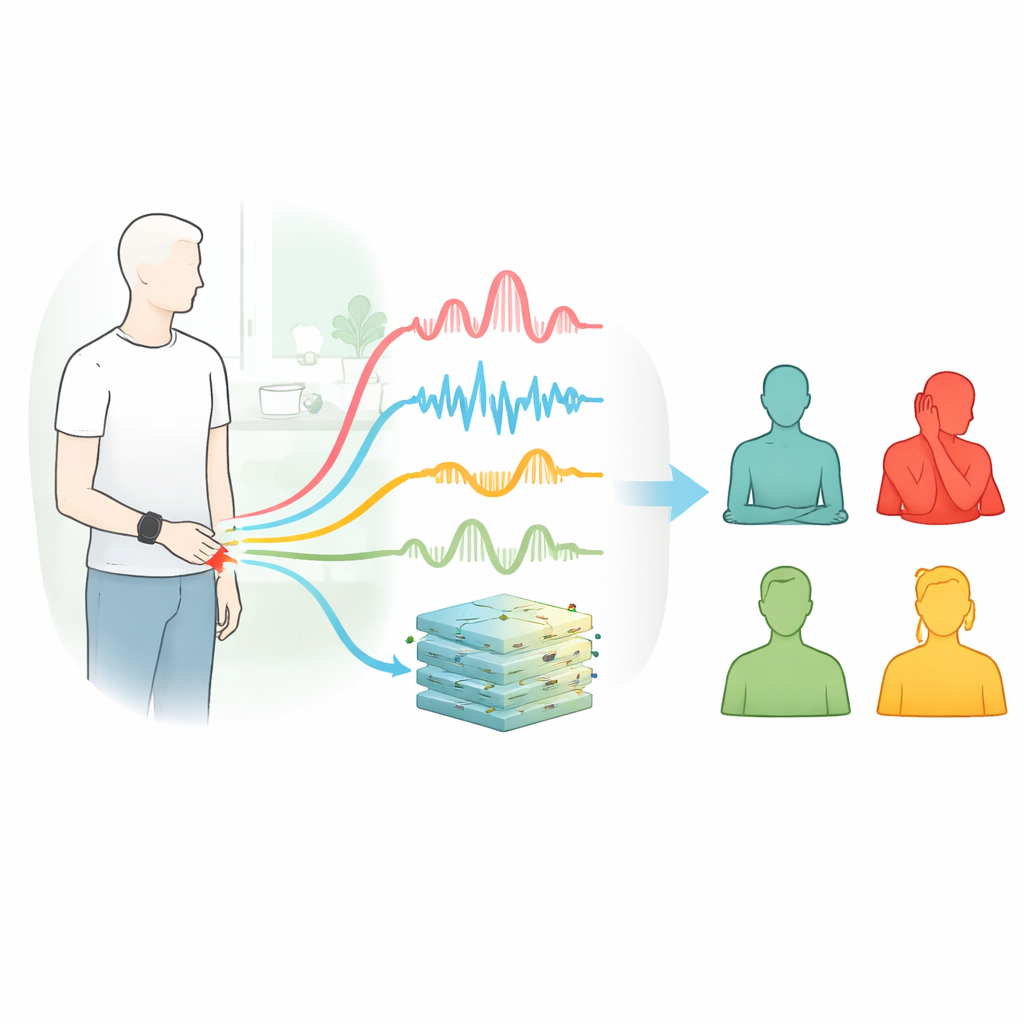
Listening to the Body Through Simple Sensors
The study centers on a public dataset called WESAD, where volunteers wore a commercial wristband during calm, stressful, and amusing activities. The wristband recorded four kinds of signals: tiny changes in blood flow in the wrist (blood volume pulse), subtle shifts in skin moisture (electrodermal activity), body temperature, and arm movement from an accelerometer. Together, these streams offer a window into how the body reacts when a person is relaxed, laughing, or under pressure from tasks like public speaking and mental arithmetic.
From Raw Waves to Meaningful Patterns
Raw sensor traces are messy: they fluctuate from moment to moment and differ greatly between individuals. To make sense of them, the author cuts the continuous signals into 30‑second slices and examines how each slice behaves across both time and frequency, using a standard tool from signal processing called the Short-Time Fourier Transform. From these colorful time–frequency “pictures,” the study extracts numerical descriptors such as average energy, how spread out the energy is, and where the strongest rhythms lie. This richer description captures not just how strong a signal is, but how its rhythm and variability change when a person becomes stressed.
Picking Only the Most Telling Clues
Even after this processing, hundreds of potential descriptors remain, and most are not very helpful. The core idea of the paper is to use a supervised measure called Information Gain to rank these descriptors by how well they separate the three states: baseline, stress, and amusement. In simple terms, a descriptor scores highly if knowing its value makes it easier to guess the correct state. The top 50 descriptors across all four sensor types are then fused into a compact portrait of what is happening in the body during each 30‑second slice, drastically cutting down the data while retaining the most telling clues.
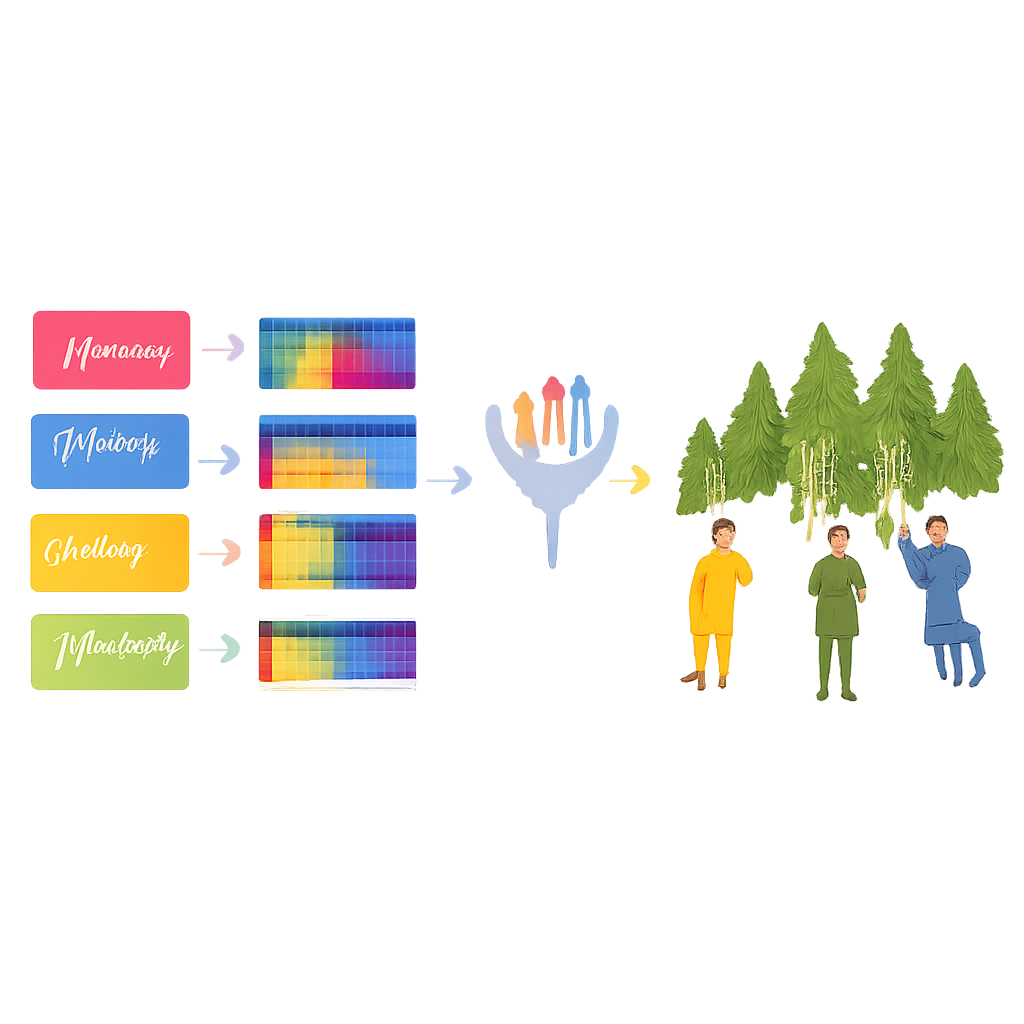
Testing on New People, Not Just New Samples
A common pitfall in stress-detection research is accidentally training and testing on data from the same person, which makes results look better than they really are. This work avoids that trap by using a strict “leave one subject out” evaluation: models are trained on everyone except one volunteer, and then tested on that held-out person. The author compares several common feature-selection strategies and learning algorithms under this demanding setting. The combination of time–frequency features, Information Gain–based selection, and a Random Forest classifier consistently performs best among the tested options, reaching subject-independent accuracies around three out of four samples classified correctly and peaking near 90 percent for some individuals. It also outperforms alternative feature representations such as Hilbert-based and quadratic-kernel approaches.
What This Means for Everyday Stress Tracking
For non-specialists, the key message is that we do not necessarily need gigantic deep-learning models or complicated sensor setups to detect stress from wearables. By carefully choosing which aspects of simple wrist signals matter most, this study builds a lean and interpretable pipeline that generalizes reasonably well to new people. Blood-flow and skin-temperature patterns emerge as especially strong indicators, supported by skin conductance and motion. While accuracy still falls short of perfection and drops when tested on very different, synthetic data, the work shows a practical path toward trustworthy, energy-efficient stress monitoring that could one day help consumer devices warn us when our bodies are under strain before we consciously notice it.
Citation: Chouhan, S.A. Supervised information gain-based feature selection for multimodal physiological signals in stress prediction. Sci Rep 16, 12169 (2026). https://doi.org/10.1038/s41598-026-41734-6
Keywords: wearable stress detection, physiological signals, feature selection, machine learning, multimodal sensing