Clear Sky Science · en
A dual-function dry electrode for electromyography recording and transcutaneous electrical stimulation
Helping Muscles Talk and Listen
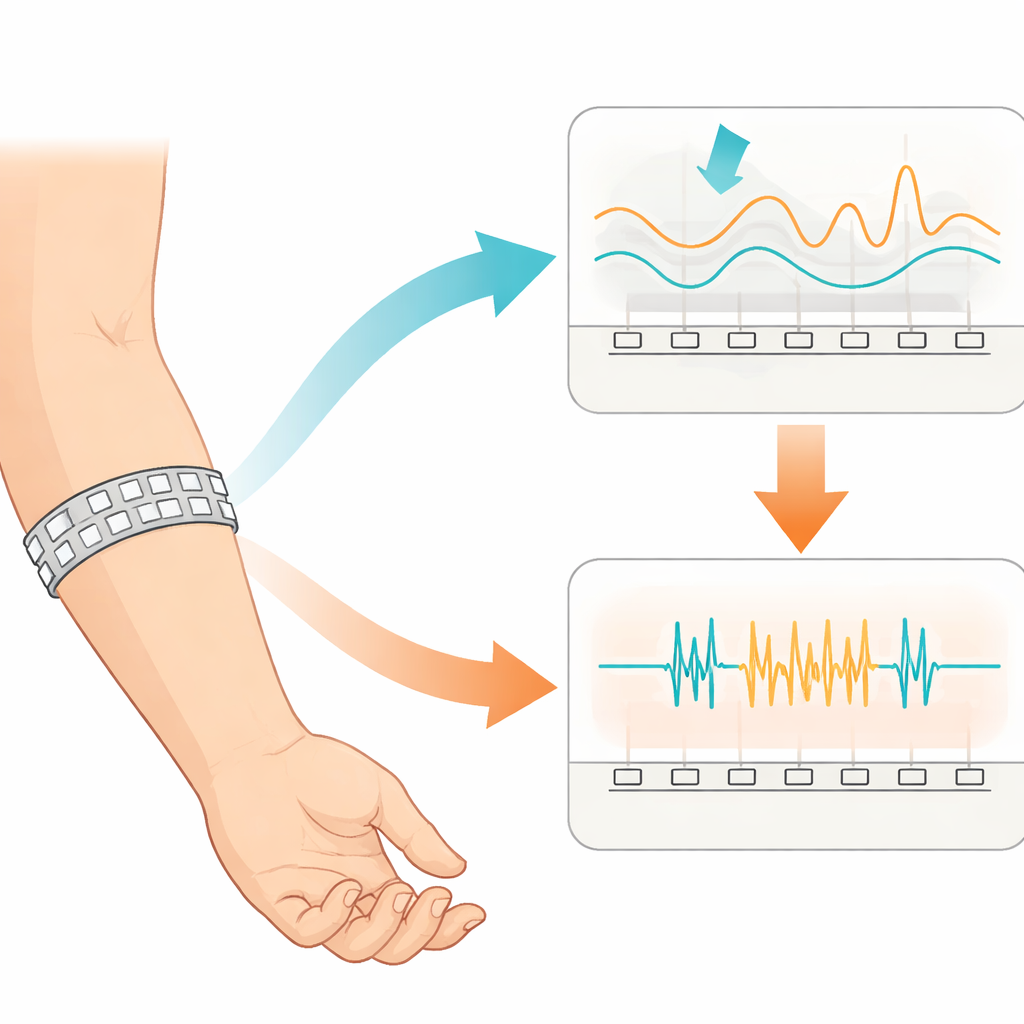
When a person tries to move a hand after a stroke or injury, the brain may send a signal but the muscle does not always respond. Therapists often need to both “listen” to the weak muscles and “nudge” them with gentle electricity to help movement return. Today this usually requires two different sets of sticky, gel-based electrodes on the skin, which can be messy and hard to fit on small muscles. This study introduces a new kind of dry armband electrode that can both read muscle activity and deliver electrical stimulation through the same hardware, potentially simplifying future rehabilitation devices.
Why One Band Is Better Than Two
Muscle activity can be monitored using electromyography, which picks up tiny electrical signals from muscles through the skin. To help those same muscles move, therapists also use transcutaneous electrical stimulation, which sends electrical pulses back into the body. In many patients—especially people recovering from stroke—there is very little space on the arm or hand to place separate sensors and stimulators near the same small muscle groups. Swapping electrodes during therapy is slow and can lead to poor targeting of the right spot. A single wearable that can both sense and stimulate in exactly the same location could make treatment faster, more precise, and more comfortable.
Building a Reusable, Gel-Free Band
The researchers designed a slim armband made from small squares of copper that were coated with a thin layer of gold. Unlike common “wet” electrodes that rely on sticky gel, these dry metal contacts work directly against the skin. Gold was chosen because it conducts electricity well and forms a stable, durable surface. Six of these small electrodes were mounted on each plastic segment, and eight segments were linked together into a flexible band that fits around the forearm. Forty volunteers wore this band while performing six simple hand and wrist gestures, such as opening the hand or bending the wrist, so the team could test how well the new electrodes captured muscle activity over time.
Teaching the Band to Recognize Hand Gestures
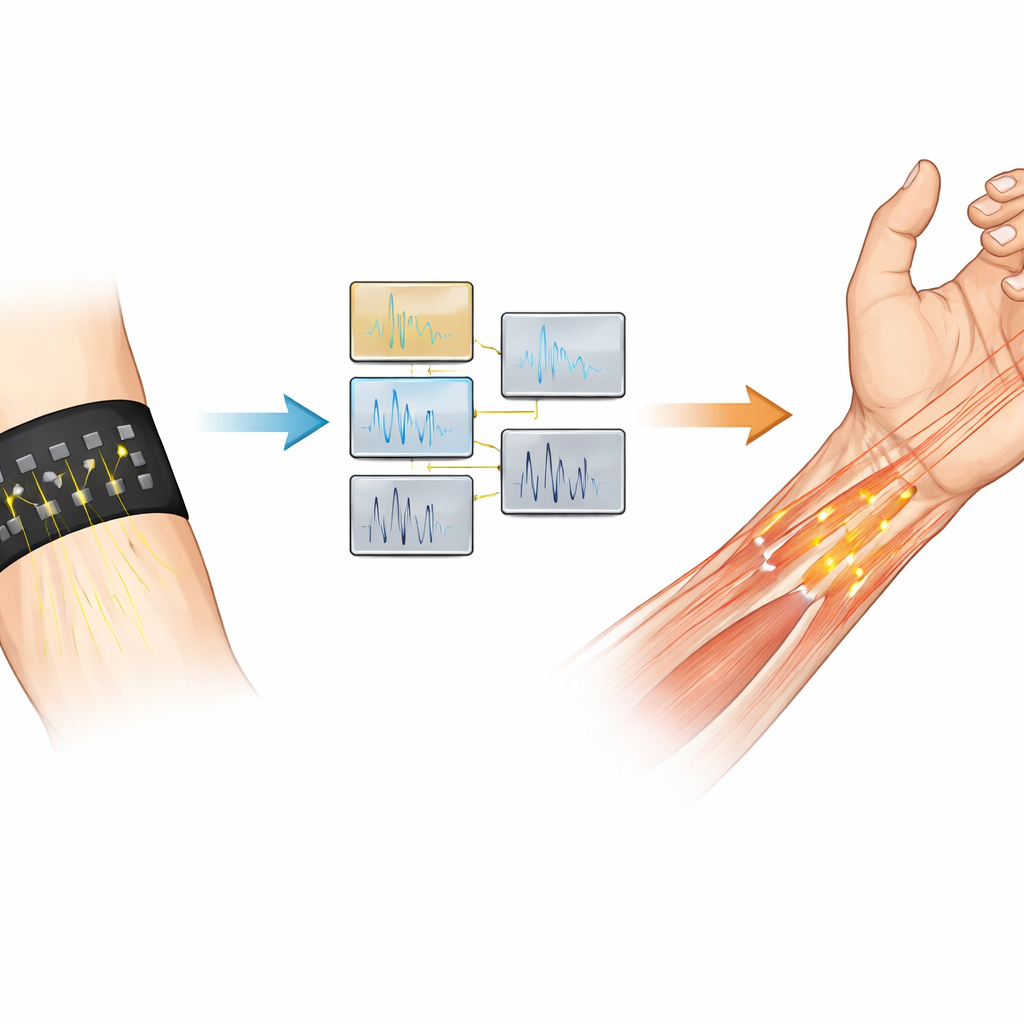
To judge signal quality in a real-world way, the team did more than just measure noise levels. They trained a computer algorithm to recognize which gesture a person was making based only on the electrical patterns recorded by the armband. The approach used a network of small image-based classifiers that together decided which of the six gestures was most likely. The same experiment was repeated using a popular commercial armband called Myo for comparison. The new dry band achieved about 80.5% accuracy in identifying the correct gesture, essentially matching the commercial device’s 80.3% accuracy. The signal-to-noise ratio of the dry electrodes remained stable for up to 21 months of repeated use, suggesting that the gold-coated contacts stay reliable over time.
Testing How Well It Can Move Muscles
Next, the researchers examined how effectively the band could deliver electrical stimulation. Two segments of the dry armband were placed over muscles that bend the wrist and ring finger, and a standard clinical stimulator was used to send pulses through the electrodes. They measured the lowest current that users could feel, the current needed to trigger a visible muscle contraction, and a slightly higher level. At the same time, a torque sensor attached to the hand or finger measured how much force the muscle produced. These tests were repeated with conventional gel-based electrodes in the same locations. Across 40 participants, there were no meaningful differences between the dry and wet electrodes in the currents required or in the torque the muscles produced, showing that the new design can stimulate as effectively as existing clinical pads.
Looking Ahead to Smarter Rehab Devices
The study shows that a single dry, gold-coated armband electrode can reliably pick up muscle signals for gesture recognition while also delivering safe and effective stimulation. To a layperson, this means that future rehabilitation tools could look more like a simple sleeve or bracelet that both understands your movement intentions and helps your muscles carry them out—without messy gels or constant re-positioning. While the current work tested sensing and stimulation separately, the authors outline how future versions could rapidly alternate between the two functions to support real-time, intention-driven therapy for people recovering from stroke or other neuromuscular conditions.
Citation: Mohammadiazni, M., Zhou, Y. & Trejos, A.L. A dual-function dry electrode for electromyography recording and transcutaneous electrical stimulation. Sci Rep 16, 11576 (2026). https://doi.org/10.1038/s41598-026-41729-3
Keywords: surface electromyography, electrical stimulation, rehabilitation technology, wearable sensors, hand gesture control