Clear Sky Science · en
Damping behavior of adaptable shoe under torsional loading at varying angular velocities: replicating the effects on cutting maneuvers
Why Twisting in Sports Shoes Matters
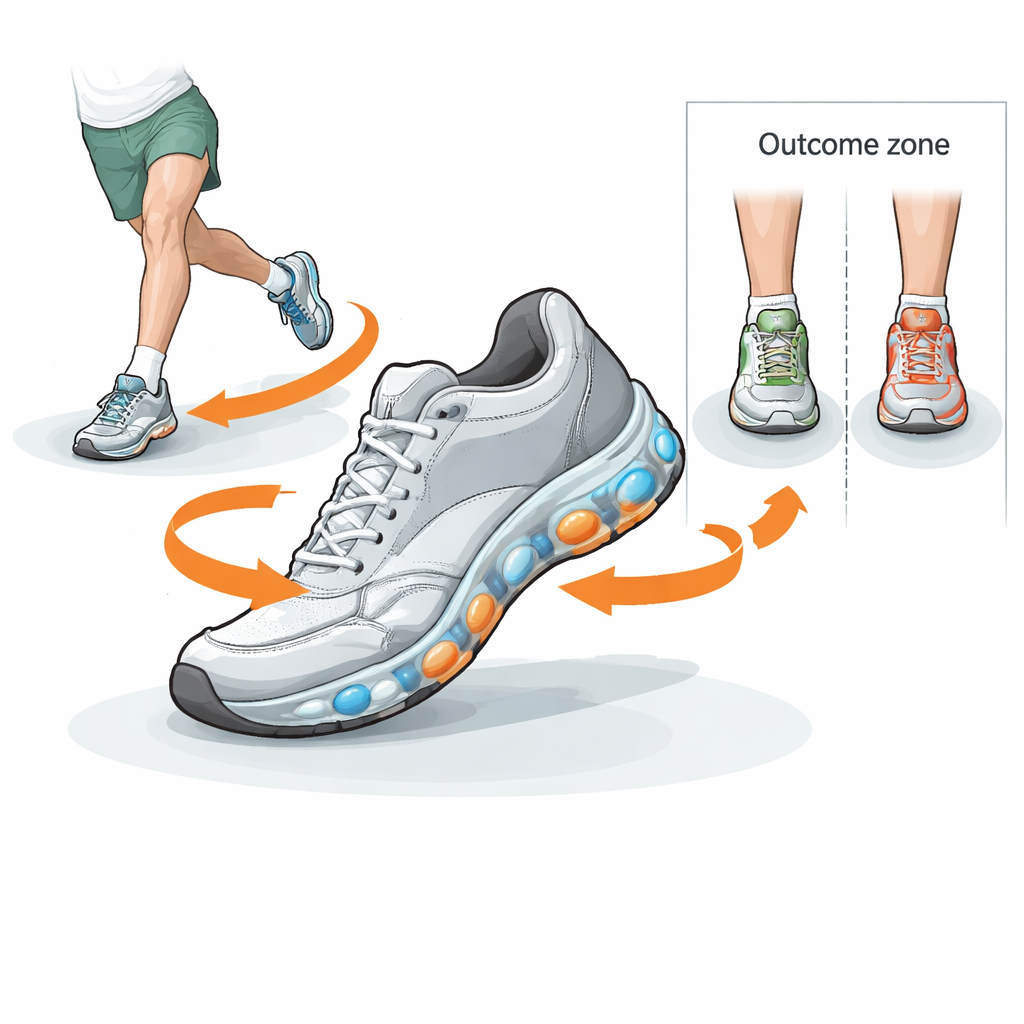
Anyone who has sprinted down a court or field and suddenly cut sideways knows that your shoes can make or break the move. This study looks inside a special kind of athletic shoe with air-filled soles to ask a simple but important question: when the shoe twists quickly, how much of that motion is soaked up by the shoe itself, and how much is passed on to your foot and ankle? The answers could help designers build footwear that better balances performance and injury protection during sharp change‑of‑direction moves.
How Shoes Soak Up Motion
When a material or structure moves and then settles back, some of the energy is lost as heat rather than bounced straight back; engineers call this energy loss damping. In running and cutting, the foot–shoe system acts like a spring with built‑in damping. If damping is too low, more of the twisting and impact forces travel into your joints. If it is higher, more energy is absorbed in the shoe itself. Modern sports shoes rely heavily on foams and air cushions that behave like soft springs, and their response depends on how fast they are loaded. That means it is not enough to know how a shoe behaves in slow, static tests; we need to know what happens at the rapid twisting speeds seen in real games.
Three Ways to Build an Air Cushion Sole
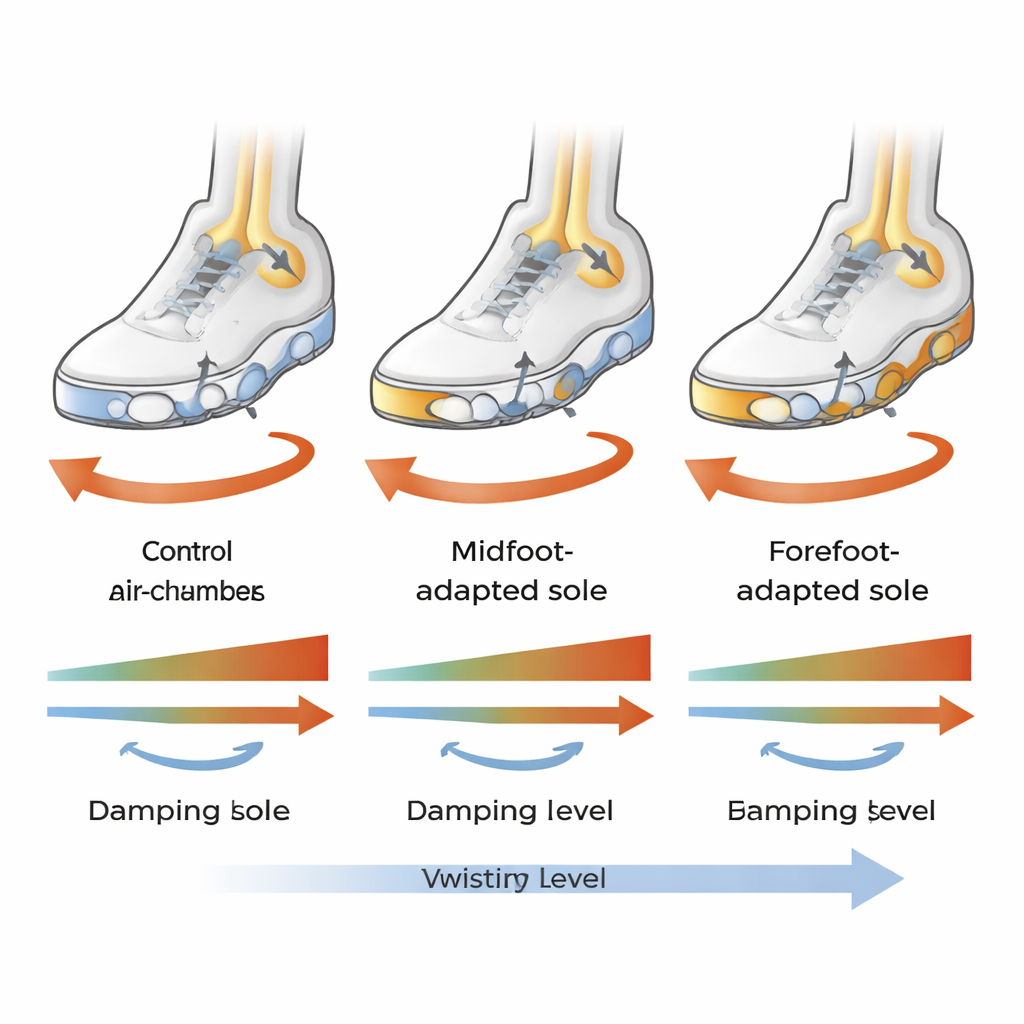
The researchers tested an "adaptable" air‑cushion shoe whose sole consists of inflatable chambers and hollow spaces rather than a traditional foam block. They compared three versions: a control shoe with only air‑filled chambers, a midfoot‑adapted shoe where extra elastomer spacers stiffened the middle of the sole, and a forefoot‑adapted shoe where spacers were concentrated under the ball of the foot. By rearranging these spacers, they could subtly change how each shoe twisted without altering the overall look or basic construction, making it easier to link differences in mechanical behavior back to specific regions of the sole.
Twisting Shoes to Mimic Cutting Moves
To imitate a cutting maneuver, the team clamped the back of each shoe in a torsion machine and repeatedly twisted the forefoot inward and outward over a 0–30 degree range, similar to the inversion–eversion motion of the foot. They ran fifteen twist–untwist cycles at each of six angular speeds ranging from a gentle 25 degrees per second up to 150 degrees per second, which lies within the range observed in real running direction changes. Using custom computer scripts, they focused on the steady final cycles, cleaned the data to remove noise, and calculated a damping coefficient that captures how strongly the shoe resists and dissipates twisting energy as the twisting speed changes.
What Happens as Twisting Gets Faster
Across all three shoe designs, the key pattern was clear: as twisting speed increased, the damping coefficient decreased. In other words, when the shoe was twisted slowly, it absorbed more energy; when twisted rapidly, it let more energy pass through. At the highest speed tested, all shoes showed their lowest damping, meaning they stored and returned most of the twisting energy instead of dissipating it. Among the three designs, the forefoot‑adapted shoe consistently had the smallest damping values, especially at high speed, while the midfoot‑adapted shoe generally showed intermediate behavior between the control and forefoot‑adapted versions.
What This Means for Ankles and Forefeet
The mechanical behavior of the shoes has direct implications for how forces reach the body. Low damping during fast twists means that higher twisting loads can be transmitted to the ankle and the metatarsophalangeal (MTP) joint at the ball of the foot. The forefoot‑adapted shoe, with its particularly low damping in the front, may allow more force to reach the MTP joint when an athlete plants and cuts, potentially challenging joint stability if muscles and ligaments cannot compensate. Higher damping at lower twisting speeds, in contrast, implies greater energy loss in the shoe and possibly lower force transmission, which could be more forgiving for the joints but might also influence how responsive the shoe feels.
Why These Findings Matter
To a non‑specialist, the takeaway is that shoes do not behave the same at all speeds: during rapid, game‑like direction changes, these adaptable air‑cushion soles absorb less twisting energy and pass more of it on to the foot and ankle. Subtle design choices about where to stiffen or soften the sole—particularly under the forefoot—can shift how much twisting load reaches sensitive joints. While this study was done on a specific shoe type and without an actual foot inside, it offers early guidance for designing athletic footwear that balances energy return, responsiveness, and joint protection during quick cuts. Future work that combines these mechanical tests with measurements on real athletes could help fine‑tune damping so that shoes support both performance and long‑term joint health.
Citation: Arefin, M.S., Lin, CJ., Chieh, HF. et al. Damping behavior of adaptable shoe under torsional loading at varying angular velocities: replicating the effects on cutting maneuvers. Sci Rep 16, 12445 (2026). https://doi.org/10.1038/s41598-026-41715-9
Keywords: sports footwear, ankle stability, cutting maneuvers, shoe damping, torsional loading