Clear Sky Science · en
AI-driven emergency logistics network deployment in dynamic environments
Why smarter emergency deliveries matter
When disasters strike—a pandemic, a blizzard, a major accident—getting medicines, food, and other essentials to the right places fast can literally be a matter of life and death. Yet emergency delivery systems often guess where demand will be and follow rigid plans that crumble when reality changes. This study introduces an artificial intelligence–driven approach that helps cities continuously rethink where to place vehicles and supplies so they can serve people quickly and reliably, even when conditions are chaotic and uncertain.
Seeing the city as a living network
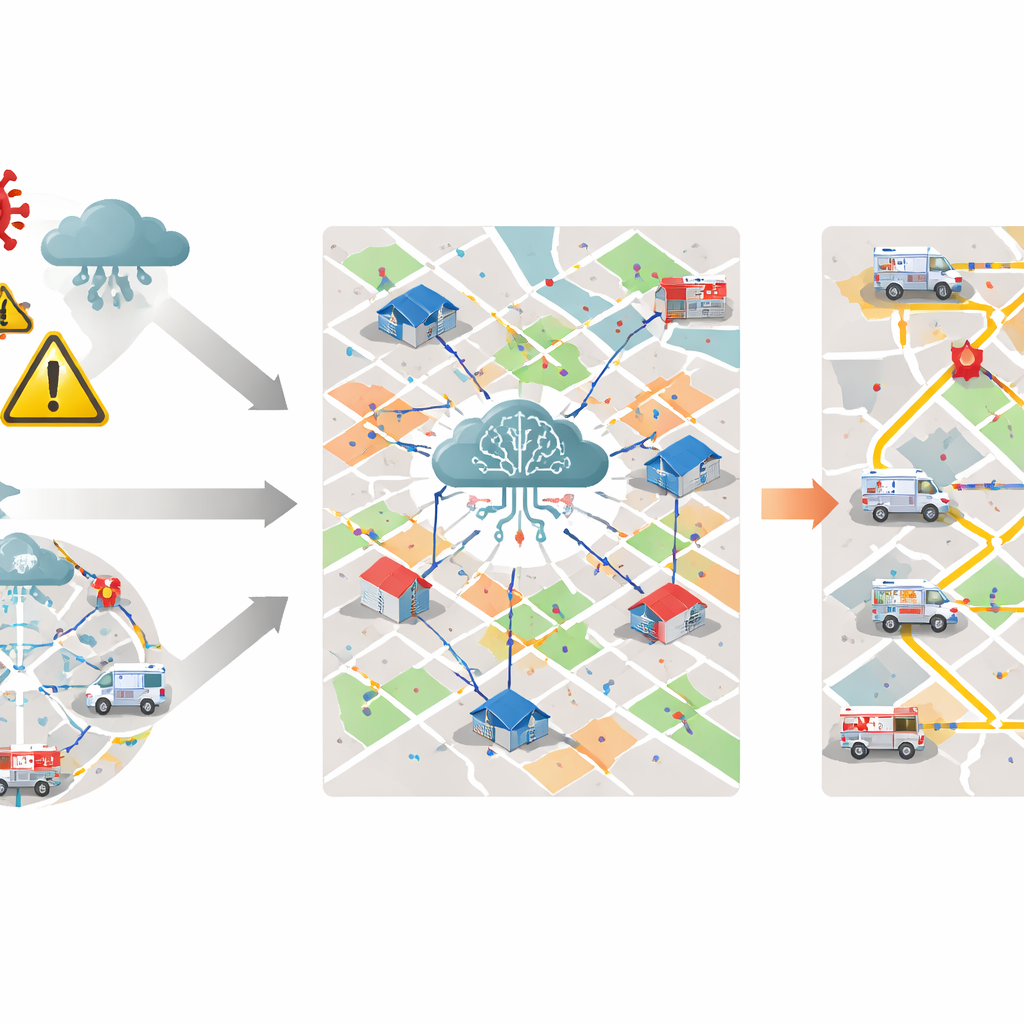
The authors treat a city’s emergency logistics system as a network of connected regions and roads. Demand for rides or deliveries surges and fades from hour to hour and neighborhood to neighborhood, especially during major events. Traditional planning tools often rely on averages or simple trends, which fail when a sudden wave of illness or a snowstorm disrupts normal patterns. Here, the city is modeled as a web of nodes (areas that need service) and links (roads), allowing the system to watch how demand ripples across space and time rather than treating each area in isolation.
Letting events reshape the forecast
At the heart of the framework is an event-driven prediction engine, a type of graph-based neural network. Instead of forecasting future demand from past numbers alone, it also ingests information about real-world shocks such as virus spread, weather warnings, or road closures. This AI model learns both how demand typically flows between neighboring regions and how major events bend or break those patterns. Rather than outputting a single best guess for future demand, it produces a range of likely values and how uncertain each one is—essentially a probability cloud over what might happen next in each part of the city.
Planning for the worst without wasting resources
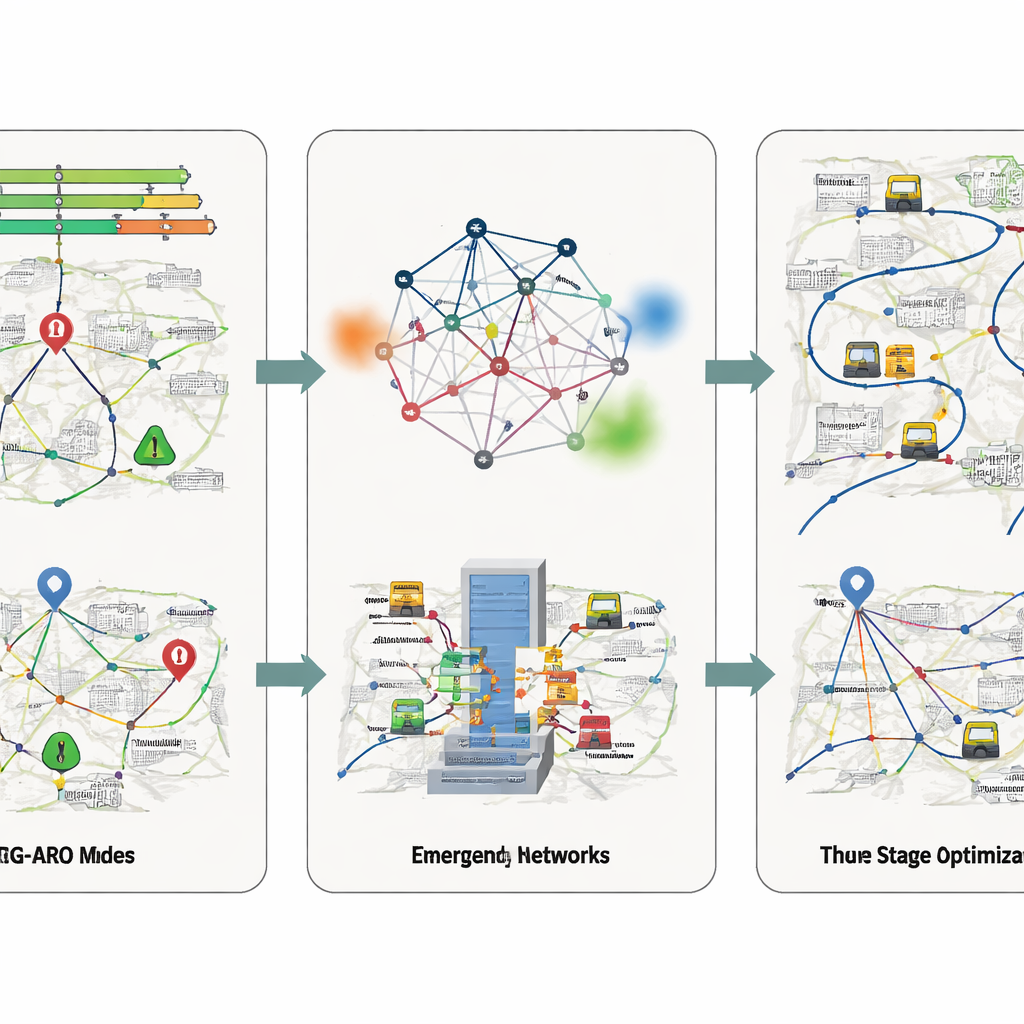
Predictions, no matter how smart, are never perfect. If planners simply optimize around a single forecast, they can be blindsided when reality turns out worse, leaving vehicles and supplies in the wrong places. To address this, the study uses an approach called adaptive robust optimization. It takes the AI’s uncertainty estimates and converts them into a carefully designed “uncertainty set” that captures how demand might deviate from the central forecast. The planning problem is then split in two stages: first, decide where to position warehouses and vehicles before the next period; second, once actual demand and road conditions are observed, adjust routes and resupply in the most cost-effective way. This two-step logic mirrors what emergency managers do in practice—prepare broadly, then fine-tune on the fly—while mathematically guaranteeing good performance even in worst-case conditions.
Learning and adjusting as crises unfold
The full system operates in a rolling loop of predict–optimize–update. Hour by hour, it takes in new data, updates its forecasts, rebuilds the uncertainty set, and recomputes deployment and routing plans. The researchers tested this closed-loop framework on a huge real-world dataset of New York City for-hire vehicles from 2019 to 2022, which includes the COVID-19 outbreak and a severe blizzard. In simulated emergency delivery tasks using these conditions, their method raised the share of met demand from about 71% to over 96% and slashed average delivery delays from 45 minutes to about 12 minutes compared with a strong baseline that already used AI forecasts but relied on simpler planning. It also used the vehicle fleet more efficiently and held operating costs in check, showing that robust planning need not be overly cautious or wasteful.
What this means for future emergencies
In plain terms, the study shows that combining AI’s ability to anticipate shifting demand with careful risk-aware planning can make emergency deliveries both faster and more dependable. By explicitly preparing for uncertainty instead of pretending it does not exist, the framework keeps service levels high even when disasters are at their most disruptive. While more testing in other cities and disaster types is still needed, this work points toward emergency logistics systems that think ahead, adapt continuously, and help ensure that critical supplies arrive where and when they are needed most.
Citation: Mei, L., Chenjing, Y. & Sha, S. AI-driven emergency logistics network deployment in dynamic environments. Sci Rep 16, 11596 (2026). https://doi.org/10.1038/s41598-026-41708-8
Keywords: emergency logistics, dynamic deployment, robust optimization, demand forecasting, disaster response