Clear Sky Science · en
Identification and characterization of Phi1 and Phi3 bacteriophages targeting Xylella fastidiosa subsp. pauca, the causal agent of olive quick decline in Italy
Why sick olive trees matter to all of us
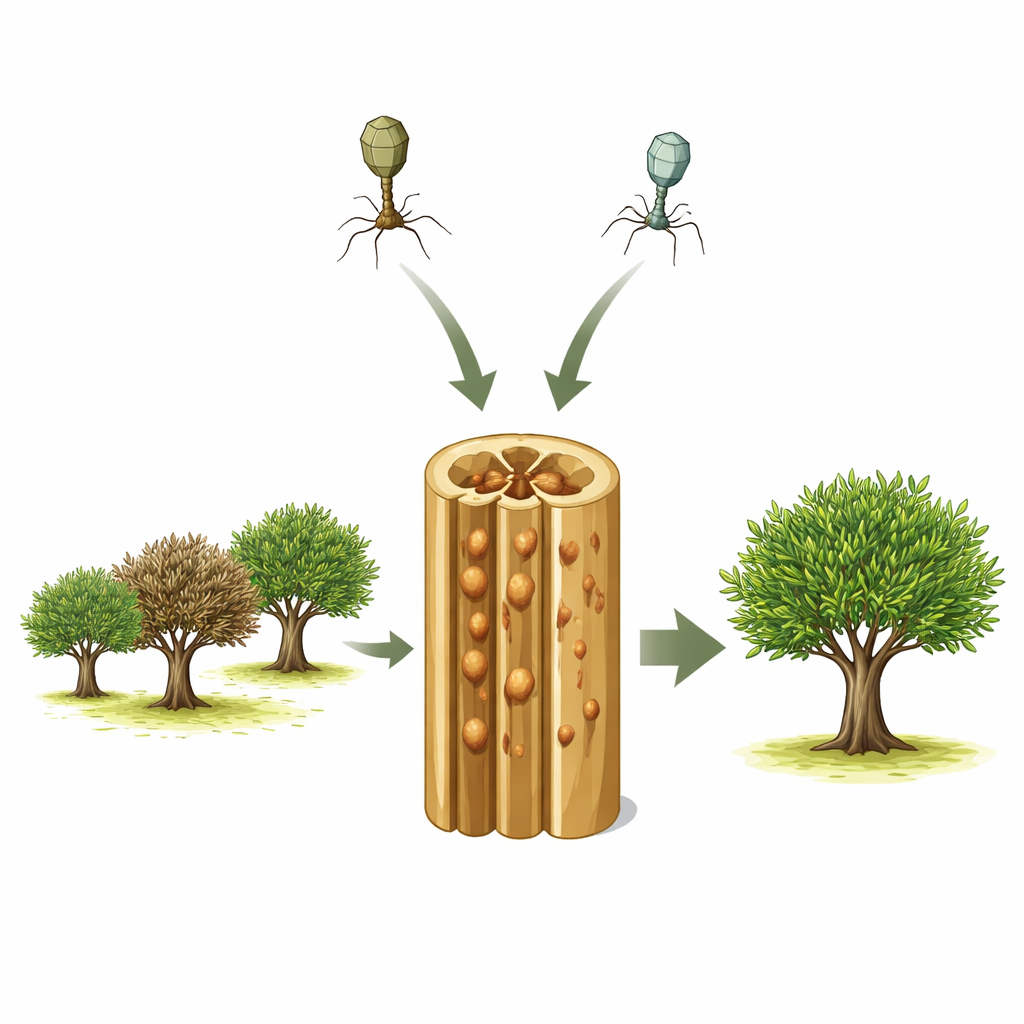
Across the Mediterranean, ancient olive trees are withering and dying from a bacterial infection that blocks the plants’ water pipes, threatening landscapes, livelihoods, and the price and taste of olive oil. This study explores an innovative, nature-based tactic to fight that disease: using tiny viruses that prey on bacteria—called bacteriophages—to hunt down and kill the culprit microbe inside olive trees without harming the rest of the farm ecosystem.
The hidden killer in the tree’s water pipes
The main enemy in this story is Xylella fastidiosa subsp. pauca, a bacterium that lives inside the xylem, the thin tubes that carry water through a plant. In olives, it causes olive quick decline syndrome, a condition that scorches leaves, dries branches, and can eventually kill whole groves. In southern Italy, this single pathogen has devastated tens of thousands of hectares of olives and cost hundreds of millions of euros. Conventional tools—chemical sprays, cutting down diseased trees, and controlling the insect vectors that spread the bacterium—have not stopped its advance, pushing researchers to search for more targeted and sustainable solutions.
Viruses that only attack bacteria
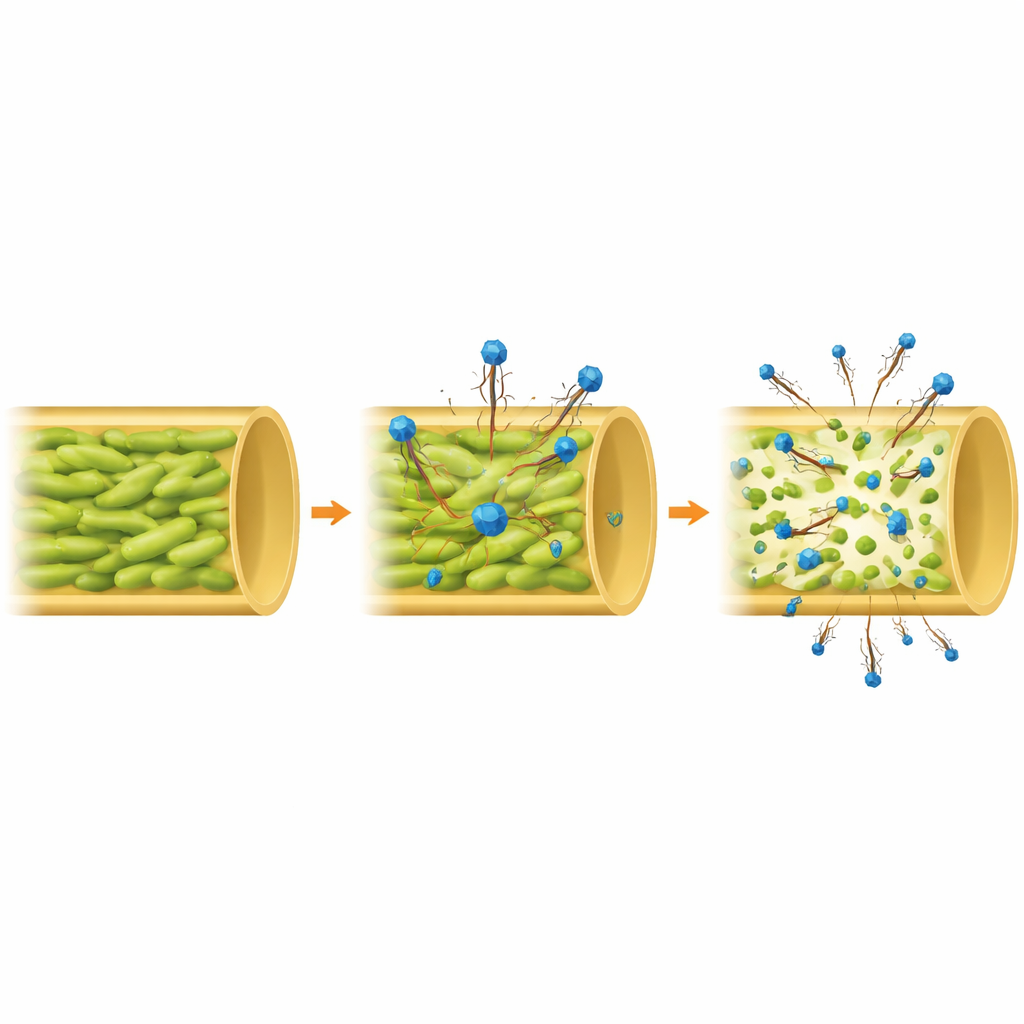
Bacteriophages, or phages, are viruses that infect bacteria but are harmless to plants, animals, and people. The researchers collected sewage water from a treatment plant in Bari, Italy, a rich reservoir of microbial life, and screened it for phages capable of attacking the olive-infecting strain of Xylella. They isolated two promising candidates, named Phi1 and Phi3, and first grew them using a related bacterium that is easier to cultivate. Under the electron microscope, Phi1 showed a compact head with a short tail, while Phi3 had a similar head but a long, flexible tail—shapes typical of well-known phage families. Images of infected Xylella cells revealed all stages of attack: the phages attaching to the bacterial surface, multiplying inside, and finally rupturing the bacterial cell, confirming that these phages actively destroy their target.
Reading the phages’ genetic instruction manual
To judge whether Phi1 and Phi3 would be safe and effective tools, the team sequenced their entire genomes. They found that Phi1 carries about 44,000 DNA building blocks and Phi3 about 55,000, encoding dozens of proteins. Crucially, computer analyses showed that both phages follow a strictly “lytic” lifestyle—they invade, replicate, and burst out of bacteria—rather than quietly integrating into the host genome in a way that might spread unwanted traits. The genomes lacked genes linked to antibiotic resistance or bacterial virulence, features that would make them unsuitable for use in the field. Comparisons with known phages showed that Phi1 is genetically distinct enough to be considered a new species, while Phi3 is very closely related to an already described Xylella phage called Salvo, reinforcing that such viruses form a recognizable group specialized on these plant bacteria.
Built-in bacterial shredding tools
Beyond killing whole bacterial cells, phages often encode enzymes that chew through the protective layers around bacteria and their sticky biofilms. Using specialized software, the researchers identified several proteins in Phi1 and Phi3 that likely act as such molecular tools. Some are predicted to punch holes in the bacterial cell wall or membrane; others may help break down the slimy matrix that Xylella builds inside xylem vessels. These properties could make purified phage enzymes, not just the phages themselves, useful as future treatments to unclog infected water pipes inside trees or to complement other biological control agents.
Safe for friendly microbes and tough in the real world
Any biological control must spare beneficial microbes that support plant health. The scientists therefore tested Phi1 and Phi3 against a collection of bacteria taken from olive trees, as well as several well-known helpful species used in agriculture. Neither phage was able to infect or kill any of these non-target strains, indicating a very narrow host range focused on Xylella and its close relatives. In additional tests, both phages remained active across a wide range of temperatures—from below freezing up to typical Mediterranean summer conditions—and across acidic to mildly alkaline pH levels. They lost activity only at very high temperatures, suggesting that they would be physically robust enough for use in orchards.
What this means for future olive groves
This work shows that Phi1 and Phi3 are potent, highly specific enemies of the bacterium behind olive quick decline and lack obvious genetic features that would raise safety red flags. They also carry built-in enzymes that may one day be harnessed as precision antimicrobials. While these findings are based on lab experiments and computer analyses, they lay the groundwork for testing phage-based sprays or injections in living olive trees and for designing phage mixtures that reduce the risk of bacterial resistance. If successful, such approaches could help protect iconic olive landscapes using tools borrowed directly from nature’s own microscopic battles.
Citation: Sabri, M., El Handi, K., Mektoubi, K. et al. Identification and characterization of Phi1 and Phi3 bacteriophages targeting Xylella fastidiosa subsp. pauca, the causal agent of olive quick decline in Italy. Sci Rep 16, 11969 (2026). https://doi.org/10.1038/s41598-026-41707-9
Keywords: olive quick decline, Xylella fastidiosa, bacteriophages, biological control, plant health