Clear Sky Science · en
Percolation threshold for vertical fluid flow through granular sea ice
Why tiny pathways in sea ice matter
Sea ice might look like a solid, lifeless sheet, but on the inside it is riddled with microscopic channels of salty water. These hidden pathways control how heat, gases, and nutrients move between the ocean and atmosphere, shaping everything from climate to the survival of algae that live inside the ice. This study asks a simple but crucial question: at what point does this inner plumbing of sea ice become connected enough for water to flow freely up and down? The answer turns out to be very different depending on how the ice crystals are arranged, and that difference has big implications for how we model a warming polar world.
Two kinds of sea ice, two very different behaviors
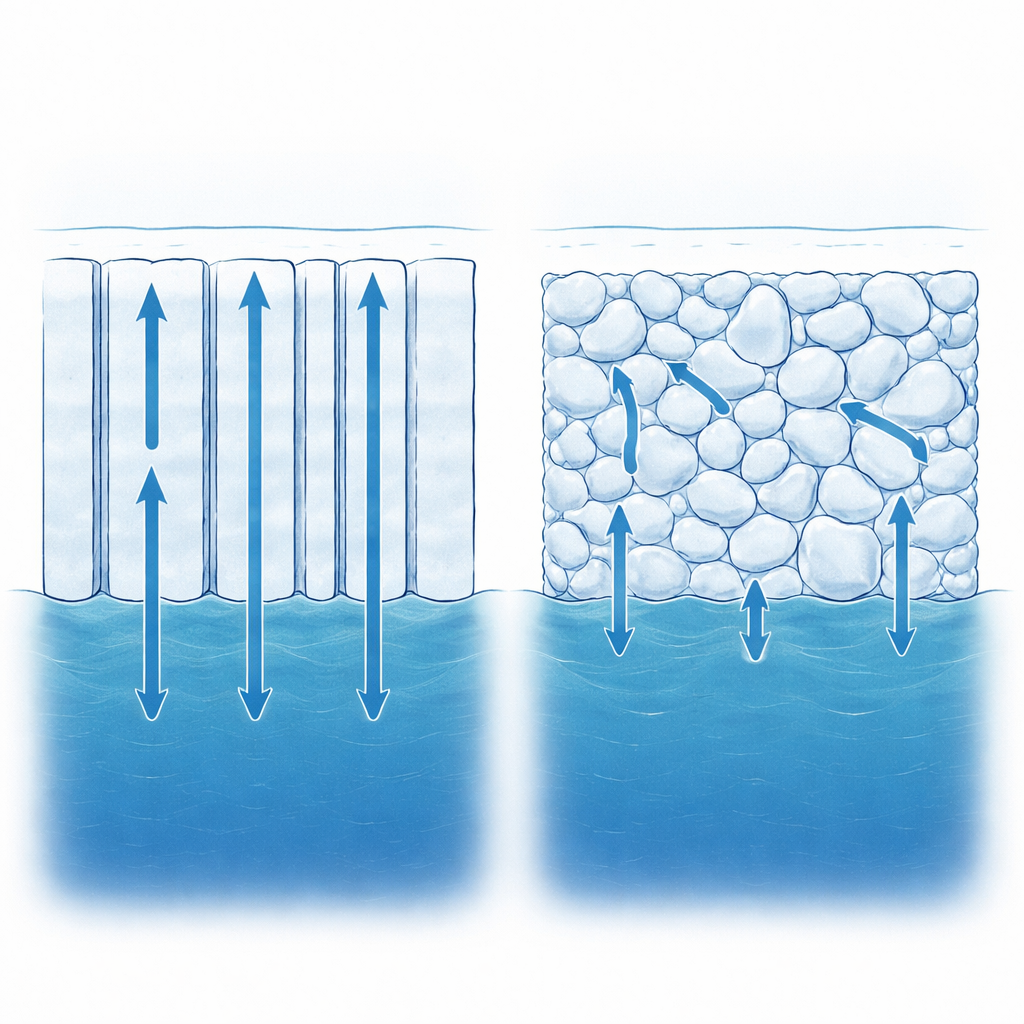
Not all sea ice is built the same way. In "columnar" ice, the crystals grow as long vertical platelets with brine trapped in layered sheets and channels between them. In "granular" ice, the crystals are more like a pile of small grains, with brine filling thin films and pockets in the spaces in between. Earlier work showed that columnar sea ice becomes effectively watertight to bulk vertical flow when the brine volume falls below about 5 percent. Above that level, salty fluid can percolate through continuous pathways. This simple guideline is known as the "rule of fives" and is widely used in sea ice models. But granular sea ice, which is common in the Antarctic and increasingly present in the thinner, younger Arctic ice pack, was suspected to behave differently because its brine network is less neatly connected.
Measuring when water can move
To pin down how granular ice behaves, the authors conducted over a hundred field measurements on first-year Antarctic pack ice during the SIPEX II expedition. They drilled partial vertical holes into the ice, sealed the sides with a fitted pipe, and used pressure sensors to track how quickly seawater rose into the hole from below. From this "bail test," they could work backward to calculate how easily water moves through the ice just beneath the hole. They then combined these measurements with detailed temperature, salinity, and crystal-structure profiles from nearby cores to determine both the local brine content and whether the ice there was columnar or granular. The results revealed a striking pattern: granular ice was essentially impermeable below a brine volume of about 10 percent, and became permeable only above this higher threshold.
Supporting clues from dye and simple models
The authors also revisited dye-tracer experiments from an earlier Antarctic voyage, in which colored, chilled water was poured onto inverted blocks of sea ice. In each case, the dyed fluid quickly sank through an upper, highly permeable layer but stopped abruptly at deeper, colder layers where the brine volume was around 10 percent. Although these experiments were originally exploratory, they independently echoed the 10 percent cutoff seen in the bail tests. To understand why granular ice needs a higher brine content to conduct fluid, the authors turned to a simple model originally developed for mixtures of polymer and metal powders. By measuring the relative sizes of ice grains and surrounding brine films in micrographs of Antarctic ice, they adapted this "compressed powder" framework and found that it naturally predicts a higher percolation threshold for granular ice (around 10 percent) than for columnar ice (around 5 percent).
A universal rule hidden in the randomness
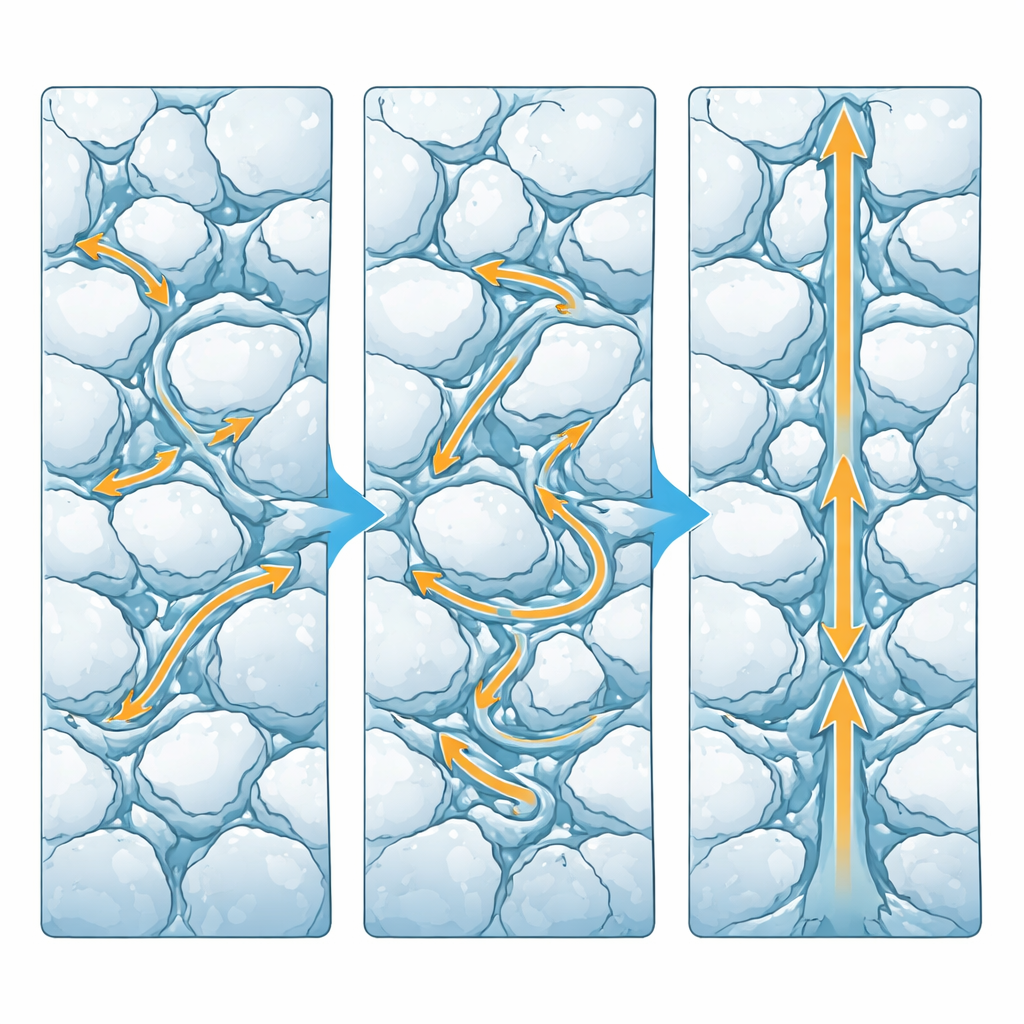
Beyond identifying the threshold itself, the study tested predictions from percolation theory—a branch of statistical physics that describes how connectivity suddenly snaps into place in random systems. Above the threshold, theory predicts that permeability follows a simple power law in how far the system is beyond that critical point, with a so-called critical exponent that is “universal,” depending only on dimension, not on microscopic details. Surprisingly, earlier work showed that columnar sea ice behaves as if it shares this same exponent with idealized lattice models. By combining their new permeability measurements on granular ice with prior imaging of its pore spaces, the authors demonstrate that granular ice follows the same universal scaling. Once the 10 percent threshold is crossed, its permeability rises with brine content in nearly the same mathematical way as in both columnar ice and abstract model networks.
What this means for climate and life in the ice
For scientists trying to predict polar climate, ocean chemistry, and ice-associated ecosystems, these findings carry a clear message: one cannot assume a single, uniform cutoff for when sea ice becomes permeable. Granular ice, which makes up a large share of the Antarctic pack and is becoming more common in the Arctic, only allows bulk vertical flow once the brine fraction reaches about 10 percent—roughly twice the familiar rule of fives for columnar ice. This higher threshold affects how quickly meltwater drains, how ponds form on the surface, and how efficiently nutrients and gases move through the ice. At the same time, the discovery that both ice types share the same universal scaling above their different thresholds strengthens the idea that statistical physics provides a powerful, unifying language for describing the complex, changing fabric of polar sea ice.
Citation: Golden, K.M., Furse, C.M., Gully, A. et al. Percolation threshold for vertical fluid flow through granular sea ice. Sci Rep 16, 11435 (2026). https://doi.org/10.1038/s41598-026-41706-w
Keywords: sea ice permeability, granular sea ice, percolation threshold, polar climate, brine channels