Clear Sky Science · en
ECLAT based association rule mining for advancing workplace mental health and organizational insights
Why your job and your mind are deeply linked
Mental health at work is no longer just a personal issue; it shapes how well companies function, how creative people feel, and how long they stay in their jobs. Yet most workplaces still rely on simple surveys or one-off wellness events that rarely show which everyday conditions actually wear people down or help them cope. This study looks at thousands of detailed employee survey answers and uses a powerful pattern-finding method to uncover which combinations of workplace conditions most often travel together with mental strain or support. The goal is to turn scattered survey responses into clear signals that leaders can act on.
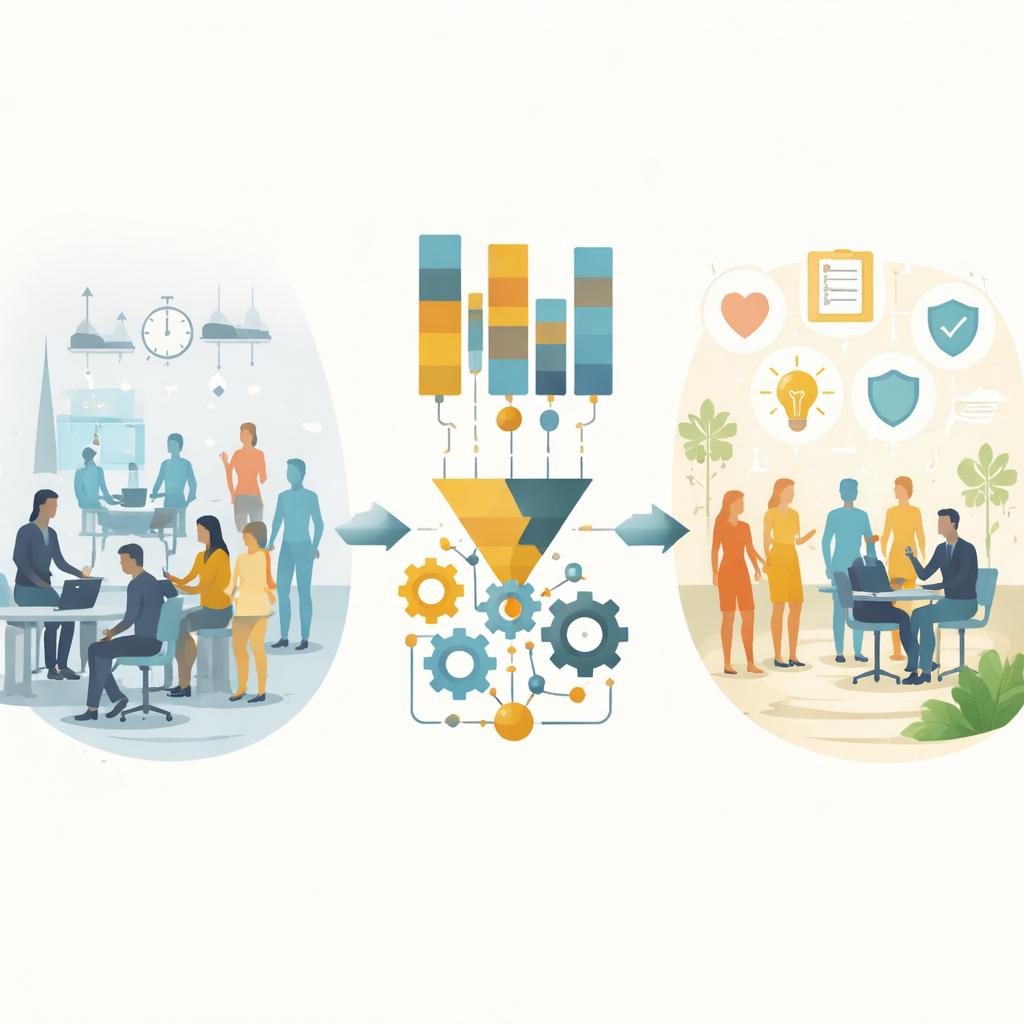
Looking beneath the surface of stress at work
The researchers started with a large, widely cited survey of employees—mainly from the tech industry—that asked about mental health history, treatment, workplace culture, and company policies. Instead of focusing on single questions, they treated each person’s full set of answers as a snapshot of their working life. Key topics included whether people knew about mental health resources, how easy it was to take leave, if they felt safe talking to bosses or coworkers, and whether mental or physical health was taken more seriously. Demographic details like age and location were set aside so that the analysis could focus clearly on the conditions inside workplaces that shape everyday well-being.
Turning survey responses into patterns
To make sense of this rich but messy information, the team used an approach called association rule mining, powered by an efficient algorithm known as ECLAT. In simple terms, the method looks for combinations of answers that appear together again and again across many employees—for example, people who say their work is often disrupted by mental health issues and also report having sought treatment. Each person’s survey answers are encoded as small building blocks, and the algorithm scans the entire dataset to find which blocks frequently cluster together. Because ECLAT works with a compact, vertical view of the data, it can search through thousands of possible combinations quickly while still keeping the results easy to interpret.
What the hidden links reveal about the workplace
The discovered patterns paint a nuanced picture of how mental health and workplace design interact. Employees who report that mental health often interferes with their work are, unsurprisingly, more likely to have sought treatment—but they are also more commonly found in organizations that do not discuss mental health in wellness programs or job interviews. In contrast, workers at tech companies more often report not seeing negative consequences for colleagues with mental health issues, hinting at a somewhat safer climate for disclosure. Strong links also emerge between knowing that wellness programs and benefits exist and actually seeking help: when support structures are visible and trusted, employees are notably more likely to use them. At the other extreme, those unsure whether their use of mental health services would remain anonymous tend to stay silent, especially in formal settings like interviews.
Measuring which links truly matter
Not all patterns are equally important, so the study evaluates each discovered relationship using three simple ideas: how common it is, how reliably one response follows another, and whether the pair shows up together more often than chance would suggest. Through this lens, some of the strongest relationships involve access to benefits, wellness programs, and company size. Larger organizations that offer clear mental health benefits and structured wellness programs are more likely to have employees who seek help. Smaller companies, and workplaces with weak supervisor or coworker support, more often lack such benefits and see fewer signs of open discussion. When the researchers compared ECLAT to other popular methods, they found it uncovered the same key patterns but with far less computing time and memory, making it practical for regular use by organizations.

From data clues to better everyday work life
For non-specialists, the message of this study is direct: employee surveys hold powerful clues about how work either protects or harms mental health, but those clues sit in the combinations of answers, not in single questions. By using fast pattern-mining tools like ECLAT, organizations can discover which mixes of policies, culture, and support—such as visible wellness programs, real benefits, and trustworthy privacy—go hand in hand with healthier workers. While the data in this study are from before recent changes in how we work, the method itself can be plugged into any modern survey. Used wisely, it can guide concrete steps to build workplaces where people feel safer to seek help, experience less hidden strain, and are better able to do their best work.
Citation: Ullah, A., Ashraf, S., Aldakheel, E.A. et al. ECLAT based association rule mining for advancing workplace mental health and organizational insights. Sci Rep 16, 14090 (2026). https://doi.org/10.1038/s41598-026-41702-0
Keywords: workplace mental health, employee surveys, data-driven HR, association rule mining, organizational well-being