Clear Sky Science · en
Dynamics of a discrete-time predator-prey model with exponential prey growth and saturated response
Why nature’s boom-and-bust cycles matter
Why do some animal populations rise and fall like clockwork, while others seem to swing wildly or even collapse without warning? This paper explores that puzzle using a stripped‑down mathematical world where hunters and their prey interact in discrete breeding seasons. By carefully tuning just a few knobs in the model, the authors show how an ecosystem can glide from steady balance into rhythmic booms and busts, and finally into full‑blown chaos—offering insight into why managing real populations, from fisheries to pests, can be so difficult.
Building a simple world of hunters and hunted
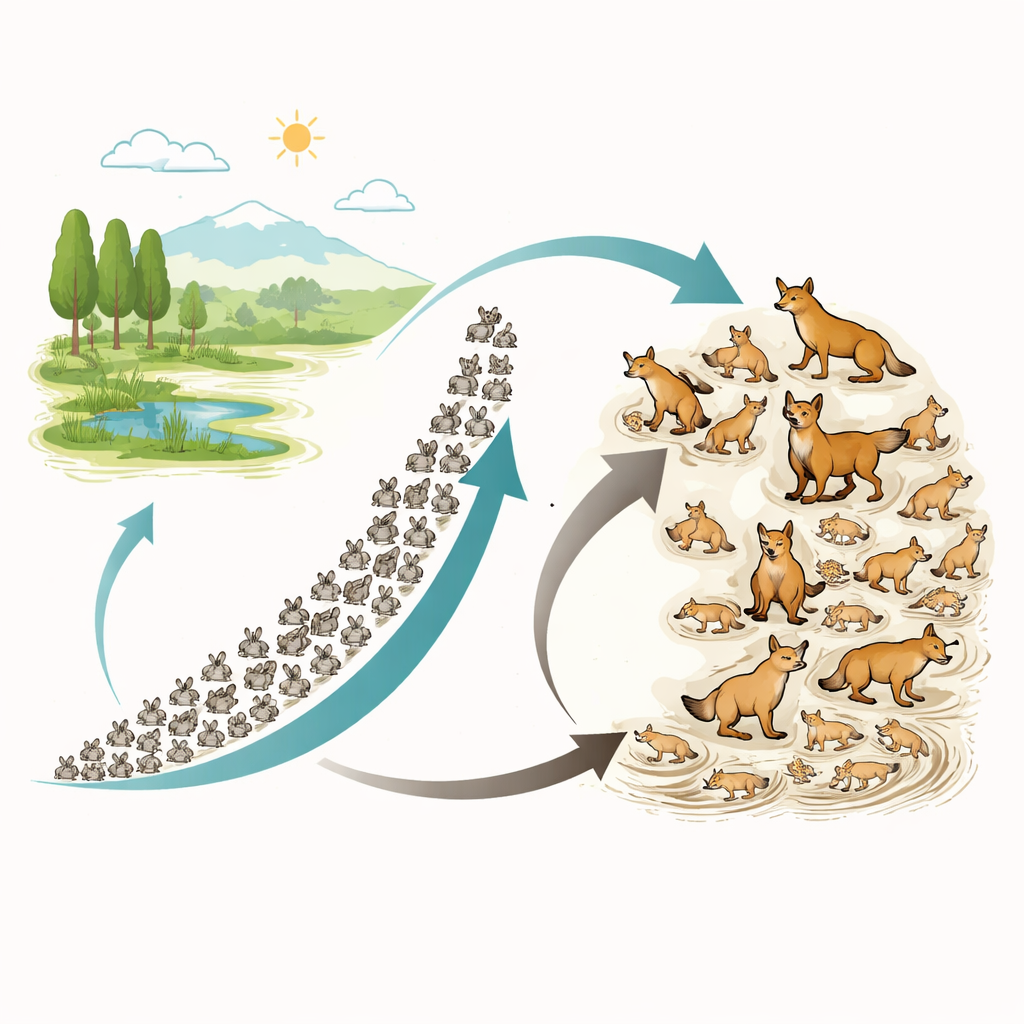
The authors study a predator–prey system in which time advances in steps, like years or breeding seasons, rather than as a smooth flow. The prey are allowed to grow almost exponentially when predators are scarce, mimicking species that can suddenly thrive when conditions are good. This is captured by what mathematicians call the Ricker map, which lets the prey population overshoot and then swing back toward an average level. Predators, in turn, eat the prey following a "saturated" feeding rule: when prey are rare, each extra prey helps predators a lot, but when prey are plentiful, predators become limited by how quickly they can handle each catch. This saturation, long recognized in ecology, is encoded through what is known as a Holling type II response.
Finding the points where everything balances
With these ingredients, the model can settle into special states where population sizes no longer change from one step to the next. One such state is total extinction, where both predator and prey vanish. Another is coexistence, where both survive at steady levels. The authors first determine when these states exist and whether they are stable. By examining how small disturbances grow or fade near each equilibrium, they identify parameter ranges where extinction is unavoidable and others where both species can persist. This analysis relies on the mathematical properties of the underlying equations but has a clear ecological message: survival or collapse can hinge sensitively on the prey’s intrinsic growth rate, the strength of predation, and the predators’ natural death rate.
When steady balance gives way to cycles and spirals
Beyond these steady states, the model reveals a rich landscape of dynamical behavior. As the prey growth rate is increased, the coexistence equilibrium can lose stability in two distinct ways. In one route, called a period‑doubling bifurcation, a formerly steady population begins to oscillate between two values, then four, then eight, ultimately leading to chaotic swings where long‑term prediction becomes nearly impossible. In another route, the system undergoes a Neimark–Sacker bifurcation: instead of settling at a point, population levels circle around it on a closed loop, creating persistent cycles whose shape and size depend on model parameters. The authors use phase portraits—plots of predator versus prey abundance—to visualize these transitions, and compute Lyapunov exponents to confirm when the dynamics truly become chaotic.

Simulated worlds that mirror complex ecosystems
Numerical experiments show how these theoretical transitions play out for different choices of parameters. For some settings, predator and prey approach a calm coexistence; for others, they trace out neat loops, then more tangled shapes, and finally erratic patterns typical of chaos. Bifurcation diagrams—which track long‑term population values as parameters are varied—reveal bands of stability interwoven with windows of chaotic behavior. These results underscore a key feature of nonlinear ecological systems: tiny changes in growth rates or interaction strengths can push populations from predictable regimes into highly sensitive ones, where small differences in starting conditions amplify dramatically over time.
What this means for understanding and managing nature
In accessible terms, the study shows that even a relatively simple predator–prey setup can naturally generate a spectrum of behaviors, from stable coexistence to wild, seemingly random swings. Because such patterns emerge from basic rules about growth, feeding saturation, and mortality, they suggest that real ecosystems may be inherently hard to foresee over long time spans. For conservationists and resource managers, this means that focusing on how strongly species interact and how fast they reproduce can be crucial. While the model deliberately leaves out many real‑world complications, it provides a clear framework for thinking about how modest shifts in environmental conditions or management practices might tip a system from balance into instability—and why keeping populations within safe parameter ranges could be vital for sustaining both predators and their prey.
Citation: Emam, H.H., El-Metwally, H. & Hamada, M.Y. Dynamics of a discrete-time predator-prey model with exponential prey growth and saturated response. Sci Rep 16, 9662 (2026). https://doi.org/10.1038/s41598-026-41693-y
Keywords: predator-prey dynamics, population cycles, chaos in ecology, discrete-time models, bifurcation analysis