Clear Sky Science · en
Regulating female ear morphogenesis in maize by uniconazole and 5-aminolevulinic acid for yield improvement
Why maize ears matter for food on the table
For farmers and consumers alike, the way a corn ear grows can mean the difference between a bumper harvest and a disappointing yield. This study explores whether carefully timed sprays of two plant regulators can subtly reshape the female ear of maize—changing its length, thickness and kernel number—and in doing so, help produce more grain without planting more land or using heavier fertilizer.

Two different helpers for the corn plant
The researchers focused on two widely used products that act in opposite ways on plant growth. Uniconazole (UCZ) is a growth retardant: it slows vertical growth and is often used to make stems sturdier. 5-aminolevulinic acid (ALA) is a gentle growth promoter that supports photosynthesis and organ development. Working in field trials in Northeast China, the team sprayed these compounds on two popular maize hybrids at a specific stage—when the plants had 12 leaves, just before flowering—then tracked how ear shape, internal chemistry and final yield responded.
How ear shape changed with treatment
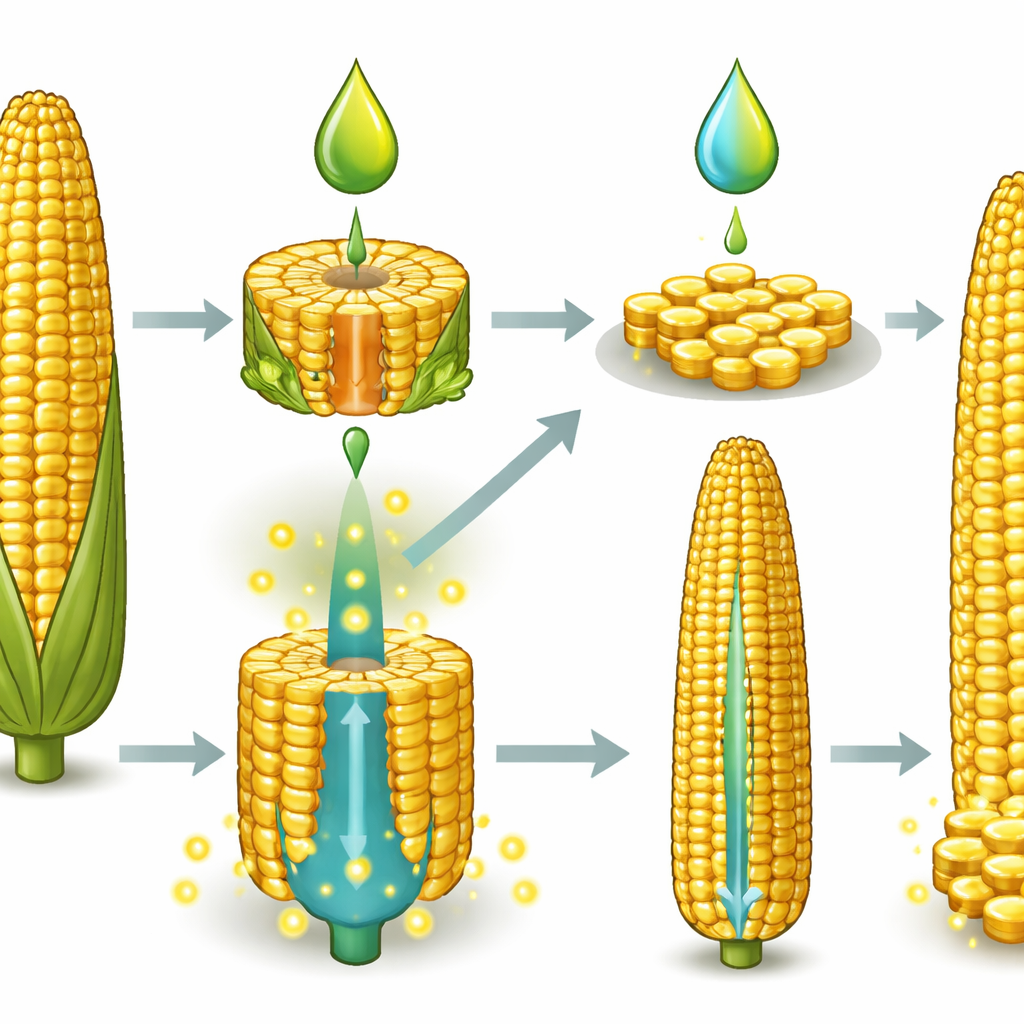
Careful measurements from just before silking to two weeks afterward showed that UCZ and ALA gave maize ears very different “body types.” UCZ shortened the ears but made them noticeably thicker, increasing both ear and cob diameter. ALA, by contrast, stretched the ears, producing longer cobs without much change in thickness. These shape shifts translated into different ways of packing kernels: UCZ mainly boosted the number of kernel rows around the cob, whereas ALA mainly increased the number of kernels along each row. In both cases, the total kernels per ear rose, and so did ear weight.
Hidden changes in plant hormones and energy stores
Behind these visible differences lay a coordinated reshaping of the plant’s internal signals and fuel supply. UCZ reduced levels of the growth-promoting hormones auxin and gibberellin, which are known to favor elongation, and raised levels of abscisic acid, which tends to slow growth. At the same time, it strongly increased a cytokinin-type hormone associated with cell division, especially in the cob, and was linked to greater radial expansion. ALA pushed hormone balances in the opposite direction: it raised auxin and gibberellin and lowered abscisic acid, favoring lengthwise growth of the ear while also elevating cytokinin. Both treatments enriched the ears in simple sugars and other non-structural carbohydrates that provide energy and building blocks for fast-growing tissues.
Building the cob’s backbone and filling it with fuel
The team also examined the cob’s supporting framework—cellulose, hemicellulose and lignin—and the starch and sugars that move through it. Structural carbohydrates were positively related to ear size and cob thickness. UCZ tended to increase these materials, reinforcing the cob and contributing to its greater diameter. ALA sometimes lowered their concentration at specific stages, likely because it accelerated cob elongation faster than the framework could thicken, effectively diluting the structural content per unit length. Meanwhile, both regulators increased starch, sucrose and soluble sugars in the ear. Early on, starch built up; later, as ears filled and kernels developed, much of this starch was broken down into sugars, feeding rapid growth and kernel formation.
What this means for farm yields
Across two growing seasons, both UCZ and ALA increased maize grain yield by about 7–14 percent compared with untreated plants, with no need for extra land or seed. UCZ did so by producing shorter, thicker ears with more kernel rows, while ALA produced longer ears with more kernels in each row. In plain terms, the study shows that thoughtfully tweaking the plant’s own growth signals can nudge ear shape in different directions, each leading to more kernels and heavier ears. These contrasting pathways offer farmers and crop advisers a more precise way to match growth regulators to local conditions and variety choice, potentially raising food production while keeping input use in check.
Citation: Xu, L., Wang, H., Huang, X. et al. Regulating female ear morphogenesis in maize by uniconazole and 5-aminolevulinic acid for yield improvement. Sci Rep 16, 13848 (2026). https://doi.org/10.1038/s41598-026-41685-y
Keywords: maize yield, ear development, plant growth regulators, uniconazole, 5-aminolevulinic acid