Clear Sky Science · en
Streamlined spectroscopic assay for besifloxacin: A one-pot approach evaluating drugs in eye drops and aqueous humor samples based on fluorescent isoindole generation. Comprehensive evaluation of whiteness, and blueness
Why measuring eye medicine really matters
Eye infections are common, and doctors often rely on powerful antibiotic drops to save sight and keep surgery safe. One of these drugs, besifloxacin, is especially good at fighting tough bacteria on the eye. But to be sure that every bottle of drops, and even the tiny amounts of drug reaching the eye’s internal fluid, are safe and effective, scientists need fast, accurate, and affordable ways to measure it. This study presents a simple light-based test that can track besifloxacin in eye drops and eye-like fluids while also being kinder to the environment than many older laboratory methods. 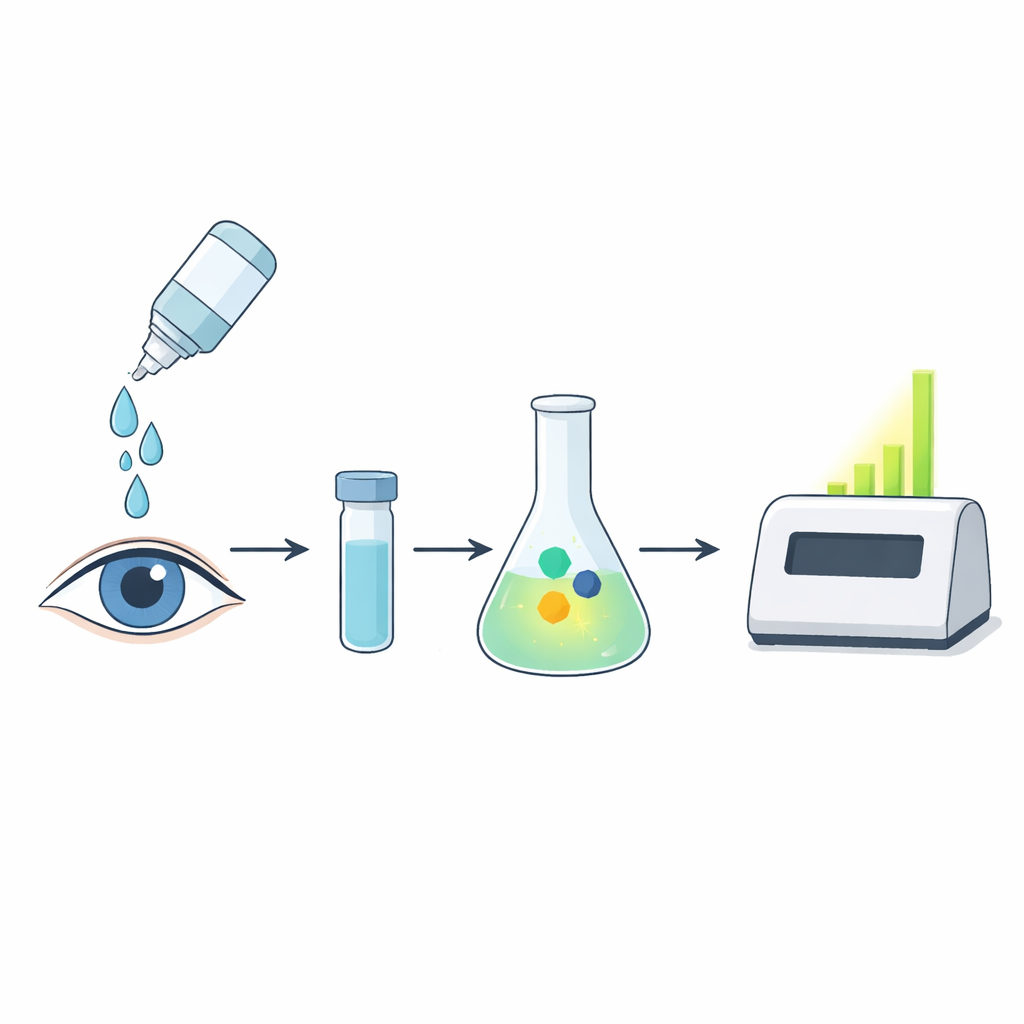
Turning an invisible medicine into a glowing signal
Besifloxacin itself does not glow strongly enough under light to be measured at the extremely low levels doctors care about. The researchers solved this by attaching the drug to a helper chemical called o-phthalaldehyde, with a small sulfur-containing molecule assisting the reaction. When these three meet in a slightly basic solution, the drug is transformed into a new structure that shines brightly when excited by ultraviolet light. The team carefully chose the colors of light used: one wavelength to excite the product and another where its glow is strongest. The brighter the glow, the more besifloxacin is present, allowing the amount of drug to be read out simply by measuring light intensity.
Fine-tuning a one-pot eye-drop test
To make this approach practical, the scientists optimized every step so that the reaction would be reliable and easy to run in an ordinary quality-control lab. They adjusted the solution’s alkalinity, the amount of buffering salts, and the volumes of both reagents to find the combination that produced the most stable glow. They also compared common solvents, discovering that methanol gave the strongest and most consistent signal. Finally, they tested how long the mixture needed to react and found that waiting about fifteen minutes was enough for full brightness. Because everything happens in a single small flask with no heating and no extraction steps, the procedure is quick and straightforward. 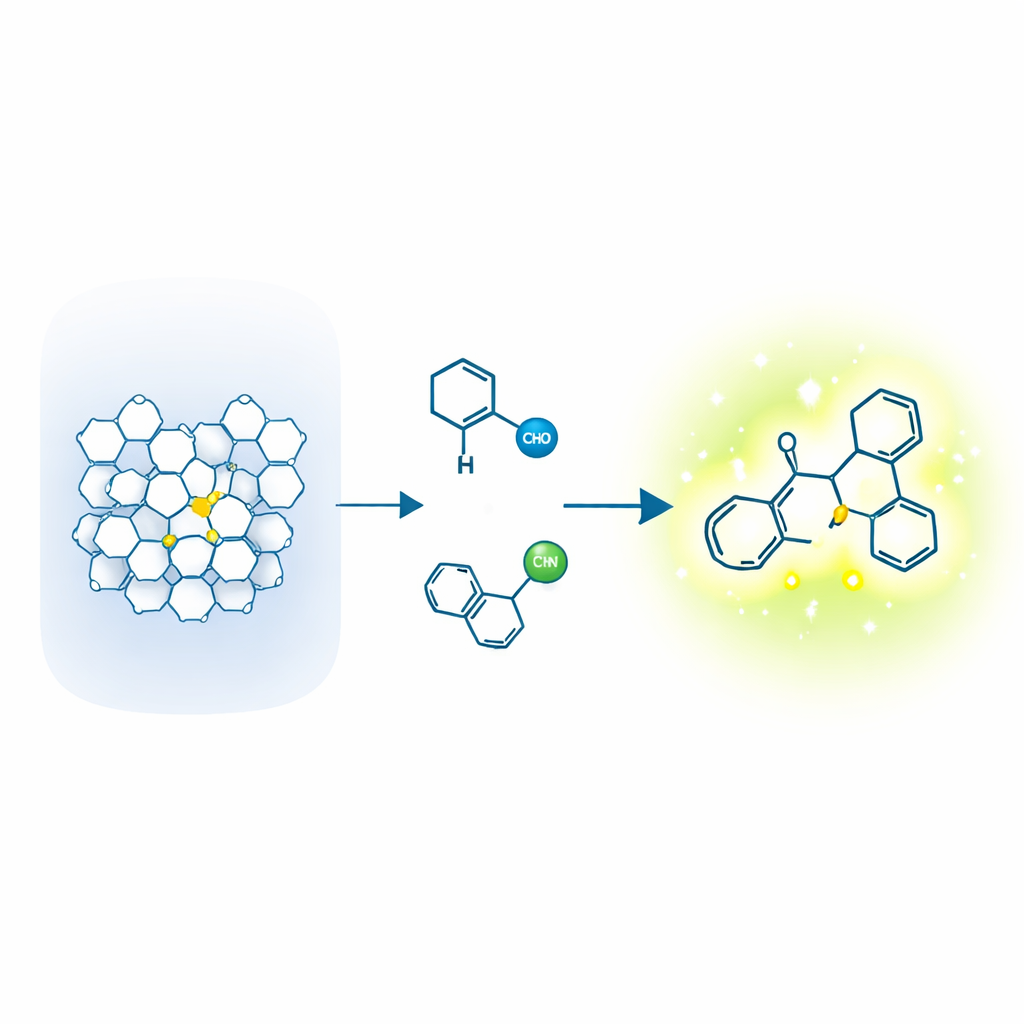
Checking performance in real-world samples
Once the conditions were set, the team validated the test using international guidelines that laboratories rely on to judge new methods. They showed that the glow increased in a straight line over a wide range of drug levels, from extremely low to much higher concentrations. The smallest detectable and reliably measurable amounts were in the low nanogram per milliliter range, meaning the method can see trace quantities of drug. When they applied the method to commercial besifloxacin eye drops, the results matched a previously published technique with no meaningful differences in accuracy or precision. The test also worked well in artificial aqueous humor, a laboratory-made fluid that mimics the liquid inside the front of the eye, even after the fluid was heavily diluted to reduce interference.
Greener and more practical laboratory work
Modern analytical chemistry is not only about accuracy; it also aims to reduce waste, energy use, and cost. To evaluate how their method performs on these fronts, the authors used two newly developed rating systems known informally as “whiteness” and “blueness” tools. These frameworks score methods on credibility, environmental impact, practicality, and overall usefulness. The besifloxacin test earned high marks, reflecting its small reagent volumes, avoidance of harsh organic solvents, moderate energy demands, and suitability for routine work without expensive instruments or complex sample preparation. In other words, it is both scientifically sound and operationally friendly.
What this means for patients and laboratories
In everyday terms, this study introduces a glow-based laboratory test that can quickly and reliably measure how much besifloxacin is present in eye drops and eye-like fluids, using a simple one-pot chemical reaction. It reaches very low detection levels, stands up well against established techniques, and does so while using fewer resources and generating less chemical waste. Although further work is needed to prove its performance in undiluted human eye fluids, the method already offers a promising, cost-effective tool for quality control and research. Ultimately, such streamlined testing helps ensure that the medicines touching our eyes are both potent and safe, while laboratories move toward cleaner and more sustainable practices.
Citation: Abu-hassan, A.A. Streamlined spectroscopic assay for besifloxacin: A one-pot approach evaluating drugs in eye drops and aqueous humor samples based on fluorescent isoindole generation. Comprehensive evaluation of whiteness, and blueness. Sci Rep 16, 13032 (2026). https://doi.org/10.1038/s41598-026-41683-0
Keywords: besifloxacin, eye drops, fluorescence assay, green analytical chemistry, ophthalmic antibiotics