Clear Sky Science · en
Tuning refractive indices in nematic liquid crystal via nanoparticles coupling
Why tiny additives can reshape light
Modern screens, smart windows, and optical sensors all rely on materials that can steer light on command. This study explores how sprinkling extremely small particles—nanoparticles—into a common liquid crystal can fine-tune how it bends and transmits light, and how stable it remains as the temperature changes. The work shows that just the right amount of the right particles can make these materials more powerful and reliable for future photonic technologies.
Liquid crystals as steerable light fluids
Liquid crystals are unusual substances that flow like a liquid but keep some of the orderly structure of a crystal. Because their rod-shaped molecules tend to point in the same direction, light moving through them “sees” different refractive indices depending on its direction, a property known as optical anisotropy. This directional response underpins LCD screens and many tunable lenses and filters. However, the way these refractive indices change with temperature, and how strongly the molecules stay aligned, sets strict limits on device performance, especially when conditions fluctuate.
Adding smart nanoparticles to the mix
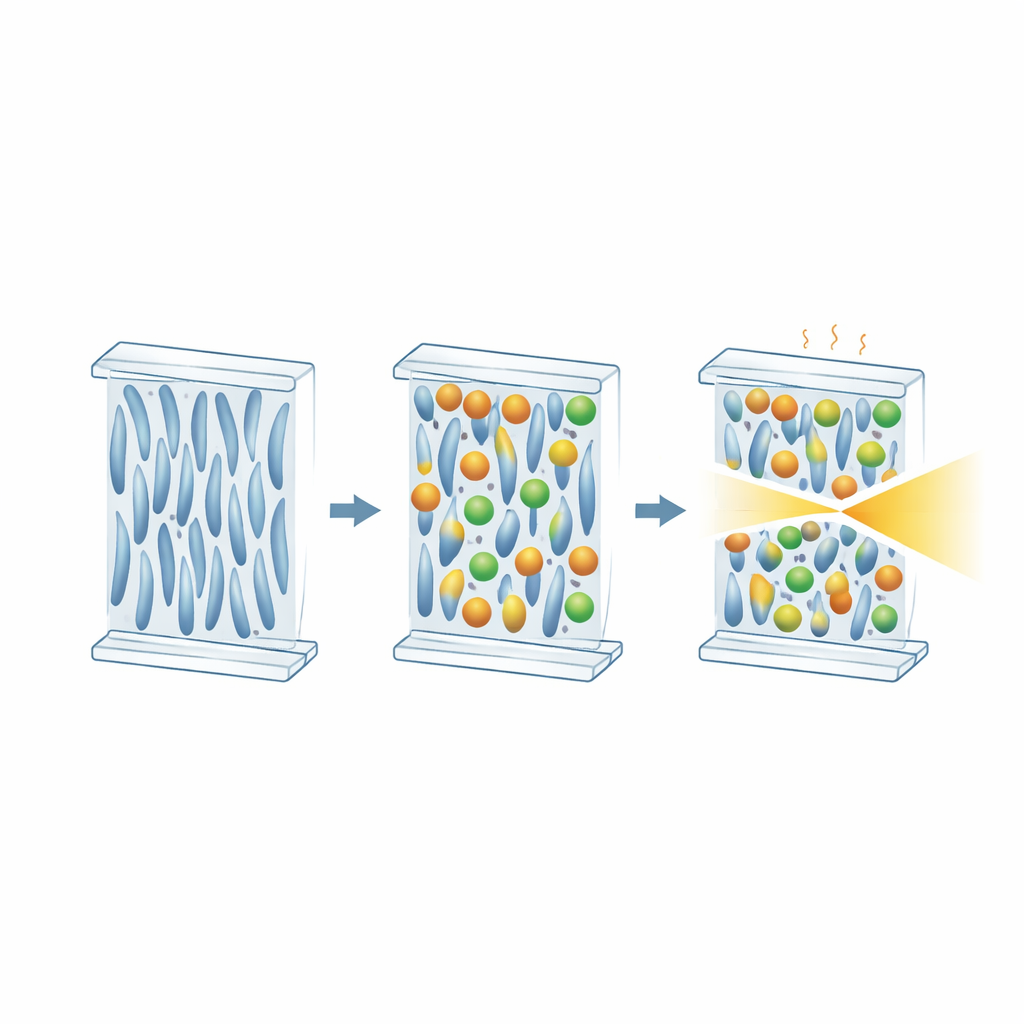
The researchers started with a widely used liquid crystal blend called E7 and added two kinds of functional nanoparticles in tiny weight percentages: ferroelectric barium titanate (BaTiO₃) and multiferroic bismuth ferrite (BiFeO₃). These particles carry strong internal electric (and for BiFeO₃, also magnetic) polarizations, which can influence nearby liquid crystal molecules. By carefully dispersing the nanoparticles and controlling their concentration from 0.1 to 0.5 percent by weight, the team measured how the material’s ordinary and extraordinary refractive indices changed with temperature, and from these, how the internal molecular order evolved.
Finding the sweet spot for better light control
Measurements showed that temperature affects all samples in a characteristic way: one refractive index decreases steadily as the material warms, while the other slightly rises, until both merge at a transition point where the liquid crystal loses its directional ordering. Doping with BaTiO₃ did not simply boost the indices in step with concentration. Instead, there was a clear optimum around 0.2 to 0.4 percent by weight, where the alignment of molecules and the difference between the two indices were maximized. At these low concentrations, the nanoparticles remain well dispersed and their surfaces encourage neighboring liquid crystal molecules to line up more tightly, strengthening the material’s ability to steer light and slightly stabilizing the ordered phase against heating.
When too much of a good thing breaks the order
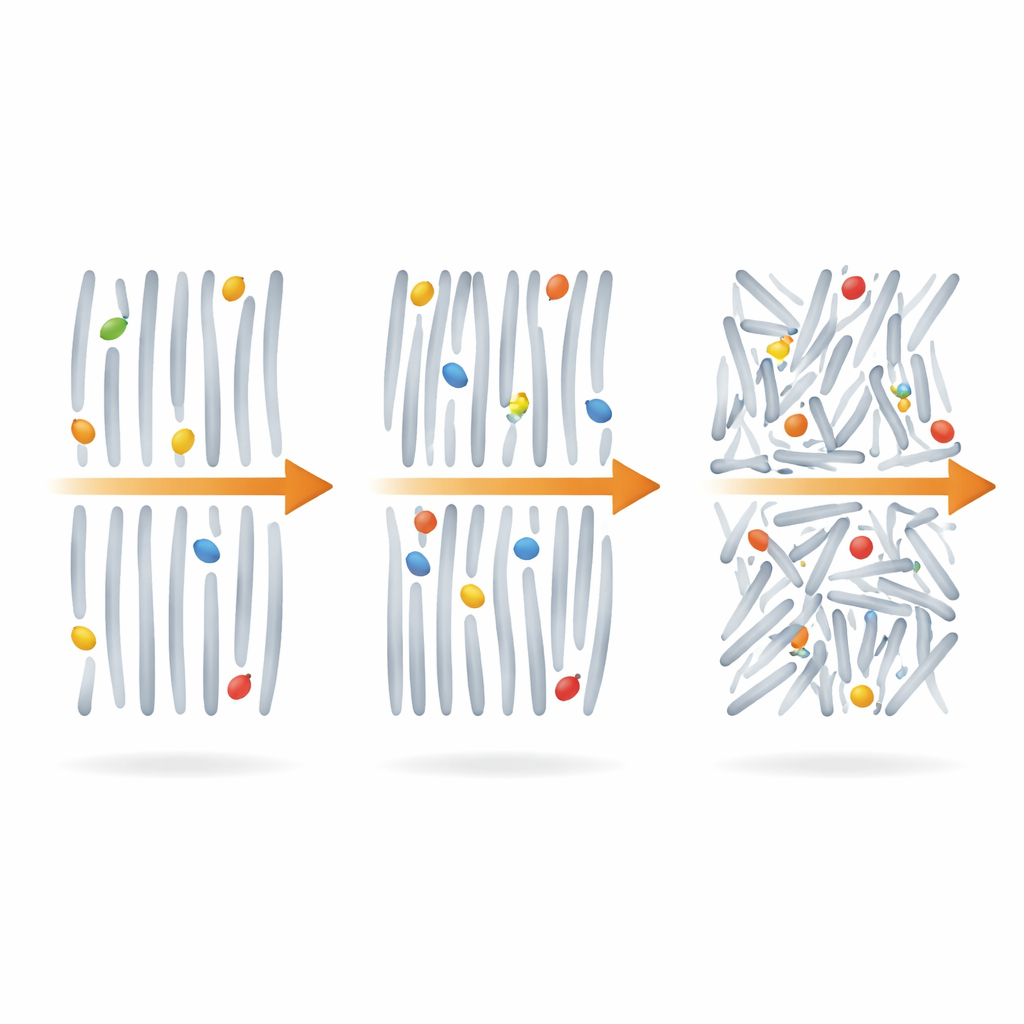
Beyond this optimum, more nanoparticles became counterproductive. Microscopy images and optical data indicated that, at higher loadings, the particles start to clump together, creating defects and distortions in the otherwise smooth molecular alignment. This aggregation weakens long-range order, lowers the useful difference between the refractive indices, and enhances light scattering. For BiFeO₃, even modest concentrations tended to reduce this optical contrast, though they improved how well the material preserved its structure with temperature, likely thanks to the combined electric and magnetic effects at the interfaces between particles and liquid crystal.
Probing internal order with light
To quantify how orderly the molecules were, the authors used three established optical models that relate refractive indices to an orientational “order parameter.” All three approaches, despite relying on different mathematical viewpoints, painted a consistent picture: both types of nanoparticles can increase molecular order when added in small amounts, with the strongest and most reliable enhancement around 0.2 percent by weight. The study also showed how key fitting parameters that describe the sharpness of the thermal transition track with the level of order, reinforcing the link between microscopic alignment and macroscopic optical behavior.
What this means for future devices
In plain terms, the work demonstrates that nanoparticles behave like tiny organizing agents when used sparingly, tightening the alignment of liquid crystal molecules and giving designers more precise control over how light is bent and modulated. But if too many are added, these same particles turn into disruptors, breaking up the orderly structure they once improved. The findings offer clear guidelines: to build more robust, temperature-stable displays, lenses, and optical switches, engineers should focus not just on which nanoparticles to use, but on dispersing them uniformly and keeping their concentration within a narrow, optimized range.
Citation: Beigmohammadi, M., Khadem Sadigh, M. & Mahiny, M. Tuning refractive indices in nematic liquid crystal via nanoparticles coupling. Sci Rep 16, 11767 (2026). https://doi.org/10.1038/s41598-026-41680-3
Keywords: liquid crystals, nanoparticles, optical materials, birefringence, photonic devices