Clear Sky Science · en
Constraint optimization and key factor analysis based vehicle emergency braking strategy generator
Why Faster, Smarter Braking Matters
When a car in front stops suddenly or a child runs into the street, every fraction of a second—and every meter of road—can be the difference between a close call and a crash. Modern vehicles already use computers to manage emergency braking, but those systems still leave room for improvement, especially on changing or slippery roads. This study explores a new way to teach cars how to brake harder and smarter using data-driven methods, cutting stopping distance while keeping the vehicle stable and meeting strict real‑time limits.
From Test Track to Virtual World
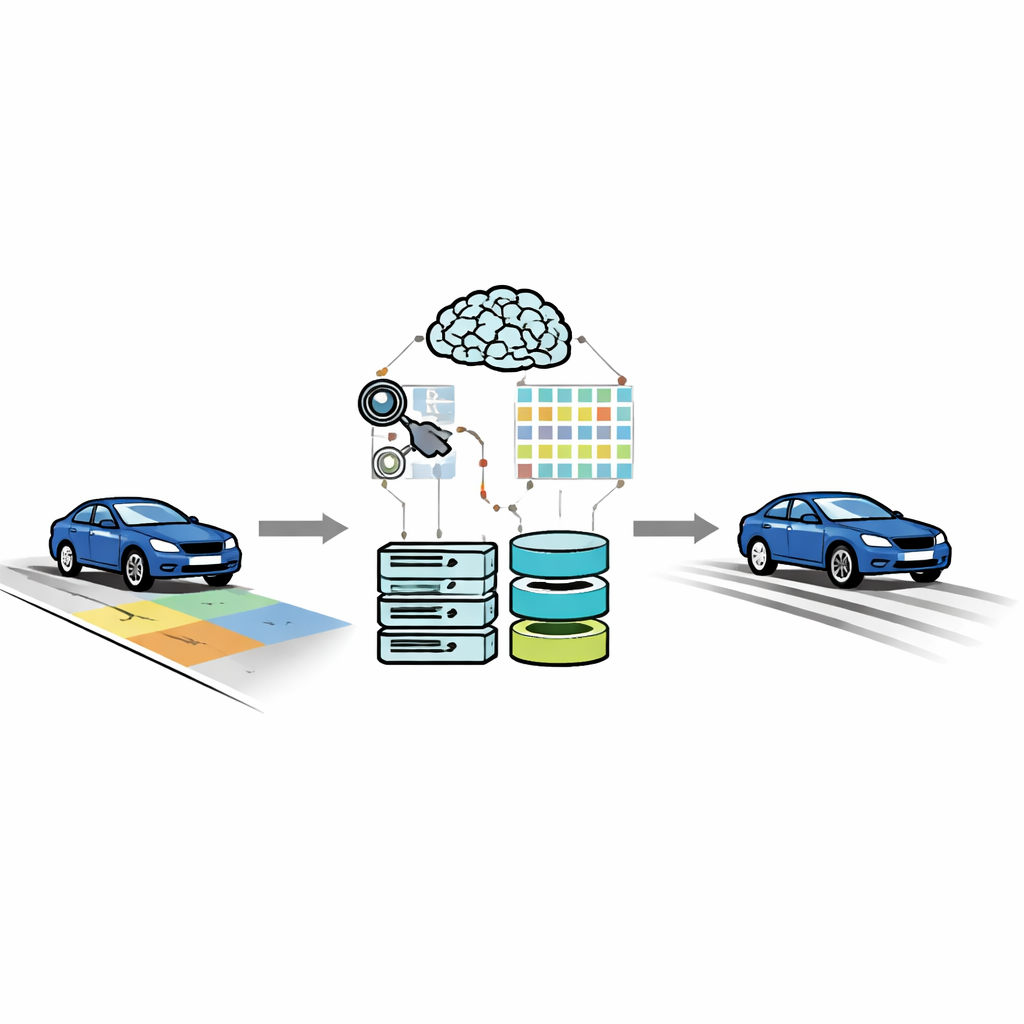
Instead of experimenting only on real roads, the researchers built a rich virtual test ground using professional vehicle simulation software. They created thousands of emergency braking scenarios that varied vehicle type, speed, tire properties, and road grip. During each simulated emergency stop, they recorded hundreds of measurements describing the car, its wheels, and the road, along with how quickly the car slowed down and how much it tended to skid sideways. This large, carefully cleaned dataset became the foundation for training and testing new braking strategies.
Finding What Really Matters
A car’s behavior under hard braking is influenced by hundreds of factors, but not all are equally important. Extra, weakly related inputs slow down onboard computers and can confuse learning algorithms. To cut through this complexity, the team designed a “key factor analysis” procedure. They trained a neural network to predict forward and sideways acceleration from all the recorded signals, then tested what happened when they artificially removed one input at a time. If prediction errors rose sharply, that input was tagged as important. By keeping only these influential signals—and a few closely related ones—they shrank the input list from 447 down to 92, actually improving prediction accuracy while reducing the data that must be processed inside the car.
Turning Data into Better Braking
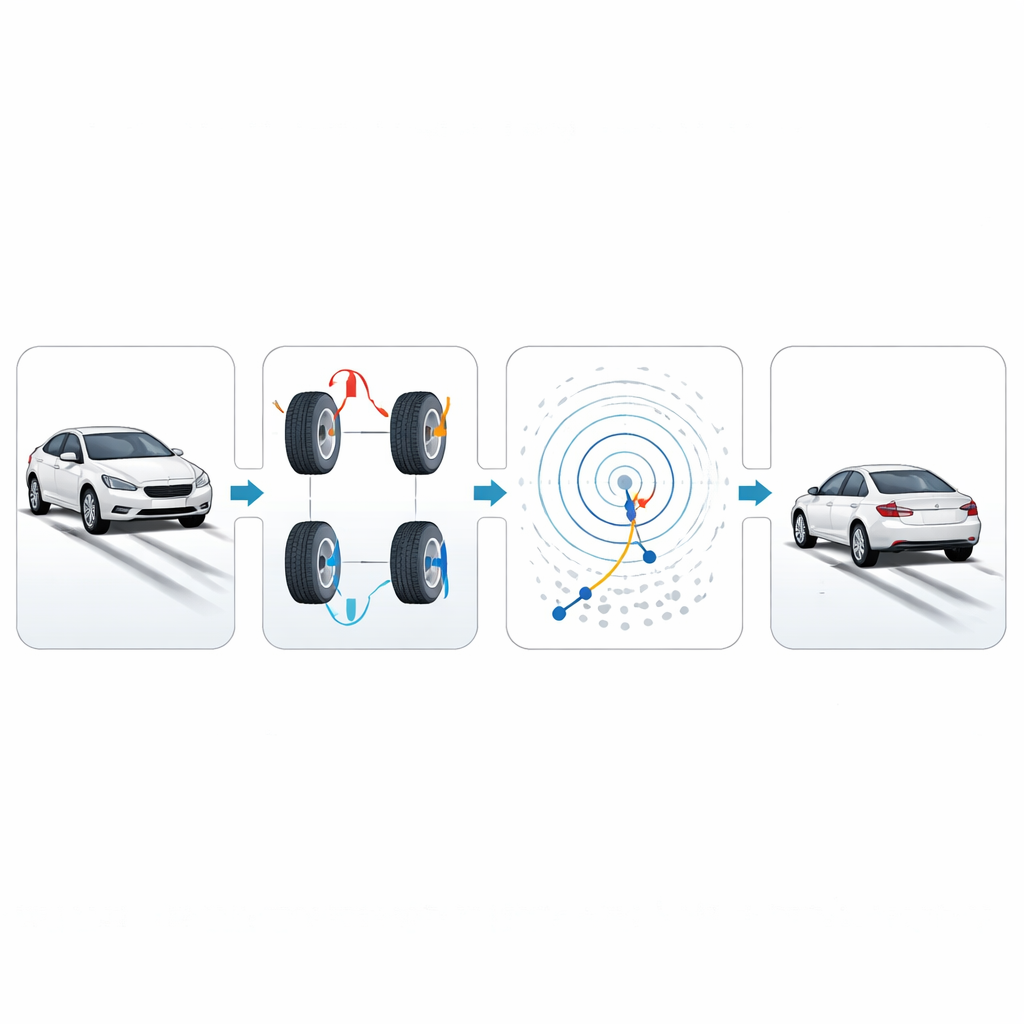
With the essential factors identified, the next step was to use them to improve how the brakes are applied. The team focused on eight core quantities that capture how strongly each of the four wheels is braked and how much each one slips against the road. Using their trained neural network as a fast “virtual car,” they repeatedly adjusted these eight values for every recorded situation, searching for a combination that would increase forward deceleration without making the car unstable. Safety rules—such as limits on total grip between tire and road, and bounds on sideways acceleration—were built directly into this search, so any proposed strategy that risked skidding or loss of control was rejected or heavily penalized. This process produced an optimized braking plan for each scenario, forming a new database of high‑performance, physically realistic emergency stops.
Instant Decisions from Past Experience
Emergency braking leaves no time for slow calculations. Many advanced learning methods need more than a hundredth of a second to process sensor data and decide what to do, which is too sluggish for the tight timing of existing vehicle controllers. To overcome this, the researchers built a “strategy generator” that, instead of computing a fresh answer from scratch, searches the optimized database for the most similar past situation. Using an efficient tree‑like structure, the system can locate the closest match among tens of thousands of examples in less than a thousandth of a second. It then reuses the corresponding wheel‑by‑wheel braking pattern, with only slight adjustments, giving the car an emergency response that is both fast and based on proven successful behavior.
What This Means on the Road
In head‑to‑head comparisons inside the simulator, the new generator produced braking patterns that increased average forward deceleration by about 13 percent compared with a widely used control method based on traditional vehicle physics models. Under typical conditions, that improvement translates into roughly an 11 percent reduction in stopping distance for the same initial speed, while keeping sideways motion within safe bounds. Just as important, the system meets strict real‑time demands, responding far faster than both conventional machine‑learning controllers and many current predictive control schemes. Although the work was done in simulation and focuses only on the car’s current state, it points toward a future in which vehicles can draw on large libraries of optimized experience to react to sudden danger more quickly and confidently, potentially preventing crashes that today would be unavoidable.
Citation: Xu, R., Xu, S., Jiang, P. et al. Constraint optimization and key factor analysis based vehicle emergency braking strategy generator. Sci Rep 16, 11268 (2026). https://doi.org/10.1038/s41598-026-41679-w
Keywords: emergency braking, vehicle safety, machine learning, autonomous driving, brake control