Clear Sky Science · en
A multi-step short-term photovoltaic power prediction model based on an improved whale migration algorithm
Why predicting solar power matters
As more homes, businesses, and cities turn to solar energy, knowing how much power solar panels will produce in the next few minutes or hours becomes critical. If the forecast is wrong, grid operators must scramble to keep the lights on, wasting money and sometimes fossil fuel. This paper presents a smarter way to make short-term predictions of solar power output that is both more accurate and more stable than many existing methods.
Solar power’s ups and downs
Solar panels are at the mercy of the weather. Passing clouds, haze, seasonal shifts, and sudden storms make the power they generate jump up and down in complex ways. Traditional forecasting tools either rely heavily on simplified physical models of solar panels or on past data alone. Physical models can miss real-world quirks, while purely statistical tools struggle when the data are noisy or highly irregular. As a result, they often perform poorly during fast changes in sunlight—exactly when operators most need reliable predictions.
Breaking a messy signal into cleaner parts
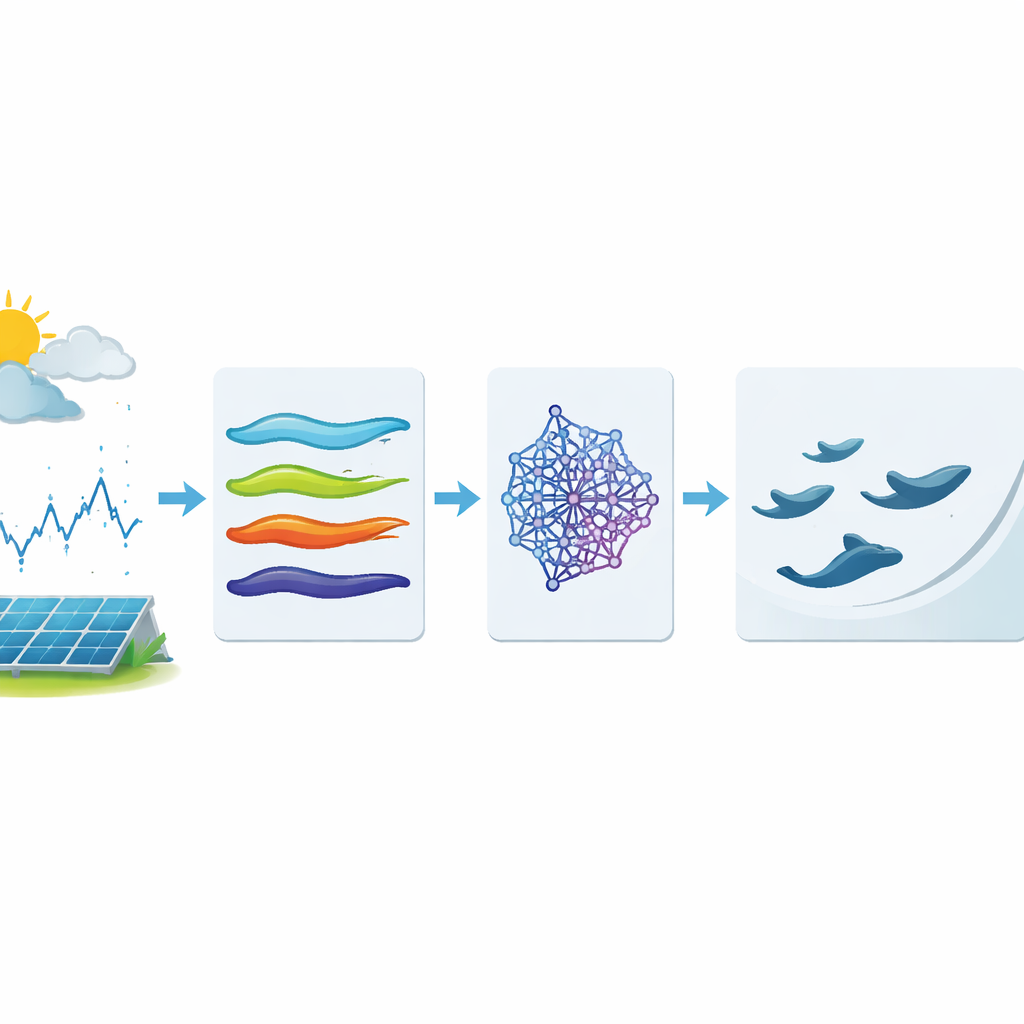
To tame this chaos, the authors first tidy up the raw solar power data before trying to predict it. They use a technique called variational mode decomposition, which splits the original, jagged power curve into several smoother components, each capturing patterns at different time scales. This separation reduces random noise and makes hidden regularities easier to see. Instead of forcing a model to learn from one tangled curve, the method feeds it a set of cleaner, more stable building blocks.
Letting machines learn patterns and tune themselves
Once the signal is decomposed, the study turns to a two-part learning system. The first part is a one-dimensional convolutional neural network, which excels at spotting local patterns and trends in time series data. The second part is a light-weight learning engine called a kernel extreme learning machine, which quickly turns those extracted patterns into numerical forecasts. Together, this hybrid model combines strong pattern recognition with fast, efficient prediction. However, its performance depends heavily on a few key internal settings, known as hyperparameters, which are usually hard to tune by hand.
Borrowing ideas from whale migrations to optimize the model
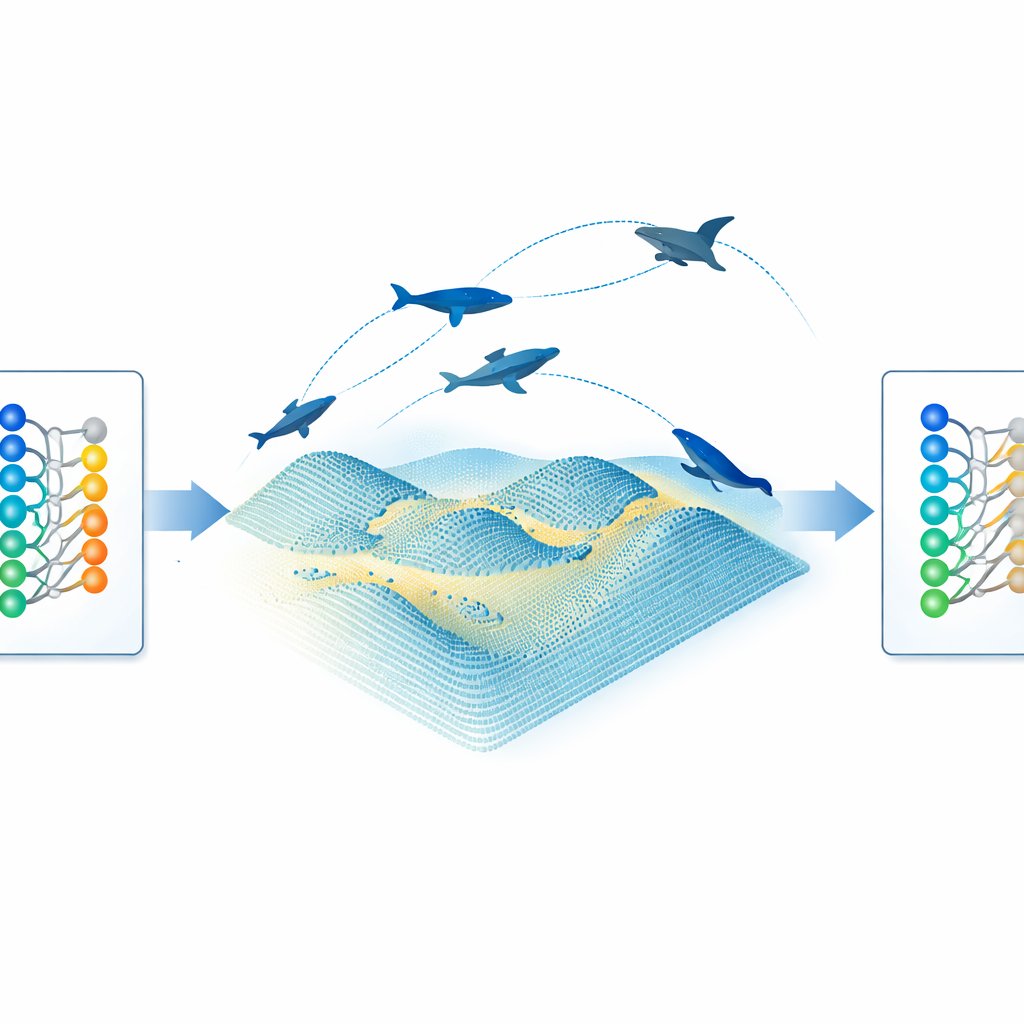
To automatically choose these crucial settings, the authors introduce an “improved whale migration algorithm.” Inspired by how humpback whales move in groups and explore the ocean, this algorithm treats each candidate set of hyperparameters like a whale searching for better feeding grounds. It uses a mix of broad exploration and fine-tuned local search, aided by controlled randomness and jump-like moves, to avoid getting stuck in poor solutions. Over many iterations, the “whales” migrate toward hyperparameter combinations that minimize prediction errors, effectively teaching the forecasting model how to tune itself.
Putting the method to the test
The team evaluates their full approach—combining signal decomposition, the hybrid learning model, and the whale-inspired optimizer—on real data from two solar power plants in China, one 50 MW and one 35 MW, covering both winter and summer periods. They compare it against nine alternatives, including standard neural networks, support vector machines, single-step predictors, and simpler hybrids. The new model not only tracks the overall daily curves but also follows sharp spikes and dips much more closely. Across several error measures, it consistently produces smaller mistakes and a tighter match to actual outputs, with goodness-of-fit values around 97% and 92% for the two sites.
What this means for everyday energy use
For non-specialists, the main takeaway is that the authors offer a more reliable “weather report” for solar power itself. By cleaning the data, using a lean but powerful learning setup, and letting a nature-inspired search routine fine-tune the system, they substantially improve the short-term forecast of how much electricity solar panels will deliver. Better forecasts make it easier to balance renewable and conventional sources, cut operating costs, and support a cleaner, more resilient power grid. The same strategy could also be adapted to other complex prediction problems, from wind power to industrial loads and even medical signal analysis.
Citation: Zhao, M., Wu, S. & Hu, Y. A multi-step short-term photovoltaic power prediction model based on an improved whale migration algorithm. Sci Rep 16, 10537 (2026). https://doi.org/10.1038/s41598-026-41673-2
Keywords: solar power forecasting, photovoltaic energy, machine learning, optimization algorithms, renewable energy grid