Clear Sky Science · en
Innovative Aboodh-based gractional analytical methods for nonlinear Burgers’ partial differential equations
Why new math tools matter for real-world waves
Many physical systems—from traffic jams and shock waves in air, to fluid flow in pipes—are described by equations that track how waves steepen, spread, and interact. A famous example is Burgers’ equation. When those systems have “memory,” meaning their current state depends on their past, the usual equations fall short. This paper introduces two advanced but efficient math tools that tackle such memory-rich systems, helping scientists and engineers get accurate solutions to complex wave problems that arise in physics, engineering, and even biology.

Equations with memory and why they are hard
Classical calculus uses whole-number derivatives to describe change. Fractional calculus extends this idea to non‑integer orders, letting equations capture long-term memory and nonlocal effects. For wave and flow problems, this leads to fractional versions of Burgers’ and KdV–Burgers equations, which better reflect reality but are also far harder to solve. Traditional numerical schemes can be slow, complicated, and may struggle with strongly nonlinear behavior. The authors focus on time‑fractional forms of these equations, using a popular way to define memory—the Caputo derivative—and ask: can we find fast, accurate, and mathematically controlled ways to approximate their solutions?
A new twist on transforms and power series
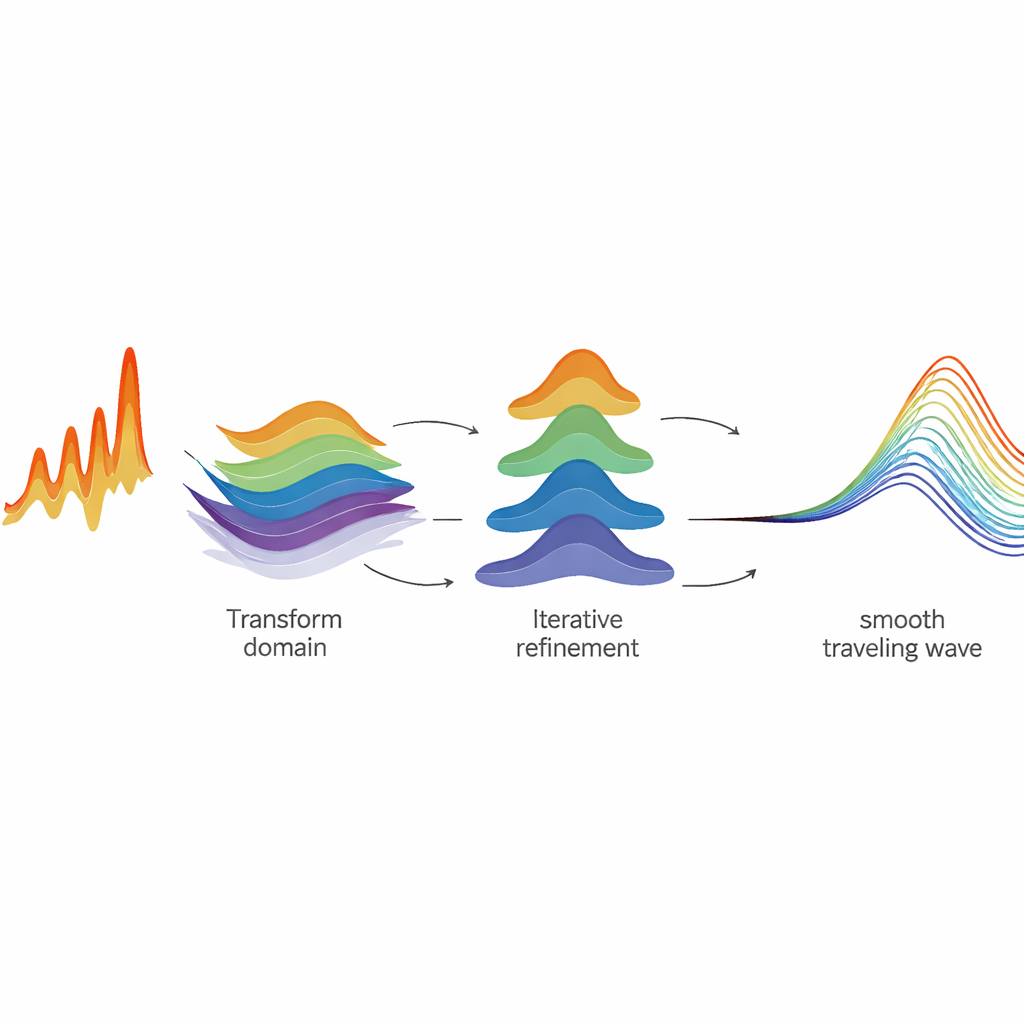
The core of the work is the use of the Aboodh transform, a relatively recent cousin of classic tools like the Laplace transform. When applied to the fractional Burgers‑type equations, it turns the original problem into algebraic expressions that have a very regular power‑series structure. This structure eliminates many of the messy convolution terms that usually plague nonlinear problems. Building on this, the authors design two complementary approaches. The Aboodh Residual Power Series Method (ARPSM) represents the transformed solution as a fractional power series and systematically adjusts the series coefficients so that the remaining error, or residual, shrinks in a controlled way. In parallel, the Aboodh Transform Iteration Method (ATIM) combines the same transform with an iterative correction scheme that refines an initial guess step by step.
How the methods are built and checked
The paper carefully develops the mathematical foundations needed to make these ideas precise. The authors prove how derivatives behave under the Aboodh transform, derive a tailored version of Taylor’s series in the transform domain, and show how to extract series coefficients from limits at infinity. They then define residual functions that measure how well a truncated series satisfies the transformed equation and prove that these residuals decay as more terms are added, ensuring convergence. Error bounds are given, showing that the approximation improves rapidly with each extra term, especially for moderate times and fractional orders between zero and one. This theoretical framework underpins both ARPSM and ATIM and guarantees that they do not just work numerically by accident.
Putting the methods to the test
To demonstrate practicality, the authors apply both approaches to two benchmark problems: a fractional KdV–Burgers equation, which combines wave steepening and dissipation, and a fractional Burgers equation, a standard model for shock‑like behavior. In each case, they choose initial conditions and parameter values for which an exact solution is known, allowing a direct accuracy check. For the KdV–Burgers case, ATIM achieves extremely small errors—down to about one part in a billion—using only a few series terms, and clearly outperforms both ARPSM and a well‑known technique called the homotopy perturbation method. For the simpler fractional Burgers equation, ARPSM slightly edges out ATIM. Graphical plots show that as the fractional order approaches one, both methods smoothly recover the classical solutions, while smaller orders yield flatter, more diffuse wave profiles that reflect stronger memory effects.
What this means for science and engineering
In everyday language, the study shows that by choosing the right mathematical “lens”—here, the Aboodh transform combined with power series or iteration—researchers can tame equations that remember their past and still obtain sharp, reliable predictions. The two proposed methods are relatively simple to implement, avoid excessive computational overhead, and deliver high accuracy across a range of test cases. This makes them promising tools for tackling realistic models of fluid flows, wave motion, transport in complex media, and other systems where memory cannot be ignored. The authors also highlight open directions, such as extending the approach to more exotic notions of memory and higher‑dimensional problems, suggesting that these Aboodh‑based techniques could become a versatile part of the modern fractional‑calculus toolbox.
Citation: Iqbal, N., Aldhabani, M.S., Haleemzai, I. et al. Innovative Aboodh-based gractional analytical methods for nonlinear Burgers’ partial differential equations. Sci Rep 16, 12602 (2026). https://doi.org/10.1038/s41598-026-41658-1
Keywords: fractional Burgers equation, Aboodh transform, residual power series, iterative analytical method, wave propagation