Clear Sky Science · en
Prevalence of Bacillus species in the lytic cultural heritage of Santa Lucia alle Malve Rupestrian Church
A Hidden World Inside an Ancient Stone Church
Visitors to the rock‑carved church of Santa Lucia alle Malve in Matera, southern Italy, are usually drawn to its centuries‑old frescoes and dramatic cave‑like architecture. Yet, just beneath the flaking paint and weathered limestone lies a bustling, invisible world of bacteria. This study opens a window onto that hidden life, showing how a handful of hardy microbes quietly shape the fate of this UNESCO‑listed monument—sometimes threatening its surface, sometimes potentially helping to protect it.
A Stone City Carved from a Cliff
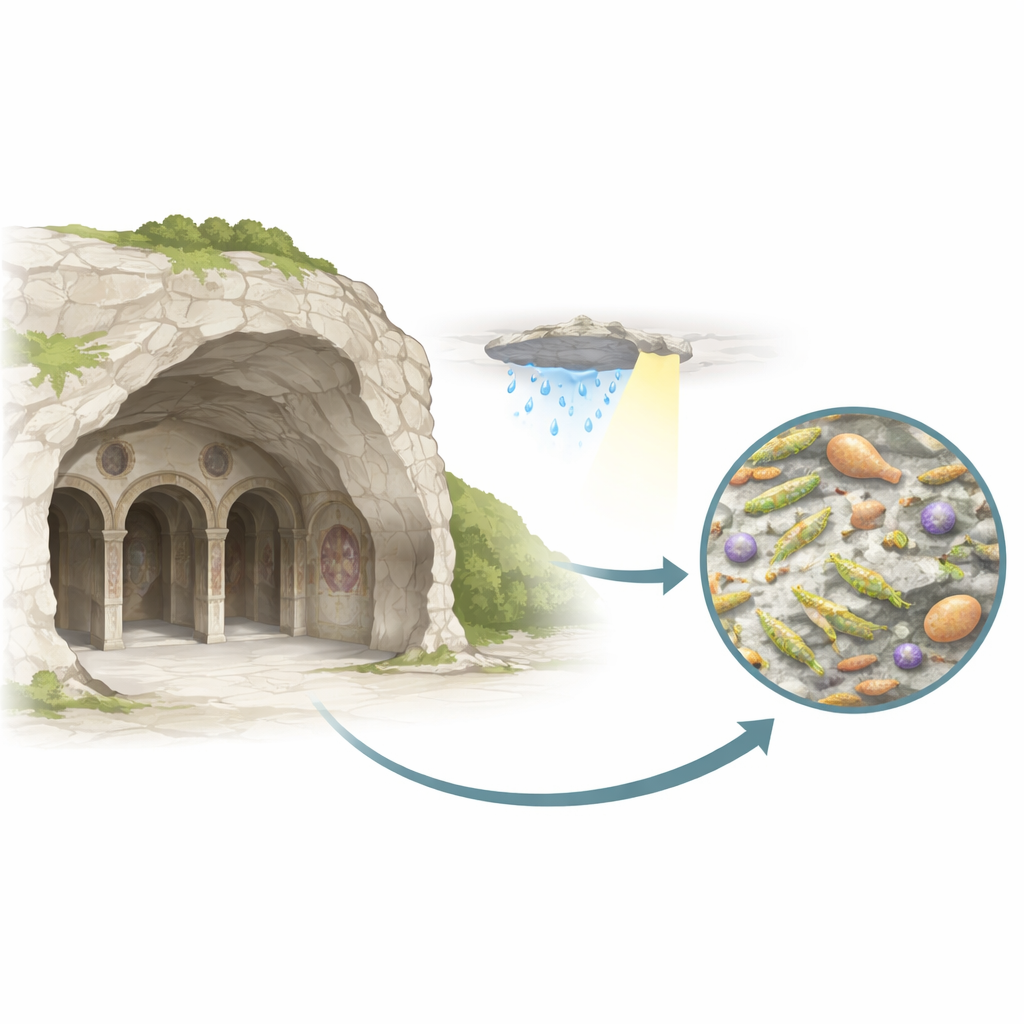
Santa Lucia alle Malve is part of Matera’s famous rupestrian (rock‑hewn) landscape, where homes and churches were dug directly into soft limestone cliffs. The church’s inner walls are decorated with fragile paintings but also streaked with discolorations, moss, algae, and other signs of decay. Because the building is carved entirely into rock, with little direct sunlight and persistent moisture seeping through the stone, it offers a stable, cool, humid refuge for microorganisms. Until now, no one had mapped in detail which bacteria actually live on these inner stone surfaces, even though understanding these communities is crucial for preserving the artwork they coat and sometimes erode.
Reading the Microbial Fingerprint
The researchers approached the problem from two directions. First, they collected tiny scrapings and swabs from four spots on the church’s interior walls and used DNA‑based methods to read the bacterial “barcodes” present in each sample. This metagenomic survey showed an overwhelming dominance of one bacterial group: Bacillota, and especially the genus Bacillus. More than 99% of the genetic reads belonged to this group, with only a scattering of other bacteria detected. Second, the team grew live bacteria from the samples in the lab and examined their shapes, behaviors, and genetic sequences. Seven representative strains were isolated and studied in depth, revealing that nearly all were close relatives within two clusters: the Bacillus cereus group and the Bacillus licheniformis group.
Same Genes, Different Personalities
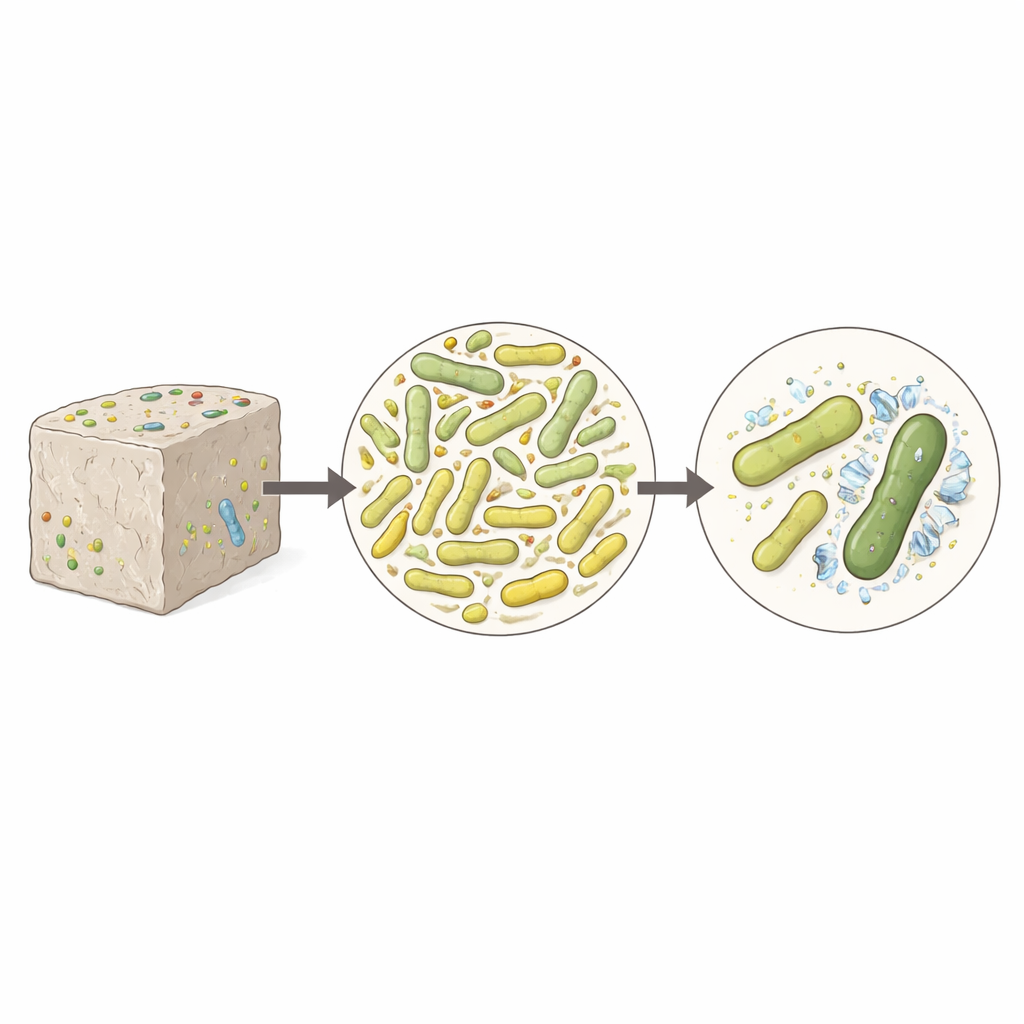
At first glance, these wall‑dwelling Bacillus strains look very similar genetically; several share almost identical sequences in a standard marker gene used for identification. Under closer inspection, however, each strain behaves a bit differently. The scientists tested how they move, what food sources they use, which enzymes they produce, and whether they can form tough, dormant spores. Despite their near‑matching DNA, the strains showed distinct “personalities” in these tests. This suggests that the stone surface hosts a community that is narrow in genetic variety but rich in functional diversity, capable of carrying out many different chemical reactions that may influence how the rock and frescoes age over time.
Unexpected Insect Killers and Human Traces
Among the isolates, two stood out: they produced tiny protein crystals alongside their spores, a hallmark of Bacillus thuringiensis, a bacterium widely used as a natural insecticide. These crystals contain proteins that can kill certain insect larvae, making the presence of such strains in a dim, relatively insect‑poor church interior surprising. Their discovery supports the idea that these bacteria may have alternative lifestyles, possibly living in partnership with plants or other organisms rather than relying only on insects. Another isolated species, Staphylococcus warneri, is better known as a harmless resident of human skin. Its appearance on the stone surfaces hints at a microbial “fingerprint” left by visitors, showing that tourism subtly reshapes the church’s microscopic residents.
What This Means for Protecting the Past
For non‑specialists concerned about the safety of visiting the site, the findings are reassuring: the bacterial mix on the walls does not point to serious health risks for tourists. For conservators, however, the picture is more complex. The dominance of spore‑forming Bacillus species helps explain why microbes persist so stubbornly in the harsh stone environment, and their varied traits suggest they could either contribute to slow surface damage or, under the right conditions, help stabilize the stone by forming protective mineral layers. By showing exactly which microbes are present and how they behave, this study lays essential groundwork for future strategies that might harness helpful bacteria, limit harmful ones, and better safeguard the delicate artworks of Santa Lucia alle Malve for generations to come.
Citation: Santacroce, M., Baranek, J., Adamski, Z. et al. Prevalence of Bacillus species in the lytic cultural heritage of Santa Lucia alle Malve Rupestrian Church. Sci Rep 16, 12992 (2026). https://doi.org/10.1038/s41598-026-41655-4
Keywords: cultural heritage microbiology, stone biodeterioration, Bacillus communities, rock-hewn churches, bioprotection of monuments