Clear Sky Science · en
Integrating EfficientNetV2 with guided filopic diffusion for enhanced rice leaf disease recognition
Why Healthy Rice Leaves Matter
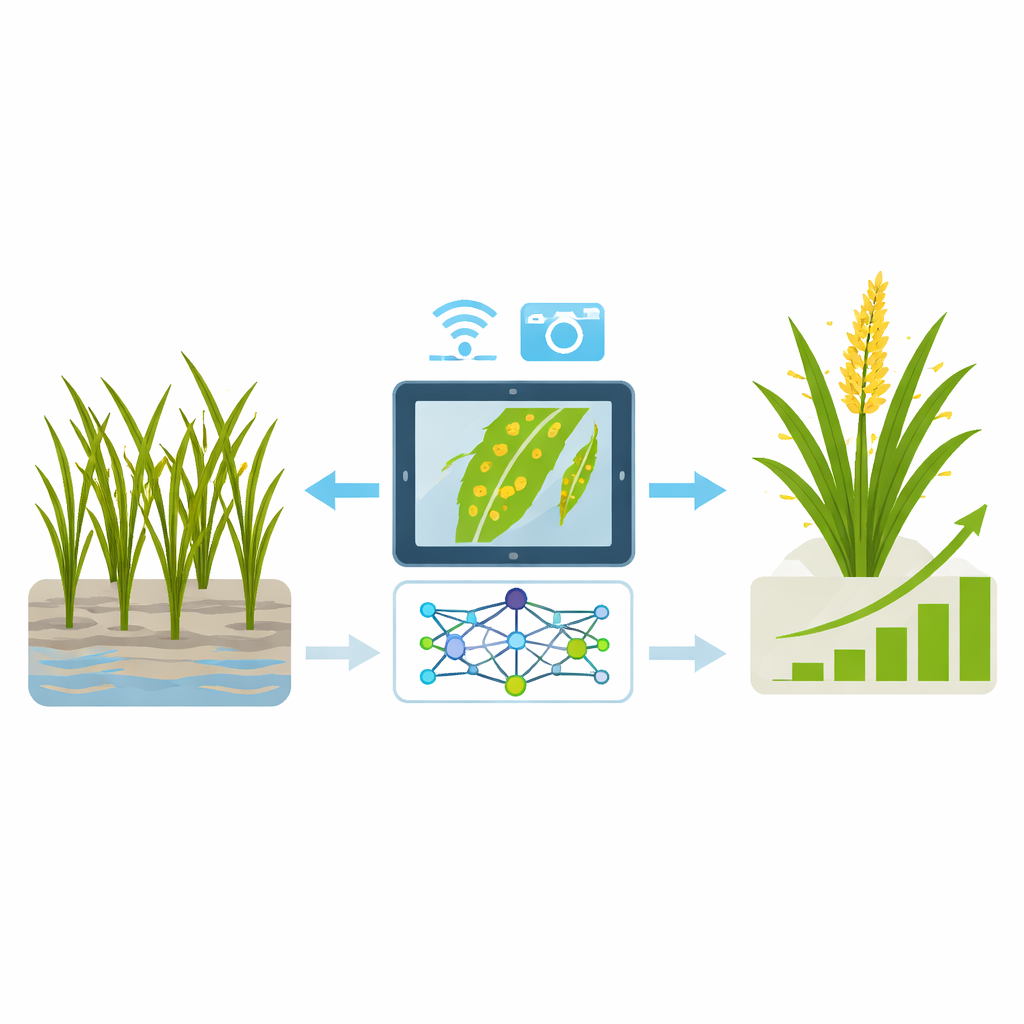
Rice feeds more than half of the world’s people, and most of it is grown in Asia, where small changes in harvests can affect food prices, family incomes, and even national food security. Three common leaf diseases—bacterial leaf blight, leaf smut (or blast), and brown spot—quietly nibble away at rice yields, sometimes causing devastating losses. Farmers usually spot these diseases by eye, which takes time, training, and many field visits. This study explores how a smart image-based system can automatically read the early warning signs on rice leaves, helping farmers act sooner, waste fewer chemicals, and protect both their crops and the environment.
The Main Rice Leaf Threats
The authors begin by outlining why these particular diseases matter so much. Bacterial leaf blight, driven by a water-loving microbe, spreads quickly in humid fields and can cut yields by a third. Leaf smut, caused by a fast-spreading fungus, scars leaves, stems, and grain-bearing tips, and in severe outbreaks can lead to near-total crop failure. Brown spot, another fungal disease, once helped trigger the 1943 Bengal famine and still thrives under poor soil nutrition and shifting weather. All three diseases can look subtly different across rice varieties, growth stages, lighting, and field conditions, which makes them hard to detect reliably with the naked eye or with simple computer programs.
Teaching Computers to Read Leaf Clues
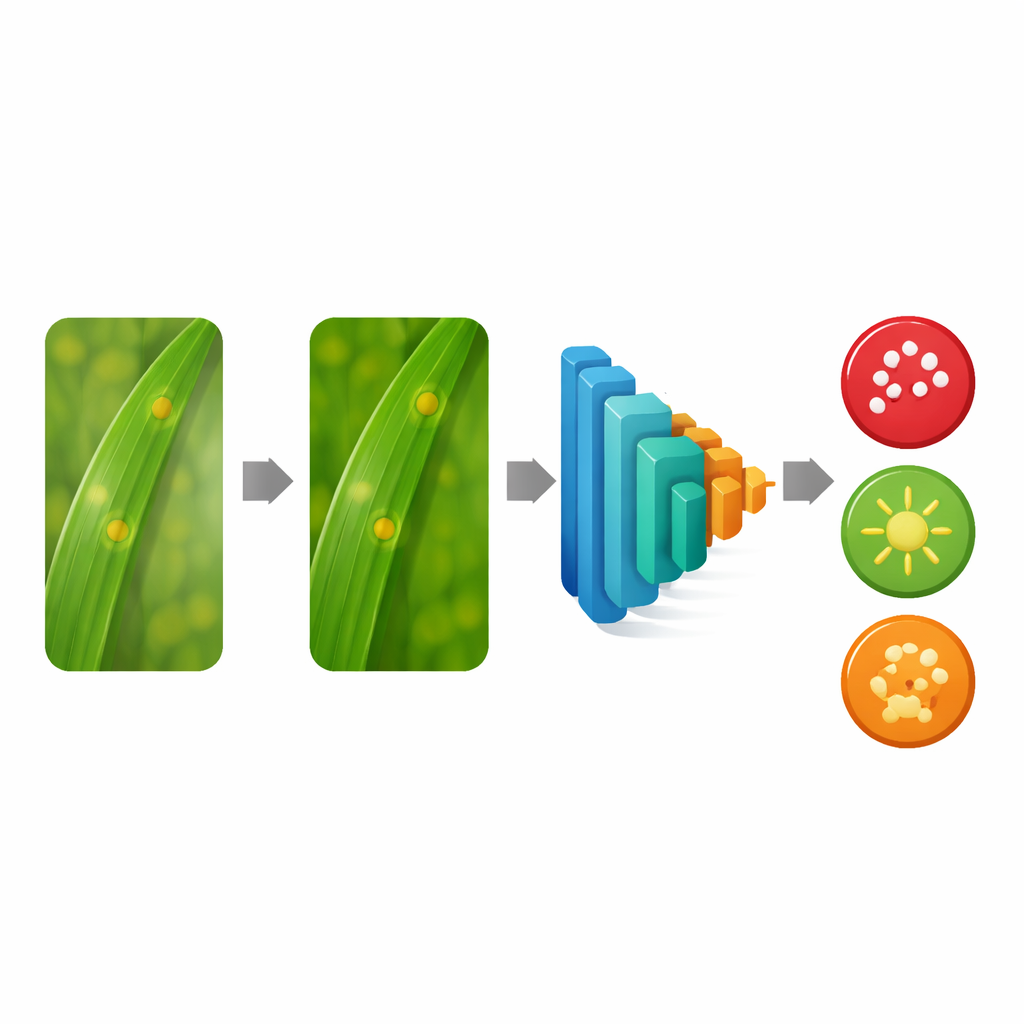
Modern image-recognition systems called deep neural networks are already good at telling dogs from cats in photos; here, the challenge is to distinguish healthy rice leaves from ones bearing three look‑alike diseases. The authors build on a compact but powerful network known as EfficientNetV2, which is designed to extract rich patterns from pictures while staying efficient enough to run on modest hardware. They train this model on a curated public dataset of 4,684 high‑resolution rice leaf images, covering the three disease types under many lighting and background conditions. The network learns to pick up on subtle visual cues such as dots, streaks, and patches that signal each disease, and then outputs which disease is present along with a confidence score.
Cleaning Up Pictures Before Making a Call
A key innovation in this work is what happens before the images reach the main network. Field photos are messy: leaves overlap, backgrounds are busy, and light varies throughout the day. To tackle this, the team introduces a preprocessing step they call guided filopic diffusion. In everyday terms, it is a clever form of digital smoothing that removes background noise while preserving the sharp edges and delicate textures of lesions on the leaf. Instead of blurring the whole picture, this process selectively enhances boundaries and spot shapes that are likely to matter for diagnosis. The cleaned and sharpened images then pass into the EfficientNetV2 model, which can now focus more on genuine disease patterns and less on distracting clutter.
How Well the System Performs
To judge whether their approach truly improves diagnosis, the authors compare it against several well‑known image‑analysis models, such as ResNet, DenseNet, MobileNet, and other EfficientNet variants, all tested under the same conditions. They measure not only how often the system is right overall, but also how well its predicted diseased areas overlap with the real lesions on the leaves. The combined guided diffusion and EfficientNetV2 model reaches an accuracy of about 98–99%, with excellent scores for correctly catching diseased leaves and avoiding false alarms. It also shows particularly strong performance for early or low‑contrast symptoms, where small improvements can make the difference between a timely spray and a missed outbreak.
What This Means for Farmers and Food Security
In practical terms, this research shows that pairing smart image cleanup with a well‑tuned recognition network can turn ordinary photos of rice leaves into reliable disease alerts. Such a system could eventually be wrapped into a phone app or low‑cost camera unit, scanning fields and flagging problems before they spread. While the current model identifies only one disease per leaf and has been tested on a single curated dataset, the authors argue that expanding and diversifying the image collections, speeding up the diffusion step, and handling multiple infections are realistic next steps. If those challenges are met, tools like this could help farmers apply treatments precisely where needed, cut chemical use, and support global goals of reducing hunger while farming more sustainably.
Citation: Kumar, V.V., Rajesh, P. & Krishnamoorthy, N. Integrating EfficientNetV2 with guided filopic diffusion for enhanced rice leaf disease recognition. Sci Rep 16, 13369 (2026). https://doi.org/10.1038/s41598-026-41654-5
Keywords: rice leaf disease detection, deep learning in agriculture, image-based crop diagnosis, plant disease segmentation, precision agriculture