Clear Sky Science · en
A comparative analysis of multi-stage evaporative cooling and conventional chillers for office-scale cooling loads
Why keeping buildings cool really matters
As cities grow hotter and offices rely more on air conditioning, cooling buildings is quietly becoming one of the biggest drivers of electricity use and climate-warming emissions. This study asks a practical question with global implications: can we keep large offices comfortable in India’s intense summers and humid monsoon seasons while using much less electricity than today’s standard cooling machines? The researchers focus on combining a familiar workhorse—the mechanical chiller—with a smarter form of “air cooling with water” to trim energy use without sacrificing comfort.
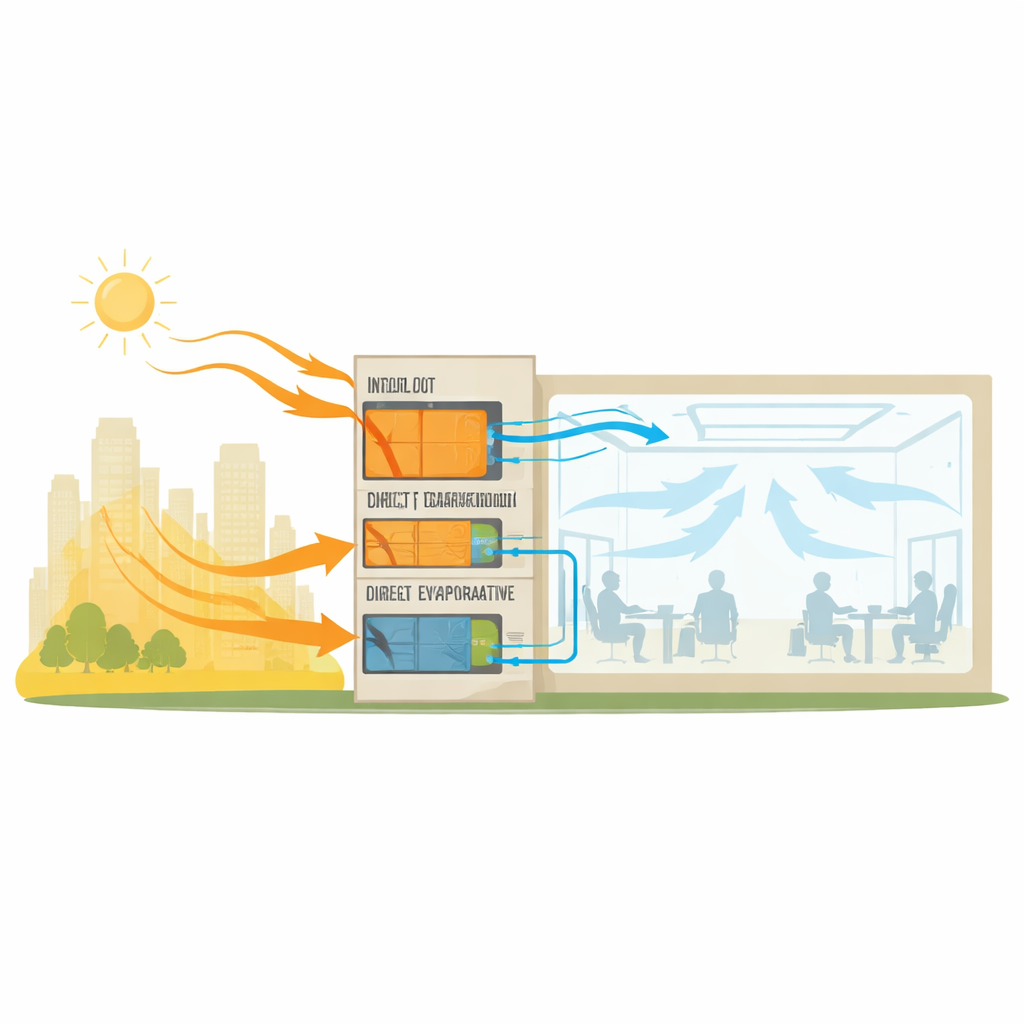
A new twist on cooling with water
Many people know desert coolers that blow air through wet pads. They use water instead of chemical refrigerants, but they struggle in humid weather and cannot always reach the comfort levels expected in modern offices. The team studied a more advanced version called indirect evaporative cooling, where outdoor air is cooled by passing alongside a wet surface without picking up extra moisture. This precooled air then goes to a regular chilled-water coil. The key idea is that if you cool the air partway with water first, the chiller does less work and consumes less electricity.
Using the building’s own air as a helper
The researchers propose a simple but powerful modification: instead of using changing outdoor air as the “working” stream inside the indirect cooler, they use return air coming back from the offices. This return air is typically more stable in temperature and, during operation, can actually be cooler than the outdoor air. By routing this air through the wet side of the indirect cooler and then exhausting it, the system can draw more heat out of the incoming fresh air. In some cases, the precooled air leaving the unit drops below the usual temperature limit set by the outdoor wet-bulb value, showing that the return-air approach squeezes extra cooling out of each kilogram of air.
Testing the idea across India’s climates
To see whether this is just a laboratory trick or a real-world solution, the authors modeled a large office-scale industrial building and computed detailed heat loads for multiple Indian cities representing hot–dry, warm–humid, temperate, cold and mixed climates. They compared three setups: a stand‑alone chiller, a conventional indirect-cooler‑plus‑chiller, and the new return‑air‑assisted version. Using standard design weather data for both peak summer and the muggy monsoon season, they tracked how much cooling each system had to provide and how much electrical energy the chiller would consume to maintain a typical indoor set point around 27 °C with comfortable humidity.
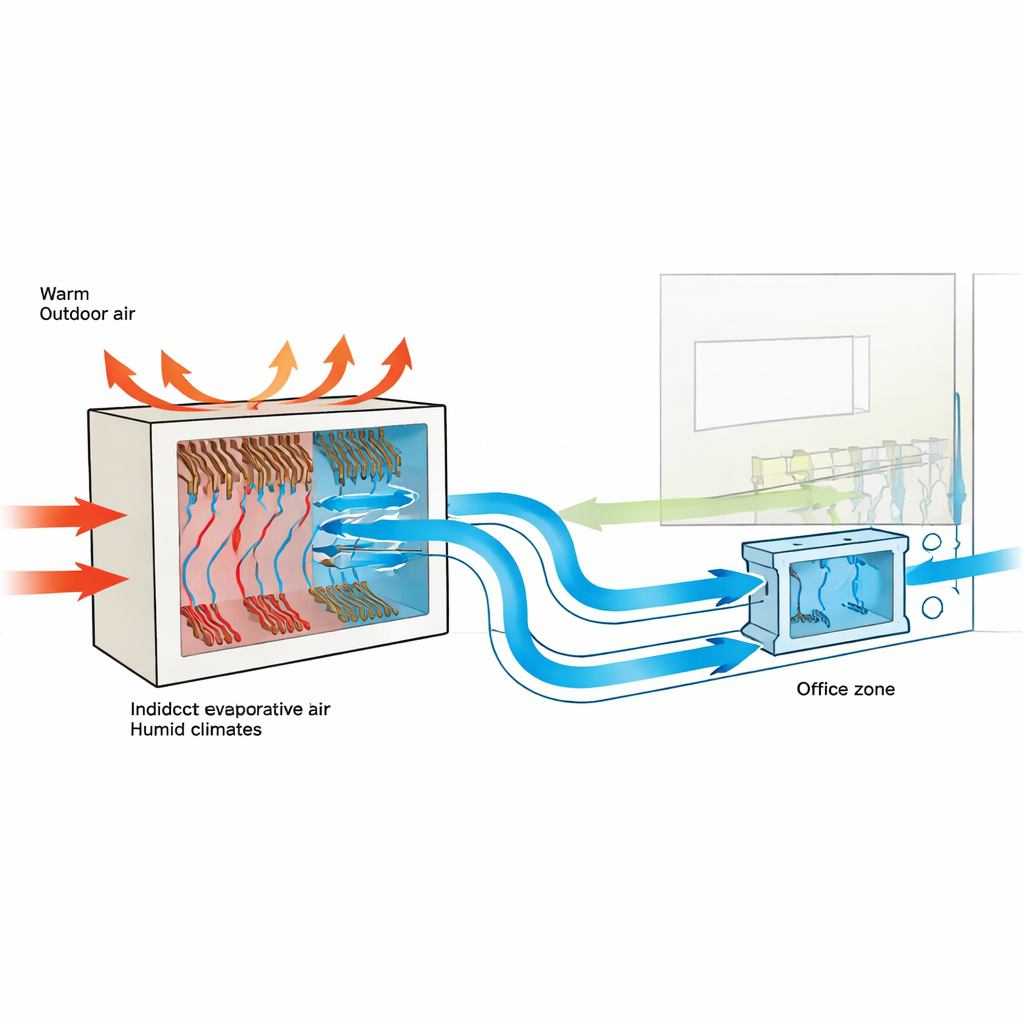
How much energy and equipment can be saved
The results show that even a conventional indirect evaporative stage in front of a chiller can cut the required chiller capacity by about 50–60 tons of refrigeration for the reference building. The modified multi‑stage system with return air goes further, trimming the needed chiller size by 80–140 tons depending on city and season. Because the air reaching the cooling coil is already cooler, the chiller runs less and uses significantly less electricity. For the same cooling demand, the ordinary chiller-plus-indirect-cooler combination reduced electricity use by about 28% compared with a stand‑alone chiller, while the new return‑air‑assisted system achieved roughly 35% savings. Importantly, this stronger performance persisted even in humid monsoon conditions, when traditional evaporative coolers usually lose much of their effectiveness.
What this means for future buildings
In plain terms, the study suggests that large offices and factories in India can keep workers comfortable while using about one‑third less cooling electricity simply by rearranging how air and water move through equipment that already exists. By letting the chiller share its job with a cleverly designed water‑based cooler that reuses indoor air as a helper stream, building owners can install smaller chillers, cut operating bills and reduce strain on power grids during heat waves. As cooling demand rises with climate change, such hybrid systems offer a practical, scalable path to cooler buildings that are kinder to both wallets and the planet.
Citation: Chiranjeevi, C., Sekhar, Y.R., Javith, J. et al. A comparative analysis of multi-stage evaporative cooling and conventional chillers for office-scale cooling loads. Sci Rep 16, 11244 (2026). https://doi.org/10.1038/s41598-026-41650-9
Keywords: evaporative cooling, building energy use, hybrid HVAC, office cooling, Indian climates