Clear Sky Science · en
A time-frequency cross-attention network model for epileptic seizure detection
Why spotting seizures faster matters
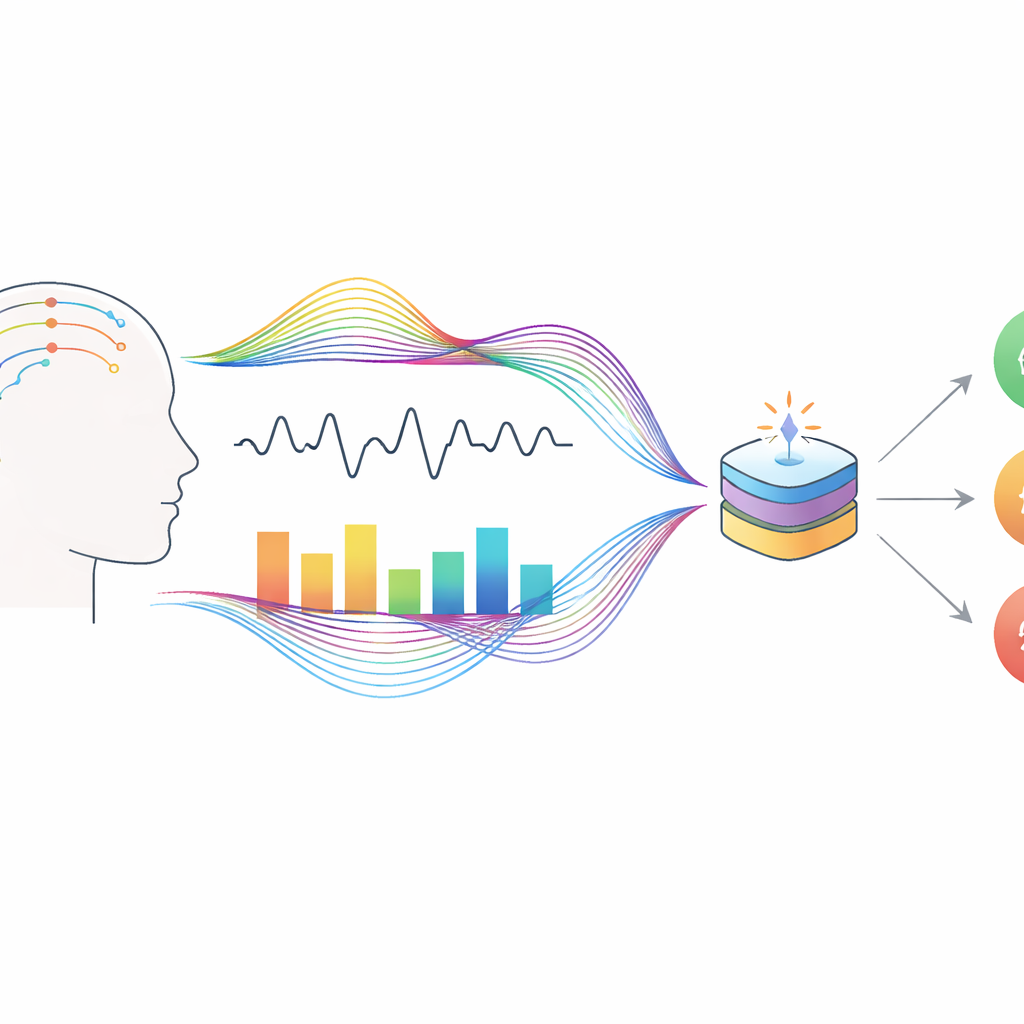
For people living with epilepsy, seizures often strike without warning, disrupting work, school, and daily life, and in severe cases putting lives at risk. Doctors use electroencephalography (EEG) — tiny voltage traces recorded from electrodes on the scalp — to spot harmful brain activity, but reading hours of squiggly lines by eye is slow, exhausting, and heavily dependent on expert judgment. This study introduces a new artificial intelligence approach that reads EEG signals more like an experienced specialist, looking not only at how the signal changes over time but also at its underlying rhythms, and combining both views to detect seizures and other dangerous patterns with striking accuracy.
Two ways of looking at brain waves
EEG recordings can be viewed in two complementary ways. One is the familiar time view: how the voltage rises and falls from one moment to the next. The other is the frequency view: how much of the signal’s energy lies in slow, medium, or fast brain rhythms. Many earlier computer models focused mainly on the time view, or treated the frequency information as a simple add-on. Yet neurologists have long known that certain seizure types are strongly tied to specific rhythmic patterns. The authors argue that a smarter system should treat time and frequency as equally important, and, crucially, learn how they relate to each other rather than just stacking them side by side.
A dual-path AI that listens and "feels the rhythm"
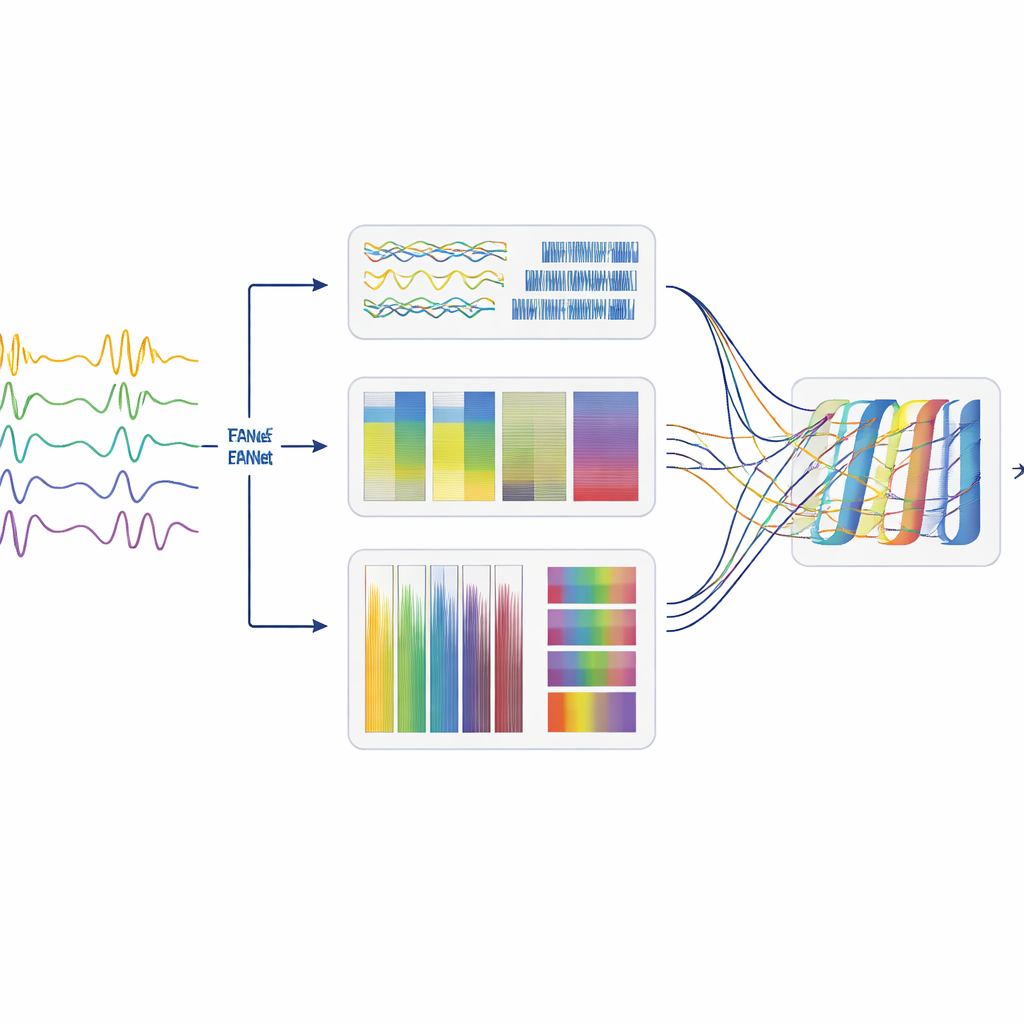
The researchers propose a model they call the Time-Frequency Cross-Attention Network (TFCANet). It starts from raw EEG signals recorded from multiple electrodes. One branch of the network concentrates on the time series: it uses specialized building blocks that first pick out local patterns and then apply an attention mechanism that focuses on important moments along the signal while ignoring less informative stretches. In parallel, the second branch converts the same signals into their frequency content using a fast mathematical transform and then passes this information through modules designed to emphasize the most informative channels and rhythmic bands while damping down noise and redundancy.
Teaching the model to connect patterns across views
Simply gluing the outputs of the time and frequency branches together turns out not to be enough. Instead, TFCANet uses a cross-attention step inspired by recent advances in language and vision AI. In this step, the time-based features act as a kind of context, asking: “Given what is happening at this moment in the signal, which frequency patterns are most relevant?” The model then selectively highlights matching frequency features while downplaying unrelated ones. This dynamic interaction lets the network discover subtle links between when a suspicious event is unfolding and which rhythmic fingerprints mark it as a seizure or another harmful pattern.
Putting the system to the test
To judge how well TFCANet works, the authors tested it on two widely used EEG collections. One is a classic research dataset from the University of Bonn, containing carefully segmented examples of normal activity, quiet periods between seizures, and full seizures. The other is a much larger, more realistic clinical dataset from a recent Kaggle competition, in which expert teams labeled diverse forms of harmful brain activity such as seizures and several types of abnormal rhythmic discharges. After balancing the training data and applying standard cleaning steps, the team compared TFCANet against a range of modern deep-learning models that rely on convolutions, recurrent layers, Transformers, or simpler time–frequency combinations.
Results that edge closer to real-world use
Across both datasets, TFCANet consistently matched or surpassed competing approaches. On the large Kaggle collection, it correctly classified five major types of harmful brain activity more than 96 percent of the time, and on the Bonn dataset it exceeded 93 percent accuracy in distinguishing five different conditions. Careful “ablation” experiments — in which parts of the model are removed or replaced — showed that both the channel-wise attention modules and, especially, the cross-attention fusion step are key to these gains. Even when using single-channel data, where some modules are less impactful, the cross-attention mechanism still improved performance over simple feature merging.
What this means for patients and doctors
In everyday terms, this work shows that computers can be trained to read EEG traces in a richer, more nuanced way by jointly considering when events happen and what rhythms accompany them, and by learning how those two views support each other. While TFCANet has so far been tested on research and competition data, its strong and stable performance suggests it could become a practical assistant in hospitals: continuously monitoring long recordings, flagging suspicious episodes for review, and helping clinicians respond to dangerous brain activity more quickly and consistently. As future studies adapt this approach to longer recordings and varied clinical settings, such time–frequency aware systems may become a core part of safer, more reliable seizure monitoring.
Citation: Wang, R., Tian, L., Li, M. et al. A time-frequency cross-attention network model for epileptic seizure detection. Sci Rep 16, 13441 (2026). https://doi.org/10.1038/s41598-026-41636-7
Keywords: epileptic seizure detection, EEG deep learning, time-frequency analysis, attention mechanisms, brain signal processing