Clear Sky Science · en
Enhanced smart commuting with artificial intelligence for intelligent health and safety monitoring in school buses
Why the Ride to School Matters More Than You Think
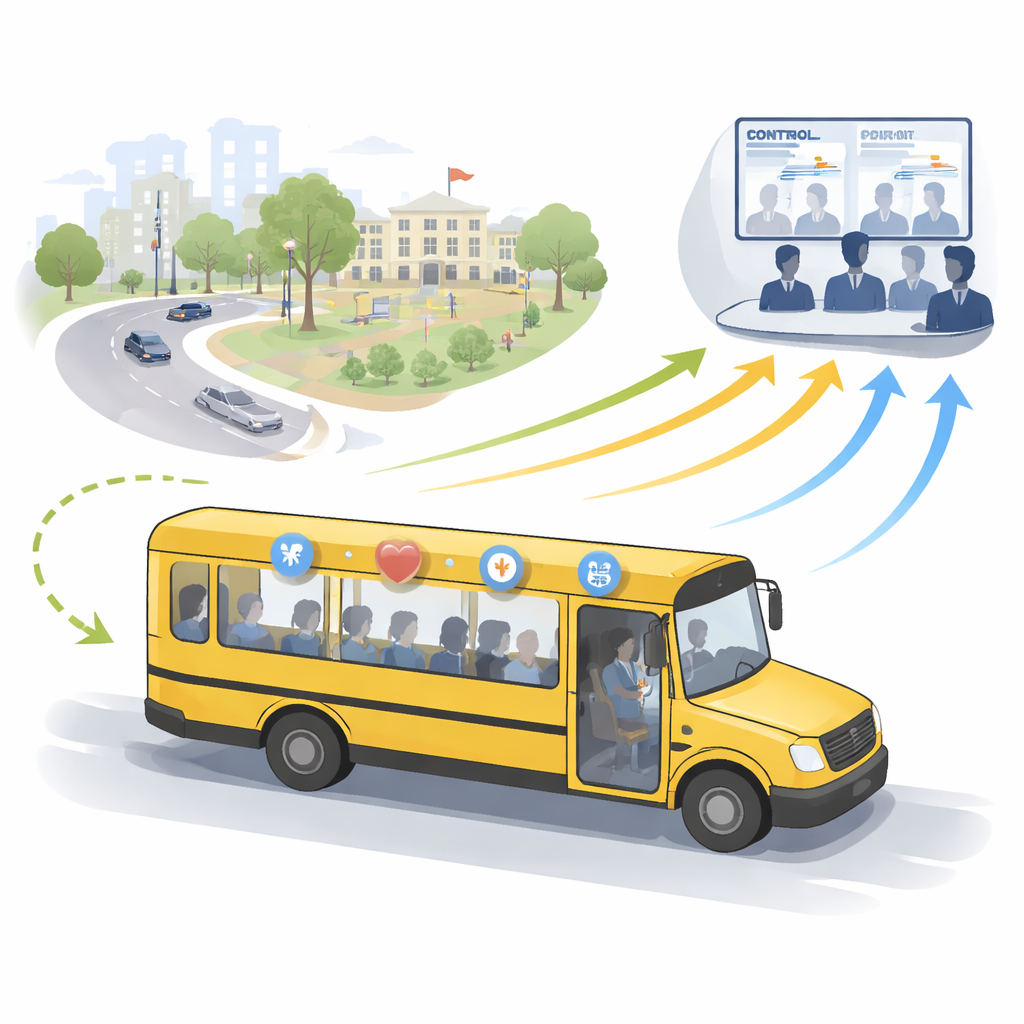
For many families, the school day begins and ends on the bus. Statistics show that buses are already one of the safest ways for children to travel, yet serious gaps remain: medical emergencies can be missed, bullying can go unseen, and the air inside a crowded vehicle can quietly become unhealthy. This paper presents ESC.AI, a smart school bus framework that uses networks of sensors and on‑board artificial intelligence to watch over students’ health, behavior, surroundings, and route in real time, aiming to turn every ride into a safer, more transparent experience for children, schools, and parents.
Many Risks, but Little Real-Time Awareness
Traditional school transportation relies on separate, often manual systems: GPS trackers for location, occasional camera recordings for behavior, and paper logs for health and attendance. These pieces rarely talk to each other, and most only provide information after something has already gone wrong. As a result, a child who faints may not be noticed right away, warning signs of aggression or distress can be missed, and high heat or stale air might build up unnoticed inside the cabin. The authors argue that this patchwork approach limits drivers’ situational awareness, slows emergency response, and undermines parents’ trust that the ride is being actively supervised, not just recorded.
A Bus That Can See, Sense, and Decide
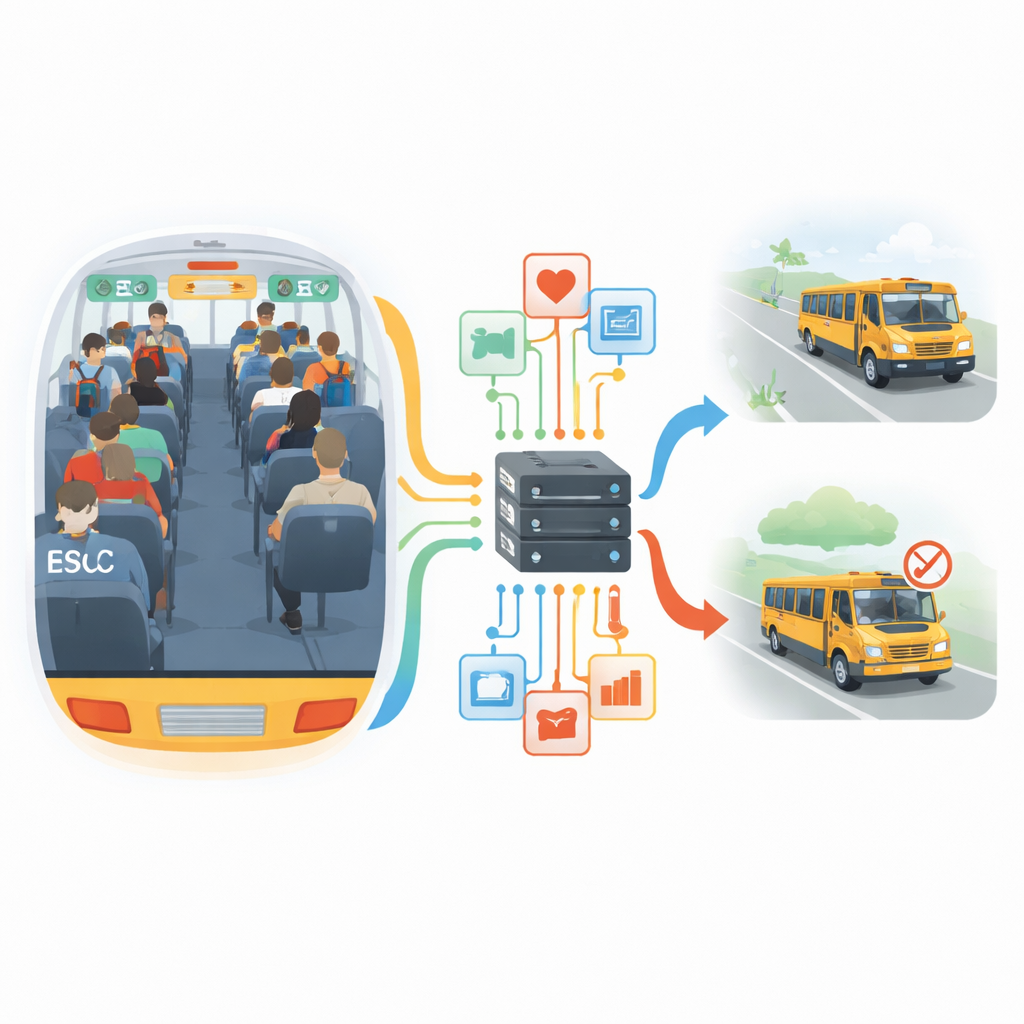
ESC.AI reimagines the bus as a rolling, coordinated sensing platform. Wearable or seat‑embedded devices track basic vital signs such as heart activity, muscle signals, breathing sounds, and oxygen levels, while built‑in sensors measure temperature, humidity, and carbon dioxide to gauge air quality and comfort. Cameras inside the bus, aided by modern computer vision models, watch for fighting, falls, and signs of driver distraction such as phone use or drowsiness. GPS receivers feed a routing engine that continuously checks traffic, road conditions, and neighborhood safety indicators to recommend safer, more efficient paths. All of these streams are processed on small computers mounted on the bus itself, so alerts can be raised in seconds even when the internet connection is weak.
Keeping Identities and Data Both Safe and Useful
A distinctive feature of ESC.AI is its approach to identifying students without relying on faces or ID cards. The system experiments with a technique that reads the tiny electrical properties of a fingertip when it touches a special sensor. Because this response comes from living tissue rather than a surface pattern, it is harder to fake and does not store an image that could be misused. Test results show this method can distinguish among individuals with accuracy above 90 percent. At the same time, the framework treats collected data as highly sensitive. Health readings, locations, and behavior records are encrypted, and key safety events—such as confirmed boarding, route deviations, or serious incidents—can be written to a tamper‑resistant digital ledger so that later investigations can verify what happened without exposing raw video or medical details.
From Raw Signals to Timely Help
Much of the technical work behind ESC.AI focuses on teaching algorithms to interpret the noisy signals of real life. Deep learning models analyze heart rhythms to flag stress or irregular beats, breathing sounds to detect wheezing or crackles, and muscle activity to spot seizure‑like movements or repeated posture shifts that might signal discomfort. Other models watch video snippets to recognize violence or falls among students and to monitor whether the driver remains attentive, belted, and hands‑free. In tests using public and custom datasets, many of these modules achieved accuracies between about 88 and 98 percent. When something looks wrong—air quality drifting into a risk zone, a possible seizure pattern, a detected fall—the system issues graded alerts to the driver, school staff, and, when appropriate, parents through dashboards and mobile apps, suggesting concrete actions such as opening windows, stopping the bus, or calling medical help.
What This Could Mean for Families and Schools
The authors stress that ESC.AI is not meant to drive the bus or replace human judgment. Instead, it is a decision‑support layer that watches continuously, connects many kinds of information, and surfaces problems early enough for adults to act. The study demonstrates that key building blocks—driver monitoring, environmental tracking, health pattern recognition, biometric check‑in, safer route planning, and secure data handling—can all function together on realistic hardware with promising accuracy. Large‑scale trials and long‑term studies are still needed, but the vision is clear: a future in which every school bus quietly acts as a smart guardian, helping keep children healthier, calmer, and safer from the moment they step on board until they arrive home.
Citation: Hossam, H., Tamer, R., Mohsen, M. et al. Enhanced smart commuting with artificial intelligence for intelligent health and safety monitoring in school buses. Sci Rep 16, 9665 (2026). https://doi.org/10.1038/s41598-026-41628-7
Keywords: school bus safety, smart transportation, health monitoring, behavior detection, edge AI