Clear Sky Science · en
Ultrashort-pulse laser-modified surface texturing for heat transfer reduction in die-cast aluminum alloys
Why keeping electric cars cool matters
For many drivers, today’s electric cars still suffer from one big drawback: their driving range feels too short. While it is tempting to blame only the battery, a surprising amount of energy is quietly lost as heat in the car’s mechanical parts. This study looks at an unusual way to cut those losses—by sculpting the inner metal surfaces of electric vehicle gear housings with ultrafast lasers so that hot oil has a harder time dumping its heat into the metal. The result is a tiny, almost invisible surface pattern that could help stretch every kilowatt-hour a little further.
Where energy quietly disappears
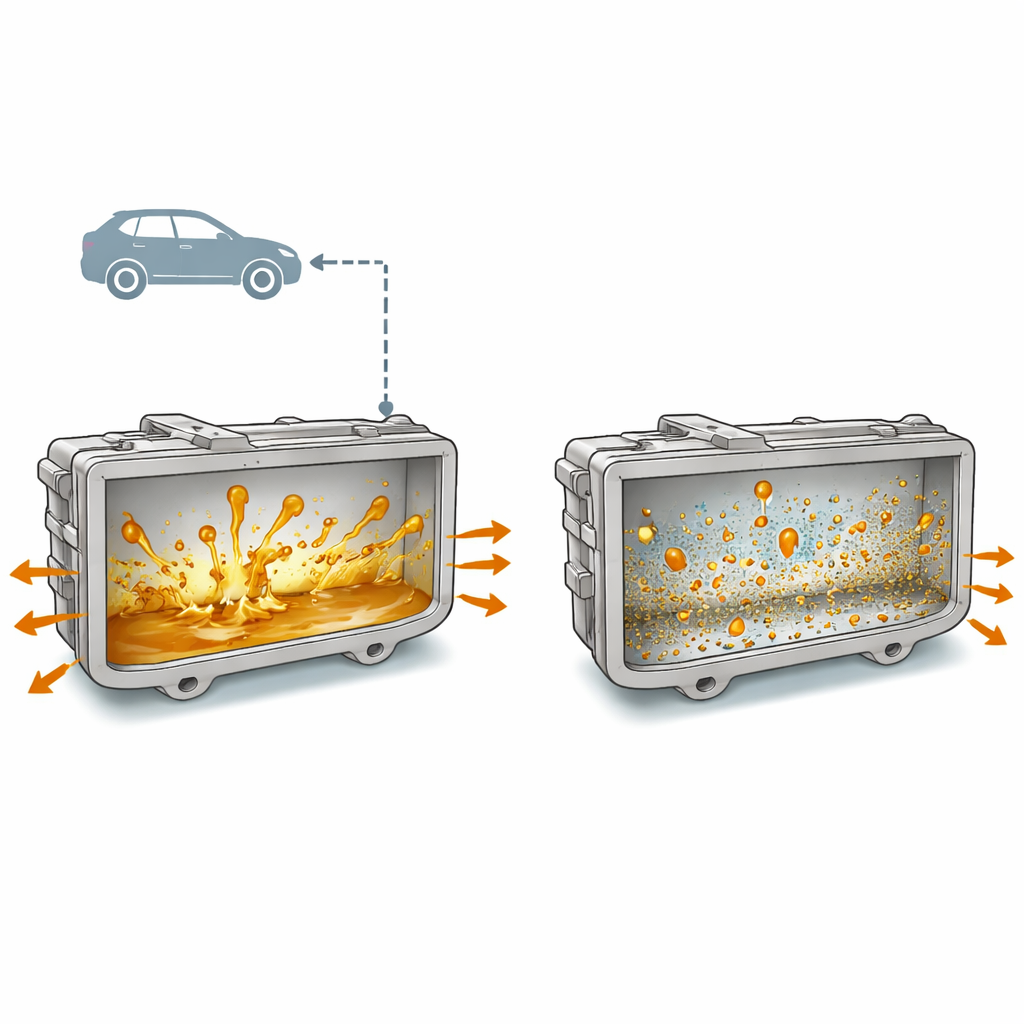
Even efficient battery electric vehicles waste a large fraction of the energy taken from the grid. For a well-studied model, only about three quarters of the incoming energy actually makes it to the wheels; the rest leaks away through charging, electronics, cooling systems and the powertrain itself. Inside the powertrain, gears and bearings sit in a bath of lubricating oil, all enclosed by a die-cast aluminum housing. As the car runs, splashing oil droplets strike the housing walls and transfer heat to the metal, which then leaks to the outside air. The authors identify this heat path—from oil to aluminum—as a preventable loss worth targeting, especially because aluminum housings are now standard for many electric powertrains.
Borrowing tricks from lotus leaves
Nature offers a clue to controlling how liquids touch solids: lotus leaves stay remarkably clean and dry because their surfaces are covered with tiny bumps on multiple size scales. Water droplets sit on top of this microscopic landscape, with pockets of air trapped underneath, so they roll off easily and carry dirt away. The researchers adapt this idea for oily liquids inside an electric drive. They first smooth the naturally rough aluminum casting with a picosecond-pulse laser, then use an even shorter femtosecond-pulse laser to carve a carefully designed “hierarchical texture” of grooves and teeth. By tuning the ratio of groove width to tooth width, they find a pattern that makes both water and oil droplets stand taller and slide more readily across the metal, indicating reduced contact area and contact time.
Shaping the metal to repel hot oil
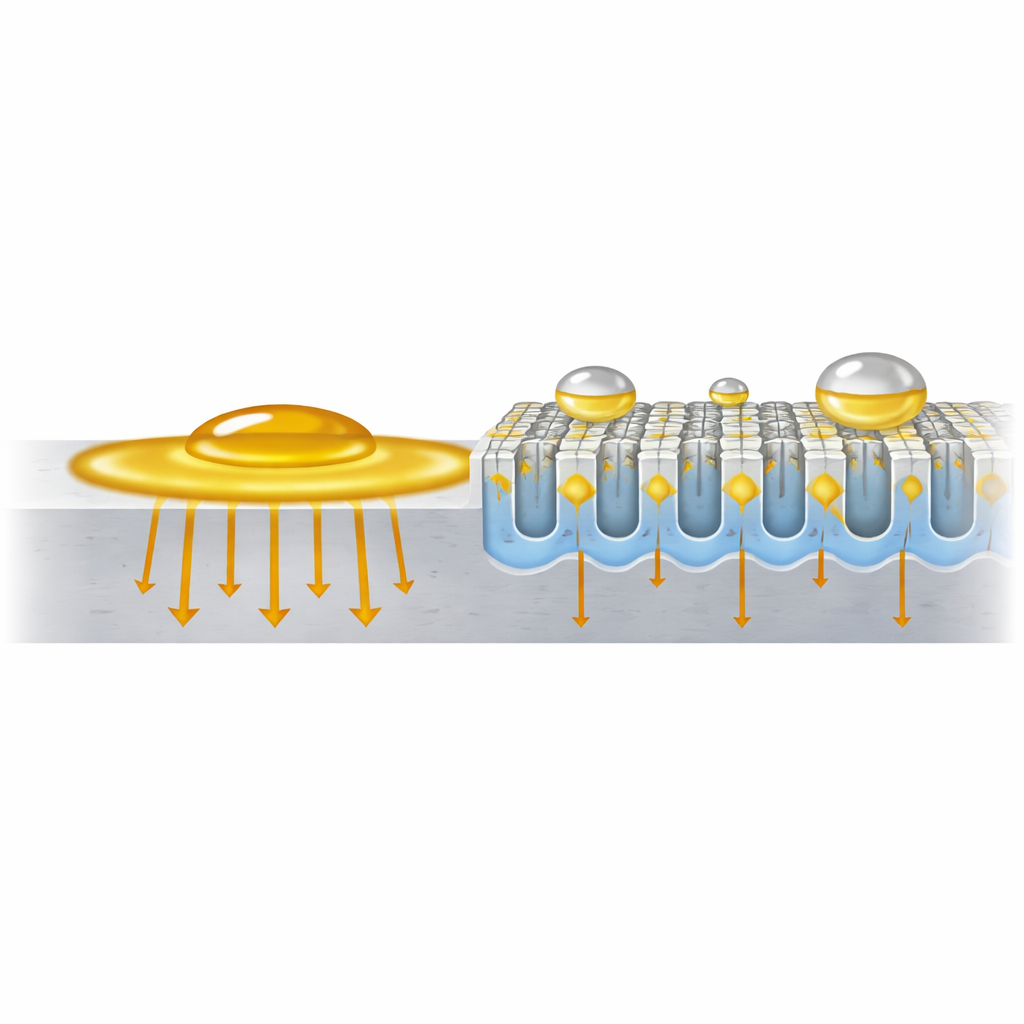
To see how well this textured surface resists oil, the team compares three kinds of aluminum plates: untreated as-cast metal, a chemically coated water-repellent surface, and the new laser-textured surface. They measure how droplets of transmission oil spread, how easily they slide, and how the apparent contact angle—how “rounded” the droplet appears—changes. On untreated aluminum, oil wets the surface strongly. On the laser-textured version, the oil droplet’s contact angle nearly doubles, and the droplet begins to rest partly on a cushion of trapped air between the grooves. The surface becomes not just water-repellent but “oleophobic,” meaning it also resists wetting by oil, even though no added coating is used.
Watching heat flow droplet by droplet
The heart of the study is a custom experiment that drops tiny amounts of hot transmission oil onto horizontally mounted aluminum test pieces while monitoring how much their temperature rises over time. With all other conditions held constant, the smooth untreated surface warms the most, the chemically treated surface somewhat less, and the laser-textured surface the least. At an oil temperature of 80 °C, the energy absorbed by the untreated aluminum is about 464 joules, while the textured surface absorbs only 347 joules. In engineering terms, the effective heat transfer coefficient drops by more than half. Calculations and high-speed observations suggest two main reasons: the air trapped within the surface pattern acts like insulation, and the droplet touches the metal over a smaller area and for a shorter time before sliding away.
What this means for future electric vehicles
To a non-specialist, the key message is that the authors have found a way to turn a plain metal wall into a kind of built-in heat shield using only light—no paints, foams, or added chemicals. Their laser-carved texture makes oil droplets hesitate to wet the metal fully and encourages them to move along quickly, so less heat is handed over to the housing. In a real electric vehicle, applying such textures to gear housings and other oil-washed components could trim powertrain heat losses and modestly extend driving range, all while remaining durable at high temperatures and avoiding extra insulating layers. It is a small change at the micrometer scale with potentially meaningful benefits at the scale of everyday driving.
Citation: Goto, R., Yamaguchi, M. Ultrashort-pulse laser-modified surface texturing for heat transfer reduction in die-cast aluminum alloys. Sci Rep 16, 13823 (2026). https://doi.org/10.1038/s41598-026-41605-0
Keywords: electric vehicle efficiency, heat transfer reduction, laser surface texturing, oleophobic surfaces, die-cast aluminum housings