Clear Sky Science · en
Metric dimension of cycloparaphenylene and its derived molecular structures
Finding Patterns in Tiny Molecular Hoops
Chemists now design new medicines and materials by thinking about molecules as tiny networks of connected points. This study explores how a simple idea from mathematics can help tell apart very similar carbon-based molecules, including nano-sized rings and chains that are candidates for next‑generation electronics, sensors, and green energy devices. By measuring how many “landmark” atoms are needed to locate every other atom in a molecule, the authors show how molecular shape and symmetry leave a clear mathematical fingerprint.
Turning Molecules into Maps
The work relies on a concept called a chemical graph, where each atom is treated as a dot and each bond as a line. In such a map, you can pick a few reference atoms and record how far every other atom is from them along the bonds. If every atom has a unique set of distances to this chosen group, then those reference atoms form what mathematicians call a resolving set. The smallest possible number of reference atoms needed is known as the metric dimension. For a lay reader, this is similar to asking: “How many GPS towers do I need so that every location on a map has a unique set of distances to those towers?” The answer turns out to depend strongly on how regular and symmetric the network is.
Hoops of Carbon and Their Sidewalls
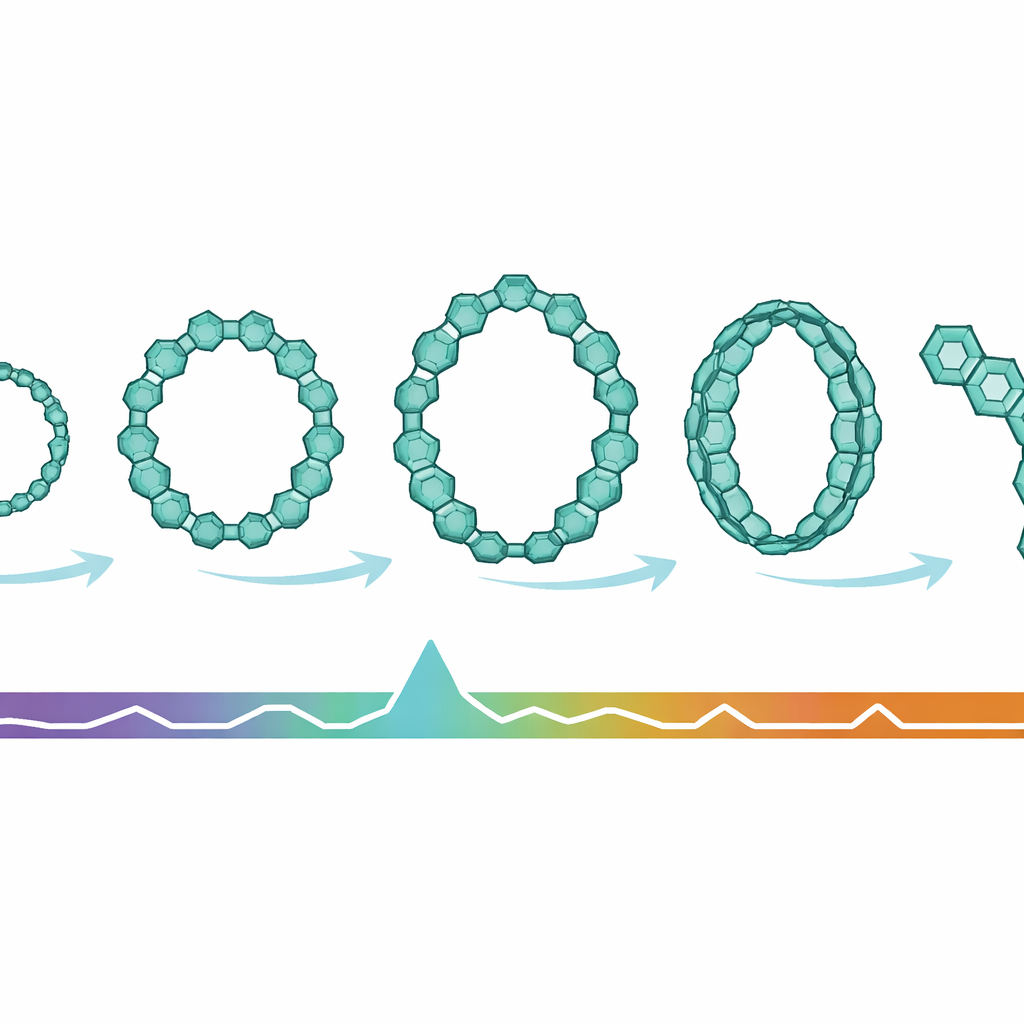
The authors first examine cycloparaphenylenes, often called carbon nanohoops, which are rings made of linked benzene units. These hoops are highly symmetric: every segment looks much like any other. The team proves that for a hoop built from n benzene rings, you need exactly n landmark atoms to distinguish all positions in the ring. They then move to more elaborate designs where the hoop carries extra “sidewall” structures made from larger flat carbon fragments such as hexabenzocoronene or pyrene. These sidewalls increase the number of atoms and connections, and the metric dimension rises to 2n + 2, reflecting the larger, more intricate landscape that must be navigated by the chosen landmarks.
Rings, Tubes, and Chains Compared
Next, the study looks at cyclacenes—looped molecules that resemble slices of zigzag carbon nanotubes—and polythiophene, a sulfur‑containing polymer often used in flexible electronics. Despite having many atoms, cyclacenes have a metric dimension of only 3, showing that their repeating ring structure makes them easy to describe with just a few well‑placed landmarks. Polythiophene, which forms a more linear chain, has an even lower metric dimension of 2. In both cases, long stretches of repeating patterns mean that once a couple of points are fixed, the rest of the structure falls into place mathematically.
What Shape Tells Us About Complexity
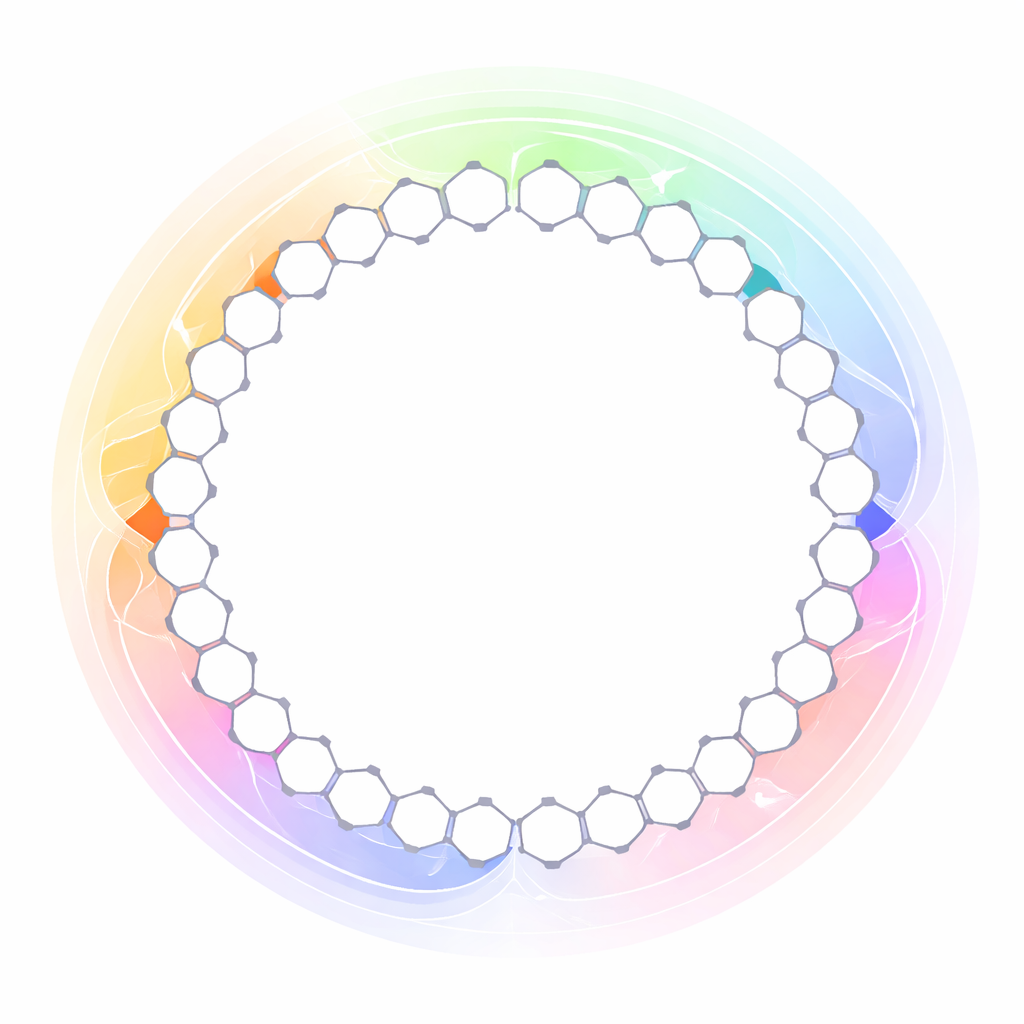
By tabulating the number of atoms, bonds, and the metric dimension for each family of molecules, the authors reveal clear trends. Structures that are simple and highly repetitive, like cyclacenes or polythiophene chains, have low metric dimensions: only a few landmark atoms are enough to identify every site. More decorated nanohoops with extra sidewalls need many more landmarks, reflecting greater structural richness and less symmetry. In this way, the metric dimension condenses a complicated bonding pattern into a single number that tracks how “navigable” the molecular network is.
Why This Matters for Future Molecules
For a non‑specialist, the key message is that a seemingly abstract number can help chemists organize and compare very complex molecules. The metric dimension works as a structural signature that distinguishes similar nano‑rings, carbon‑rich frameworks, and conducting polymers that may find use in electronics, sensing, and renewable energy technologies. Because it is sensitive to subtle changes in ring size, side groups, and connectivity, this descriptor can guide the design of new molecules with tailored properties, much like a compact map helps engineers plan efficient and reliable networks in the macroscopic world.
Citation: Prabhu, S., Jeba, D.S.R., Arulperumjothi, M. et al. Metric dimension of cycloparaphenylene and its derived molecular structures. Sci Rep 16, 14142 (2026). https://doi.org/10.1038/s41598-026-41590-4
Keywords: chemical graph theory, carbon nanohoops, metric dimension, conjugated polymers, nanoring electronics