Clear Sky Science · en
Analysis of delay differential equations with dual caputo-type fractional derivatives using laplace transform methods
Why memory in time matters
Many real-world systems—from materials that slowly relax after being stretched to populations that react to past conditions—do not respond instantly to what happens now. Their present behavior depends on a long history of earlier events and often on delayed feedback loops. This paper develops new mathematical tools to describe such memory-and-delay effects with greater flexibility and to guarantee that the resulting models behave in a predictable and stable way.
Capturing history with flexible time rules
Traditional calculus assumes that change depends only on what is happening at a single instant. Fractional calculus relaxes this idea by allowing "in-between" orders of differentiation, so that the rate of change depends on a weighted average of the entire past. The authors focus on a modern version of these operators, called Caputo–Katugampola derivatives, which include an extra knob, denoted by a parameter ρ, that adjusts how strongly the distant past influences the present. By tuning ρ, one can smoothly move between different types of memory behavior, making the framework adaptable to a wide range of physical, biological, and engineering situations.
Dealing with delays and dual effects
Many systems also react not only to past states in a smooth way but to states that are shifted in time—true delays. The paper studies equations where the current rate of change depends on a whole segment of past values over a fixed time window, combined with two distinct fractional effects acting simultaneously. One fractional term might represent a short-range memory, while the other captures a slower, long-range influence. The authors analyze an equation in which these two memory terms appear together, along with a delayed feedback term that reads off the recent history of the unknown quantity. This blend aims to model systems where both the type and the strength of memory can be finely controlled.

Turning hard equations into manageable forms
To study such intricate equations, the authors rely on a specialized version of the Laplace transform adapted to the ρ-parameter, known as the ρ-Laplace transform. This technique converts the original equation with memory and delay into a more manageable algebraic form, which can then be inverted back to give an explicit integral expression for the solution. In this representation, special functions called Mittag–Leffler functions naturally appear; they play a role similar to the exponential function in ordinary differential equations, but are tailored to fractional time dynamics. With this integral form in hand, the authors can carefully estimate how solutions behave and how they react to changes in inputs and initial data.
Guaranteeing existence, uniqueness, and robustness
Armed with the integral formulation, the authors use two classic ideas from mathematical analysis—Banach's contraction principle and Schauder's fixed point theorem—to show that the system is well behaved. Under one set of conditions, the equation has one and only one solution on the time interval of interest, meaning the model gives a single, unambiguous prediction. Under a more general set of assumptions, at least one solution is guaranteed to exist. Beyond this, the paper investigates Ulam–Hyers stability, a notion that formalizes the intuitive idea of robustness: if the initial data or the equation itself is slightly perturbed, the resulting solution changes only by a controlled, proportional amount. This property is crucial if the model is to be trusted for simulations or real-world applications, where data are never exact.
From theory to numerical evidence
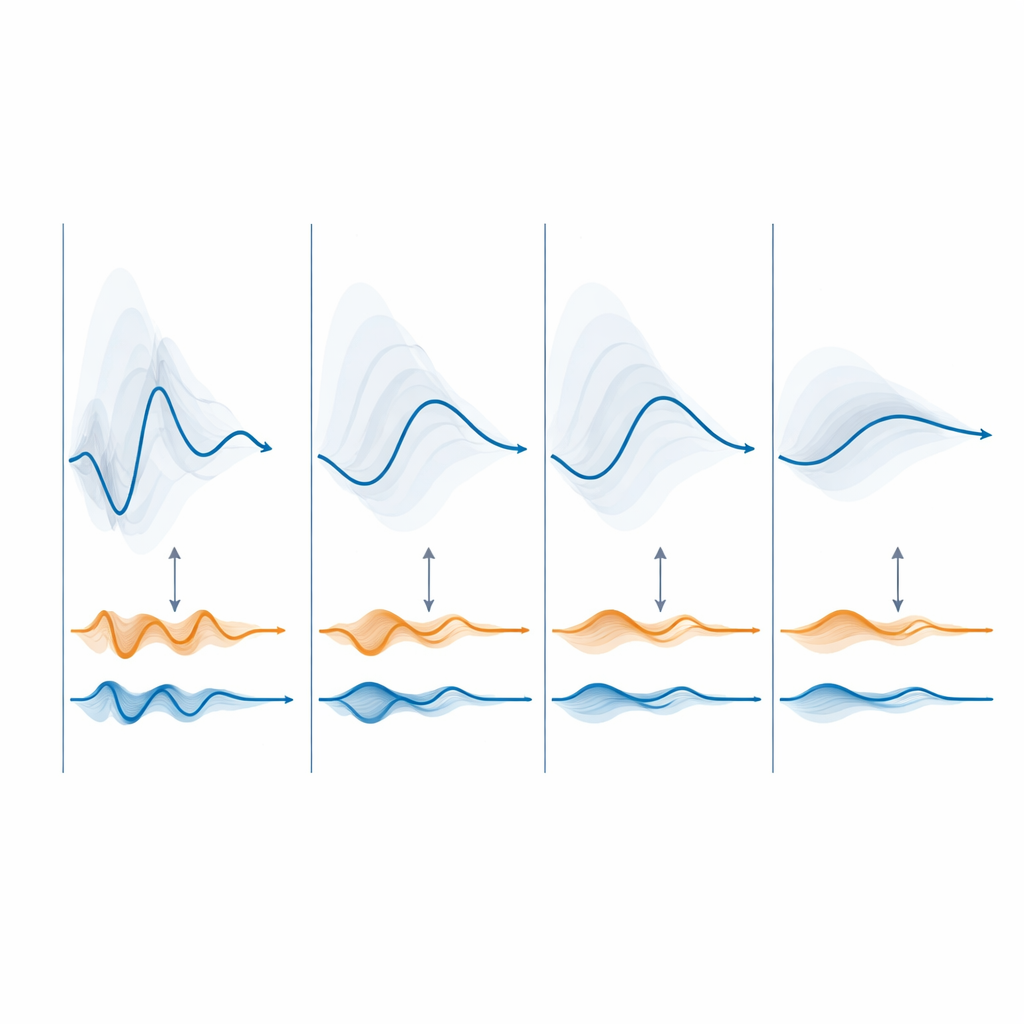
To demonstrate that the theory is not purely abstract, the authors present a numerical example involving two different fractional orders and a one-unit time delay. They approximate the solution using a standard technique for fractional derivatives known as the L1 scheme, which is well regarded for its stability and straightforward implementation. The computed solution evolves smoothly from the prescribed initial history, and the two different fractional derivatives exhibit distinct but related patterns, highlighting how each fractional order shapes the system’s memory. By introducing a small perturbation in the initial history and recomputing the solution, the authors verify numerically that the deviation remains proportional to the size of the perturbation, in line with the Ulam–Hyers stability theory.
What this means for real systems with memory
In everyday terms, the study shows that there is a flexible and mathematically sound way to describe systems whose present state depends on both a rich memory of the past and explicit delays. The Caputo–Katugampola framework, combined with the ρ-Laplace transform, not only guarantees that these models make sense and have well-defined, robust solutions, but also lends itself to practical computation. This opens the door to more accurate and reliable modeling of processes in areas such as viscoelastic materials, control systems, population dynamics, and biomedical phenomena, where memory and delay are essential features rather than small corrections.
Citation: Boumaaza, M., Boutiara, A., Djidel, O. et al. Analysis of delay differential equations with dual caputo-type fractional derivatives using laplace transform methods. Sci Rep 16, 11181 (2026). https://doi.org/10.1038/s41598-026-41584-2
Keywords: fractional differential equations, memory and delay systems, stability analysis, Laplace transform methods, numerical simulation