Clear Sky Science · en
Distribution, pollution status and controlling factors of trace metal(loid)s in Yellow river Estuary and adjacent area
Why the Yellow River’s Mud Matters
The Yellow River is often called “China’s sorrow” for its historic floods, but today another, quieter threat travels with its famously muddy waters: toxic metals. This study looks at how tiny amounts of metals such as mercury, cadmium, lead, and others are carried from land to sea, where they end up, and how dangerous they may be for the coastal ecosystem of the Yellow River Estuary and the nearby Bohai Sea. Understanding this pathway helps explain whether seafood, coastal communities, and marine wildlife are at risk—and what parts of the system most need protection.
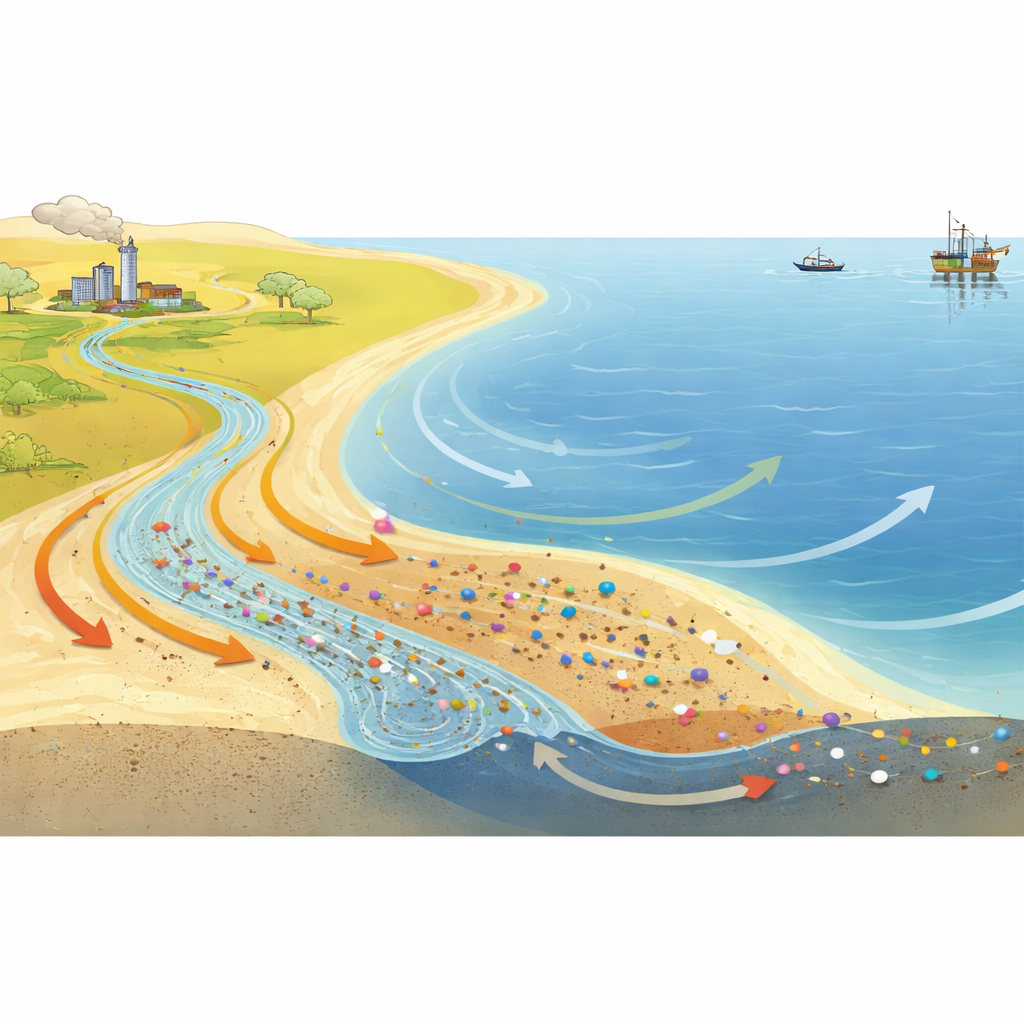
Following Pollution from River to Sea
The researchers focused on the stretch of sea just off the Yellow River’s mouth, extending into the central Bohai Sea. This region receives enormous quantities of sediment eroded from the Loess Plateau and washed downstream, along with metals released by farming, factories, cities, and wastewater. During a research cruise in May 2024, scientists collected surface water, bottom water, and the top layer of seafloor mud at 51 locations. They then measured seven trace metals—copper, lead, zinc, chromium, cadmium, arsenic, and mercury—in both the water and the sediment, and compared the results with national seawater quality standards and with natural background levels in the river’s sediments.
Clean Water, But Troubled Seafloor
The good news is that, in both surface and bottom waters, the concentrations of all seven metals were below China’s strictest seawater quality limits. In other words, the water itself is currently considered safe from metal pollution, even in areas where the river directly enters the sea. Still, the metal patterns were not uniform. Higher levels in the water tended to occur in a band stretching from the river mouth toward the northwest, while the eastern part of the study area showed lower levels. This pattern points to the Yellow River and nearby coastal activities as the main sources, with offshore currents spreading the contaminants across the estuary and into the Bohai Sea.
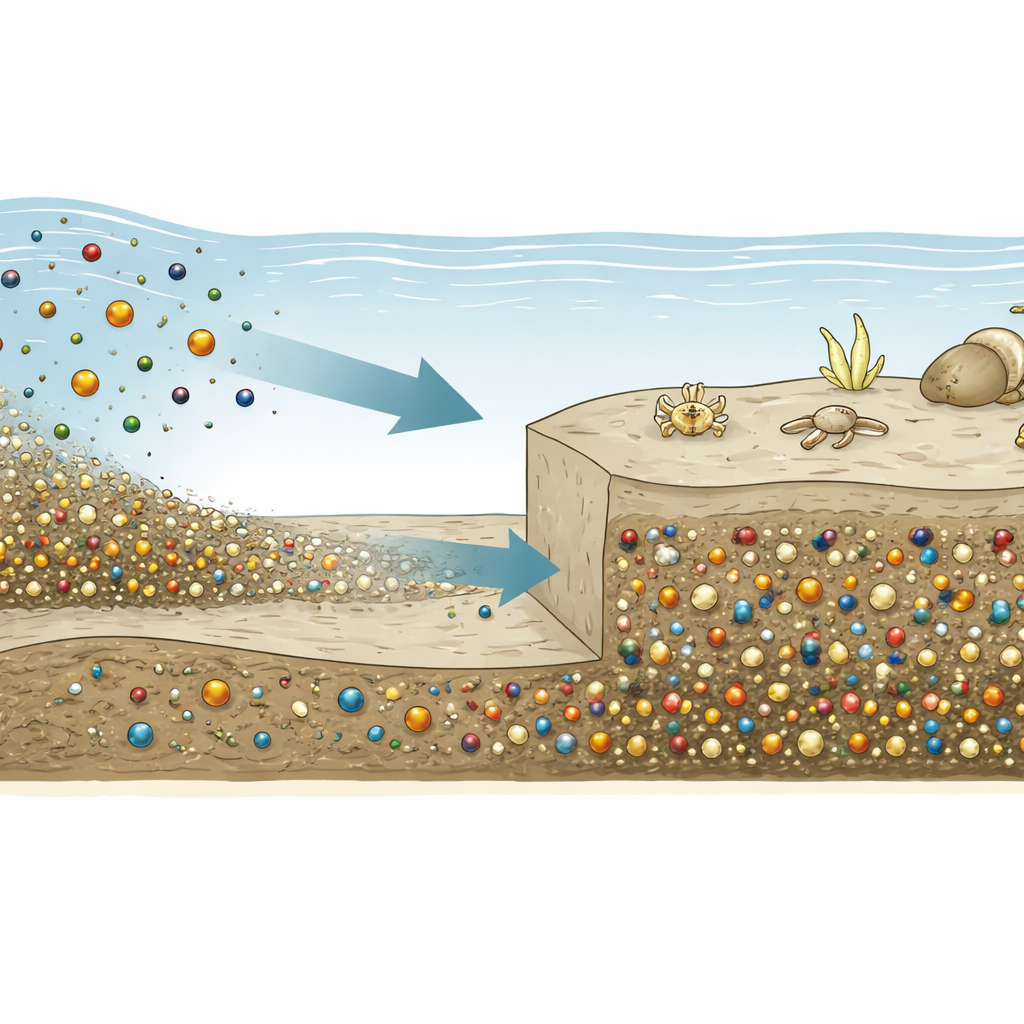
Hidden Risks Stored in Mud
The picture becomes more troubling when we look at the seafloor. The researchers found that metals are much more concentrated in fine, muddy sediments than in coarser sand. The northern part of the area and the zone just outside the river mouth, where the water slows and mud settles, contained the highest metal levels. Statistical tests showed that most metals tend to rise and fall together, suggesting shared sources and similar behavior once they reach the sea. When the team compared these sediment values with natural background levels, they concluded that most metals—copper, lead, zinc, chromium, and arsenic—remain in the “uncontaminated” range. Mercury and cadmium, however, stood out with clear enrichment across many sites.
From Stored Metals to Ecological Risk
To move beyond simple concentrations, the authors used widely accepted indices that combine how much of a metal is present with how toxic it is to bottom-dwelling organisms. These calculations revealed that copper, lead, zinc, chromium, and arsenic pose only low ecological risk in the study area. Cadmium represents a moderate risk at many stations and reaches moderate-to-heavy risk at a few hotspots near the estuary. Mercury is even more worrisome: most stations show at least moderate risk, and about one-third fall into the heavy-risk category. Overall, the combined risk from all seven metals is rated as “moderate,” with mercury and cadmium contributing the most.
How Nature and People Shape the Pattern
The distribution of metal pollution is not random. The study finds that the finest sediments, rich in organic matter, act like sponges that trap metals carried in from the river or released by human activities. Where tidal currents and coastal circulation are strong, sands dominate and metal levels stay lower; where the water slows down, mud accumulates and metals build up. Correlation analyses suggest that most metals in the sediments mainly come from Yellow River inputs, while mercury, lead, cadmium, and arsenic also bear the signature of offshore industrial activity, including nearby oil fields.
What This Means for Coasts and Communities
For the moment, the Yellow River Estuary’s waters appear relatively clean, but its seafloor is quietly storing potentially dangerous amounts of mercury and cadmium in fine mud. These buried metals can re-enter the food web through bottom-dwelling organisms and eventually reach fish and people. The study shows that the estuary acts as a natural filter, catching pollutants before they spread farther offshore, but it also highlights that this “filter” is becoming loaded with toxic material. Protecting this region will require better control of metal emissions from the river basin and offshore industries, and closer monitoring of the mud that, while out of sight, holds the long-term memory of human impact.
Citation: Yin, W., Zhang, M., Yu, Q. et al. Distribution, pollution status and controlling factors of trace metal(loid)s in Yellow river Estuary and adjacent area. Sci Rep 16, 13172 (2026). https://doi.org/10.1038/s41598-026-41583-3
Keywords: Yellow River estuary, trace metal pollution, marine sediments, Bohai Sea, mercury and cadmium risk