Clear Sky Science · en
Feasibility of modifying the washout water weir on dyna sand filters performance
Cleaner Water with Less Waste
As cities grow and rivers and canals become more polluted, water treatment plants must squeeze every drop of clean water they can from what flows in. This study looks at a clever tweak to an existing filtration technology, the dyna-sand filter, to see whether a small physical adjustment can both save water and improve water quality. By simply raising a small overflow edge, called a washout weir, the researchers show that treatment plants could waste less water during cleaning while still removing particles efficiently.
Why This Filter Is Different
Most traditional filters have to be stopped and flushed regularly to clean out trapped dirt, which costs time, water, and energy. The dyna-sand filter works differently: water flows continuously upward through a bed of sand mixed with activated carbon, which traps solid particles and some dissolved contaminants. At the same time, the sand grains themselves are slowly circulated, washed, and returned to the bed, so the system can run without shutting down. In this study, the researchers went a step further and used a dual-media bed—sand plus activated carbon—to boost the removal of cloudy particles and fine solids, simulating conditions found in demanding water and wastewater facilities. 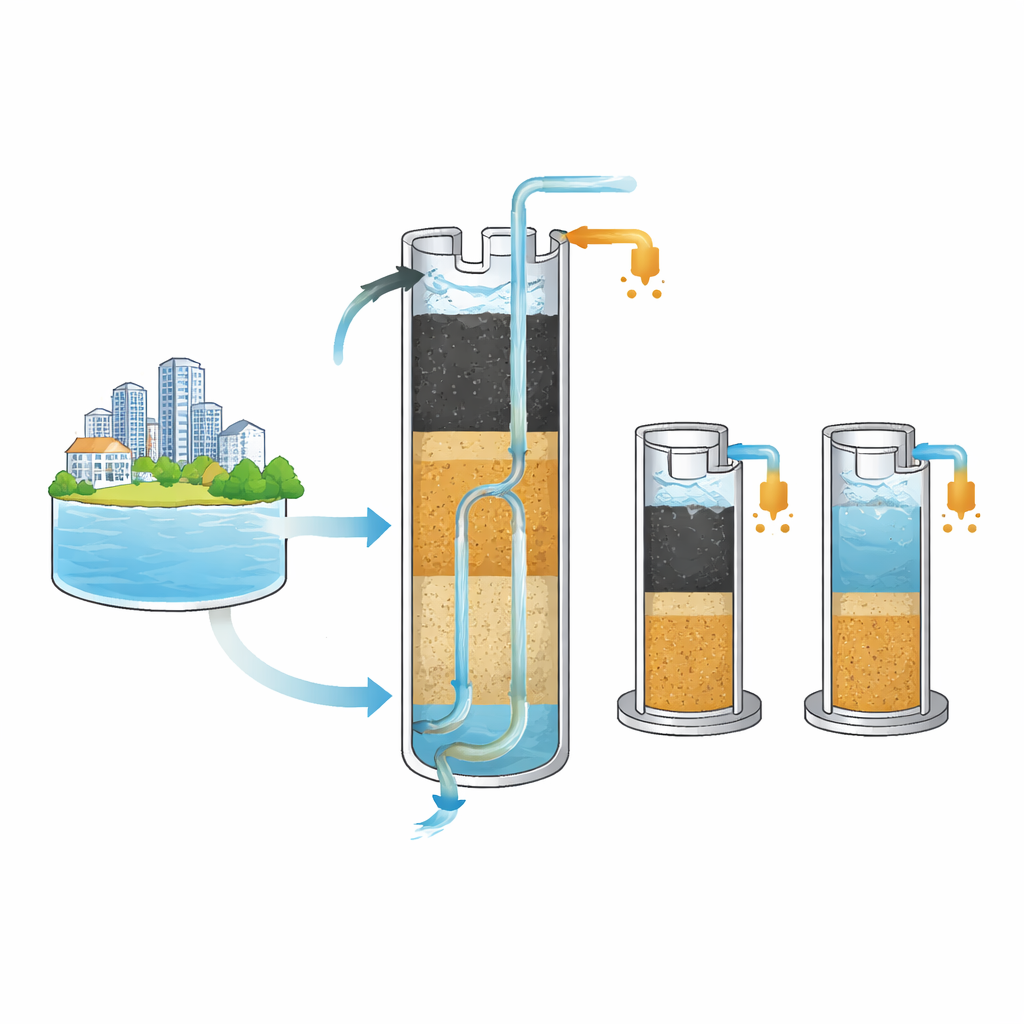
A Small Change to a Key Component
Inside this filter, dirty water that rinses particles off the sand is collected and discharged over a small barrier, the washout weir. Its height controls how much water is used for washing versus how much becomes clean product water. The team built a laboratory-scale version of the dyna-sand system and added a movable edge to this weir so they could adjust its height precisely. They then ran two sets of experiments under the same operating conditions: the same incoming solids level, the same flow rate, and the same filter media. In the first run, the filter operated with the original weir height; in the second, the weir was raised by 4 centimeters.
What Happened When the Weir Was Raised
Raising the weir changed the balance of flows inside the system. With the higher weir, the amount of water spilling away as dirty washout dropped sharply—from about 0.79 liters per minute to about 0.49 liters per minute, a reduction of roughly 38%. That meant more of the incoming water emerged as clean filtered water; overall production increased by about 2.2%, and the fraction of water lost in washing fell to around 2.5% of the inflow. At the same time, the washout water itself became much more concentrated with solids, showing that the filter was still effectively removing dirt but now doing so with less water. 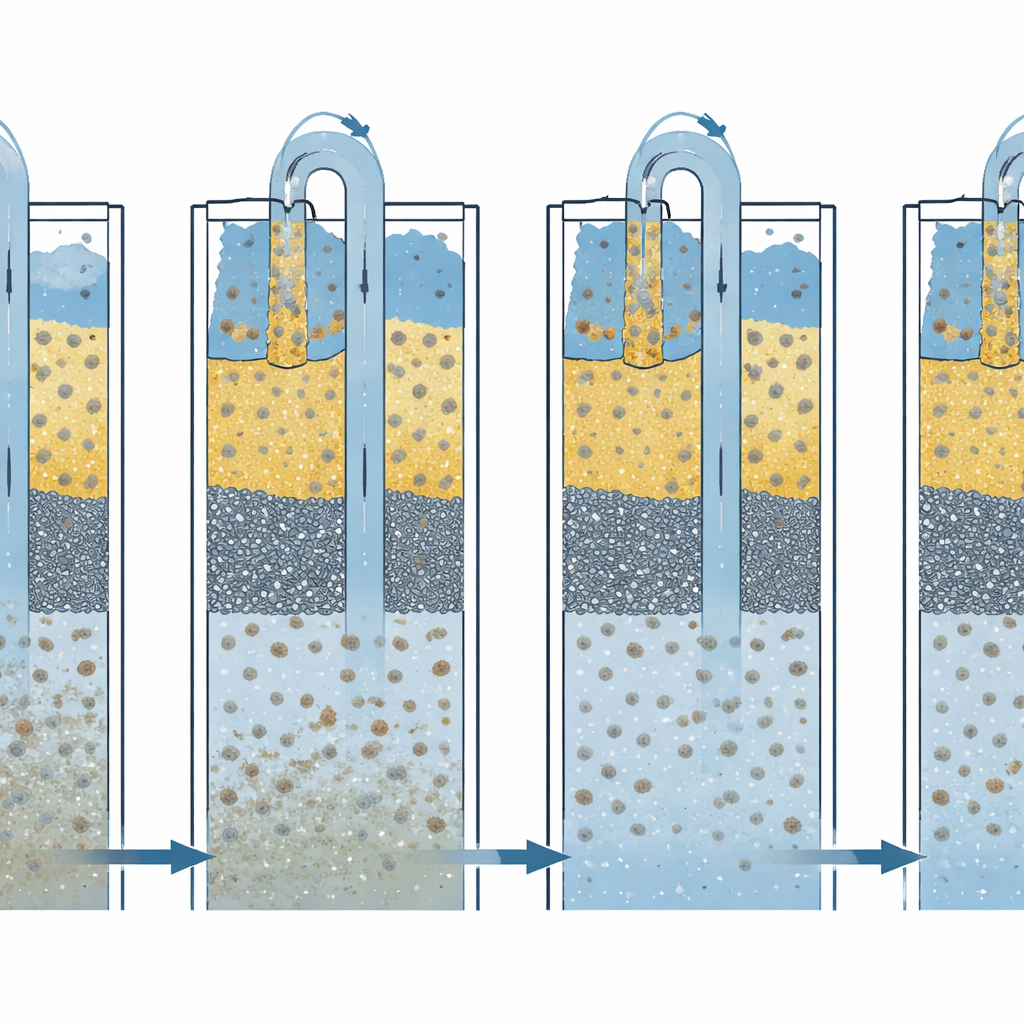
Cleaner Output and Stable Operation
Importantly, water quality at the outlet did not suffer when the washout water was reduced—if anything, it improved slightly. The incoming water had a total suspended solids (TSS) level of about 250 milligrams per liter and moderate cloudiness. In the unmodified case, the filter cut TSS to about 10.4 milligrams per liter, removing nearly 96% of the particles. After raising the weir, the outlet TSS dropped further to about 8.8 milligrams per liter, and removal efficiency nudged up to about 96.5%. Turbidity, a measure of how cloudy the water looks, stayed very low in both cases. The results suggest that the filter bed was cleaned at least as well, and possibly better, with the higher weir, supporting stable day‑to‑day operation.
What This Means for Real-World Plants
For a layperson, the main message is straightforward: a modest mechanical adjustment to a continuous sand filter can yield more clean water and less waste without adding complexity. By raising the washout weir in the dyna-sand filter, the study showed it is possible to cut the water used for self-cleaning by almost two-fifths while slightly improving how well the filter strips out particles. Although the tests were done on a laboratory unit, the underlying processes are the same as those in full-scale plants. If confirmed in larger systems, this simple change could help water utilities stretch limited supplies further, reduce the volume of dirty wash water they must handle, and support more resilient treatment under heavy pollution and high demand.
Citation: El Taher, E.E.M., El Nadi, M.H., Meshref, M.N.A. et al. Feasibility of modifying the washout water weir on dyna sand filters performance. Sci Rep 16, 9923 (2026). https://doi.org/10.1038/s41598-026-41574-4
Keywords: water treatment, sand filtration, dyna-sand filter, washout weir, water conservation