Clear Sky Science · en
Experimental performance comparison of fixed and single-axis subfields in a large-scale outdoor photovoltaic power plant
Why this solar study matters
As more countries turn to the sun to power homes and cities, a basic question becomes crucial: how should we arrange solar panels in the real world to squeeze out the most electricity? This study looks at that question in a large desert solar plant in Algeria, comparing panels that stand still with panels that slowly follow the sun. The results help show how to design better solar farms in hot, sunny regions where every extra percent of energy counts.
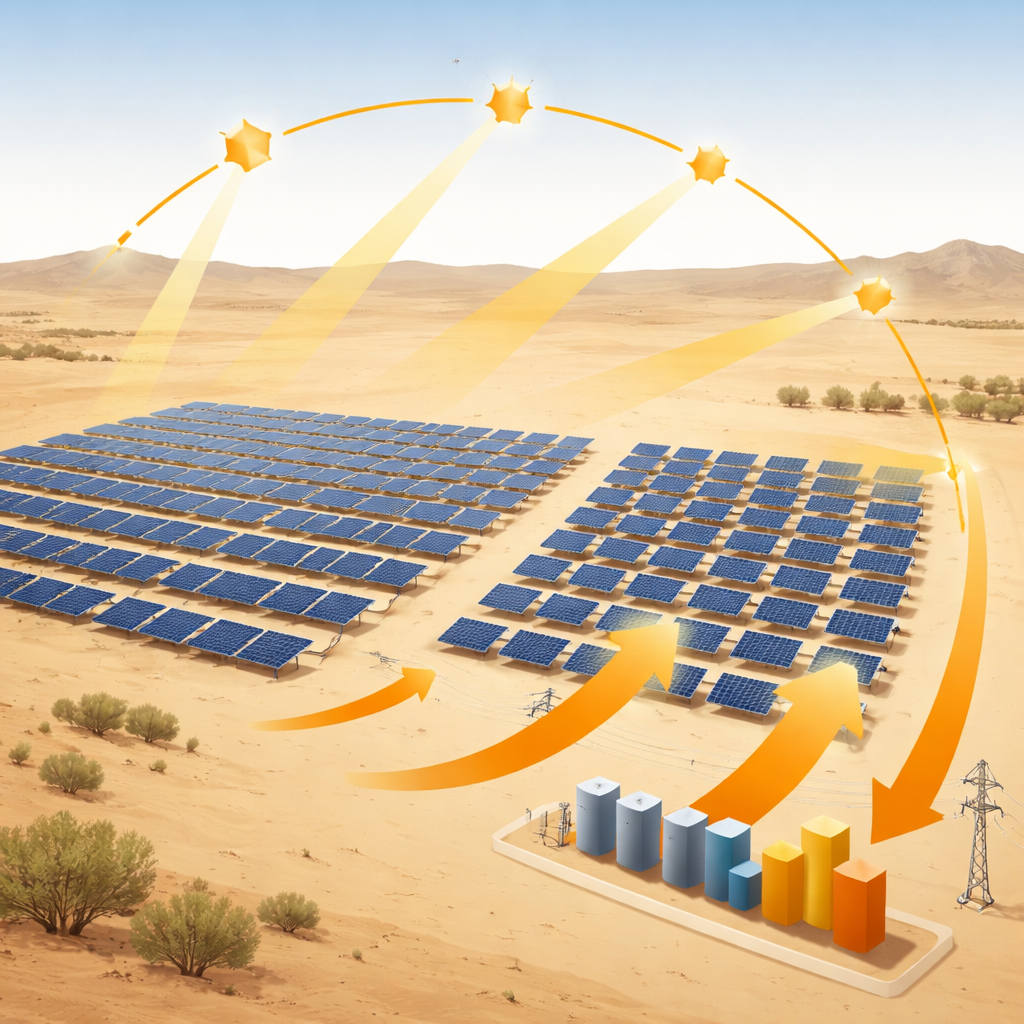
A desert power station as a real-world lab
The research takes place at a 1.1‑megawatt solar power plant near Ghardaïa, on the edge of the Sahara. Here, sunlight is intense but conditions are harsh: summer air temperatures can approach 50 °C, winds carry fine sand, and humidity swings from very dry afternoons to damp mornings. Within this plant, the team focused on four subfields of about 100 kilowatts each, all tilted at 30 degrees and facing south. Two subfields used monocrystalline silicon panels and two used polycrystalline silicon panels. For each material, one subfield was mounted on fixed frames and the other on single‑axis trackers that rotate east–west to follow the sun.
Watching the sun and the panels through the seasons
Instead of relying on simulations alone, the researchers measured what actually happened in the field. Over four days in 2016—one in winter, spring, summer, and fall—they recorded power output from every subfield every four minutes from sunrise to sunset. At the same time, a weather station on the control-room roof tracked solar brightness, air temperature, panel temperature, wind speed, and humidity. The team also tested a well-known mathematical model of sunlight on tilted surfaces, checking whether it could accurately predict the incoming solar energy using local geographical and atmospheric data. The model’s predictions matched measurements closely, especially in summer and fall, confirming it can reliably estimate available sunlight in this region when dedicated sensors are not available.
Fixed panels versus sun‑tracking panels
The power curves revealed how the different setups behave over a typical day. On a bright spring day, the fixed monocrystalline field briefly reached the highest peak power—about 96 kilowatts—slightly more than its tracking twin, because conditions at noon favored its exact orientation. But when the team looked at the whole day rather than the single highest moment, the story changed. Across all four seasons, the tracking systems produced more average power and more total daily energy than the fixed systems. In summer, the single‑axis monocrystalline subfield delivered about 19% more average power than its fixed counterpart, and the tracking polycrystalline field gained about 21% over its fixed twin. Daily energy followed the same pattern: on the July test day, tracking fields reached about 788 and 715 kilowatt‑hours, clearly beating the fixed fields, which stayed below 640 and 560 kilowatt‑hours.
How weather shapes solar performance
Because every reading was tied to weather data, the study could tease out how nature helps or hinders the plant. Stronger sunlight naturally boosted power, and the tracking fields captured more of it by keeping their faces better aligned with the sun throughout the day, especially in the morning and late afternoon. Temperatures, which often worry solar designers, stayed close enough to the panels’ preferred range that efficiency losses were modest; on the hottest summer day, high temperatures and strong sunlight together still coincided with the highest power gains for the tracking systems. Wind turned out to be a quiet ally: breezes cooled the panels and sometimes blew dust away, helping output, while high humidity and clouds in winter and fall reduced performance by dimming the light and letting moisture condense on panel surfaces.
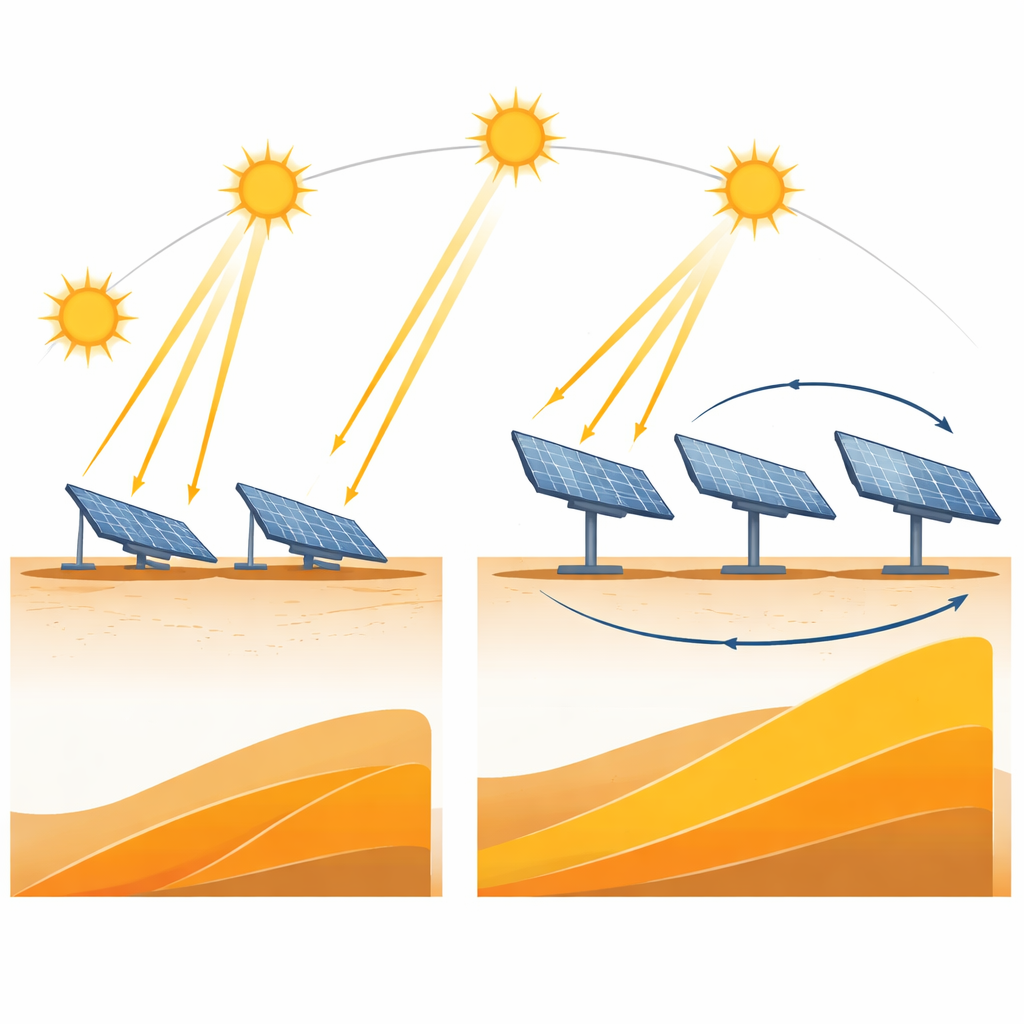
Putting numbers on the tracking advantage
To make the comparison clear, the researchers calculated an “augmentation percentage” that shows how much extra average power the tracking fields produced compared with fixed fields of the same panel type. Even in the less favorable winter and fall test days, single‑axis tracking boosted monocrystalline output by about 3–9% and polycrystalline output by roughly 12%. In the sunnier spring and summer tests, gains reached roughly 10–19% for monocrystalline panels and 20–21% for polycrystalline ones. Overall, the polycrystalline tracking field showed slightly larger percentage gains, while the monocrystalline tracking field delivered the highest absolute daily energy.
What this means for future solar farms
For readers thinking about the future of clean energy, the takeaway is straightforward: in hot, sunny deserts like southern Algeria, mounting solar panels on simple east–west tracking systems can noticeably increase the electricity produced from the same installed capacity. The study shows that these trackers not only smooth out power over the day but also respond well to local weather patterns, making better use of strong summer sun and cooling winds. The authors conclude that single‑axis tracking—especially with robust polycrystalline panels—offers a strong option for large solar farms in Saharan climates, and that reliable sunlight models can help design such systems even where detailed measurements are scarce.
Citation: Abderraouf, B., Lakhdar, L.M., Abdelkader, B. et al. Experimental performance comparison of fixed and single-axis subfields in a large-scale outdoor photovoltaic power plant. Sci Rep 16, 12293 (2026). https://doi.org/10.1038/s41598-026-41570-8
Keywords: solar tracking, photovoltaic power plant, desert solar energy, monocrystalline and polycrystalline panels, solar irradiance modeling