Clear Sky Science · en
A novel methodology to study the release of fragmented fibres, including microplastics, in laboratory washing conditions
Why Your Laundry Matters to the Ocean
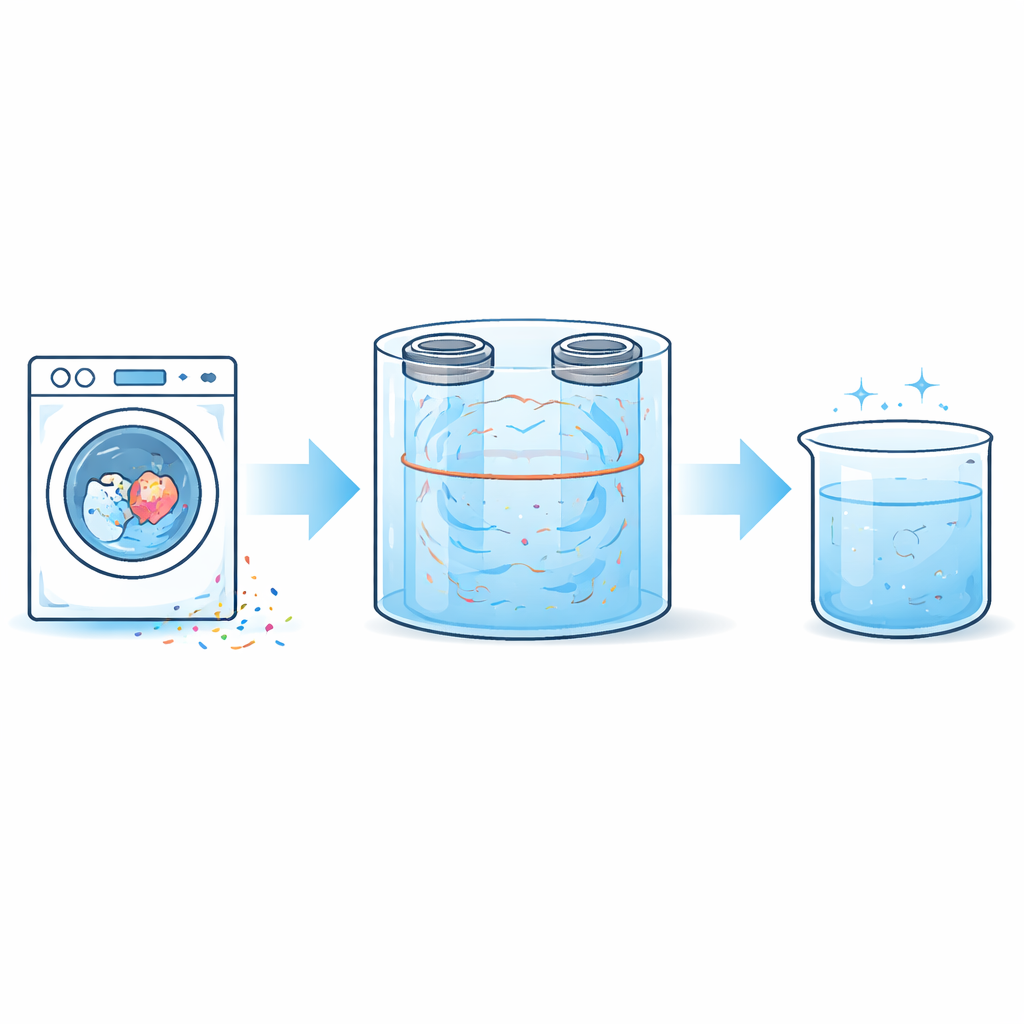
Every time we wash our clothes, tiny threads break loose and escape with the wastewater. Many of these fragments, including plastic-based fibres, drift into rivers, lakes, and oceans, where they can be swallowed by fish and other wildlife. This paper presents a new way to watch, in unprecedented detail, how individual fibres are bent, shaken, and ultimately broken off during washing. By understanding the physical forces at play, the researchers aim to help engineers design clothes and washing machines that shed fewer fibres—and thus reduce a major but largely invisible source of pollution.
Hidden Threads in the Environment
Textile fibres, whether made from plastic, regenerated materials like rayon, or natural sources such as cotton, have been found in virtually every environment examined, from deep oceans to remote shorelines. Washing clothes is now known to be one of the main ways these so‑called fragmented fibres enter the environment, contributing an estimated third of the primary microplastics reaching the sea. Existing testing standards focus on weighing what comes off garments after washing. While this tells us how much material is released, it does not reveal how or why individual fibres break and detach from fabrics in the first place. Without that mechanistic understanding, it is difficult to improve textiles or wash cycles in a targeted way.
Building a Miniature, Transparent Washer
To tackle this problem, the authors created a laboratory setup that mimics the turbulent, swirling water inside a washing machine but under much better control. At the heart of their system is a clear acrylic cylinder containing two metal disks that spin in opposite directions, generating strong circulating currents and a sharp shear zone similar to the complex flow around tumbling laundry. A single dyed yarn—either polyester, representing a common synthetic fibre, or cotton, representing a natural one—is stretched across the middle of the cylinder using a carefully tensioned wire frame. This arrangement isolates one strand of textile in a well‑defined flow so that its motion can be tracked precisely rather than lost in the chaos of real laundry loads.
Watching Water and Fibres at the Same Time
The key innovation is the simultaneous measurement of water motion and fibre motion in the same region. The water is seeded with tiny hollow glass spheres that move with the flow and are illuminated by a laser sheet. One high‑speed camera captures these tracer particles, allowing the team to reconstruct the water’s velocity field using a technique known as particle image velocimetry. A second camera, fitted with a colour filter, records only the fluorescent glow of the specially dyed yarn, ignoring the particles. Advanced image processing and an optical‑flow algorithm then turn these recordings into maps of how each point along the fibre moves, bends, and twists over time. By aligning the two camera views, the researchers can directly compare local flow patterns with the fibre’s response down to millimetre and millisecond scales.
What the Fibres Reveal Under Stress
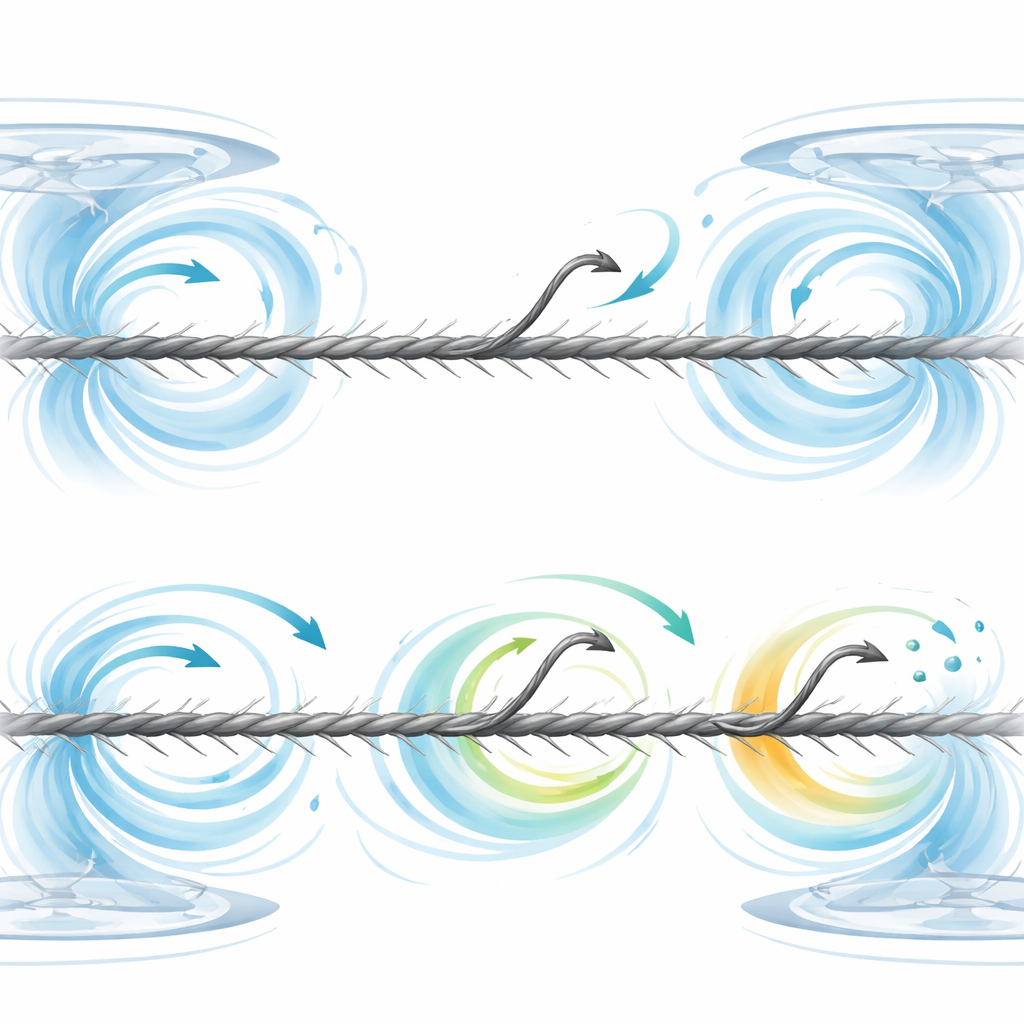
Proof‑of‑concept experiments show that the method can distinguish how different materials behave under the same washing‑like conditions. Polyester yarns tended to remain relatively straight, while cotton yarns showed more pronounced curvature and deformation, reflecting their lower stiffness. The visualisations also reveal small side fibres protruding from the yarn that oscillate in response to turbulent eddies, pivoting around their attachment points. Rapid rotations and bending, sometimes over just hundredths of a second, suggest high stresses concentrated where the fibre meets the yarn. Over many such cycles, these stresses are expected to cause fatigue and eventual breakage. Because both the water and fibre motions are quantified, the team can now relate features such as vortex strength or oscillation frequency to the likelihood that a given fibre will fragment and detach.
From Laboratory Insight to Cleaner Laundry
For non‑specialists, the main takeaway is that this new method lets scientists “see” how washing damages fibres in real time, instead of only measuring what has already broken off. This mechanistic insight opens the door to smarter solutions: adjusting drum speeds and water flow patterns to soften the most damaging turbulence, or redesigning yarns and fabrics so that fewer loose ends protrude and fatigue. Although the laboratory setup simplifies the full complexity of real washing machines, it provides a crucial baseline for testing how detergents, water quality, and textile structures influence fibre shedding. Ultimately, approaches like this could help reduce both plastic and natural fibre pollution at its source, making everyday laundry less harmful to aquatic ecosystems.
Citation: Palacios-Marín, Á., Palacios-Marín, A.V., Tausif, M. et al. A novel methodology to study the release of fragmented fibres, including microplastics, in laboratory washing conditions. Sci Rep 16, 11493 (2026). https://doi.org/10.1038/s41598-026-41563-7
Keywords: microplastics, laundry pollution, textile fibres, washing machines, turbulent flow