Clear Sky Science · en
Ultrasound-assisted aqueous two-phase extraction of flavonoids from erigeron breviscapus: process optimization, structural characterization, antioxidant study, and DFT calculation
Why a brain herb and its plant chemicals matter
Many traditional medicines come from plants, but turning a dried herb into a reliable, modern product is not straightforward. This study focuses on Erigeron breviscapus, a Chinese medicinal herb used to treat problems like stroke and poor blood flow to the brain. The researchers set out to design a cleaner, faster way to pull out its key plant chemicals—flavonoids—that may act as natural antioxidants, and to understand at the atomic level how one major compound helps disarm damaging molecules linked to aging and disease. 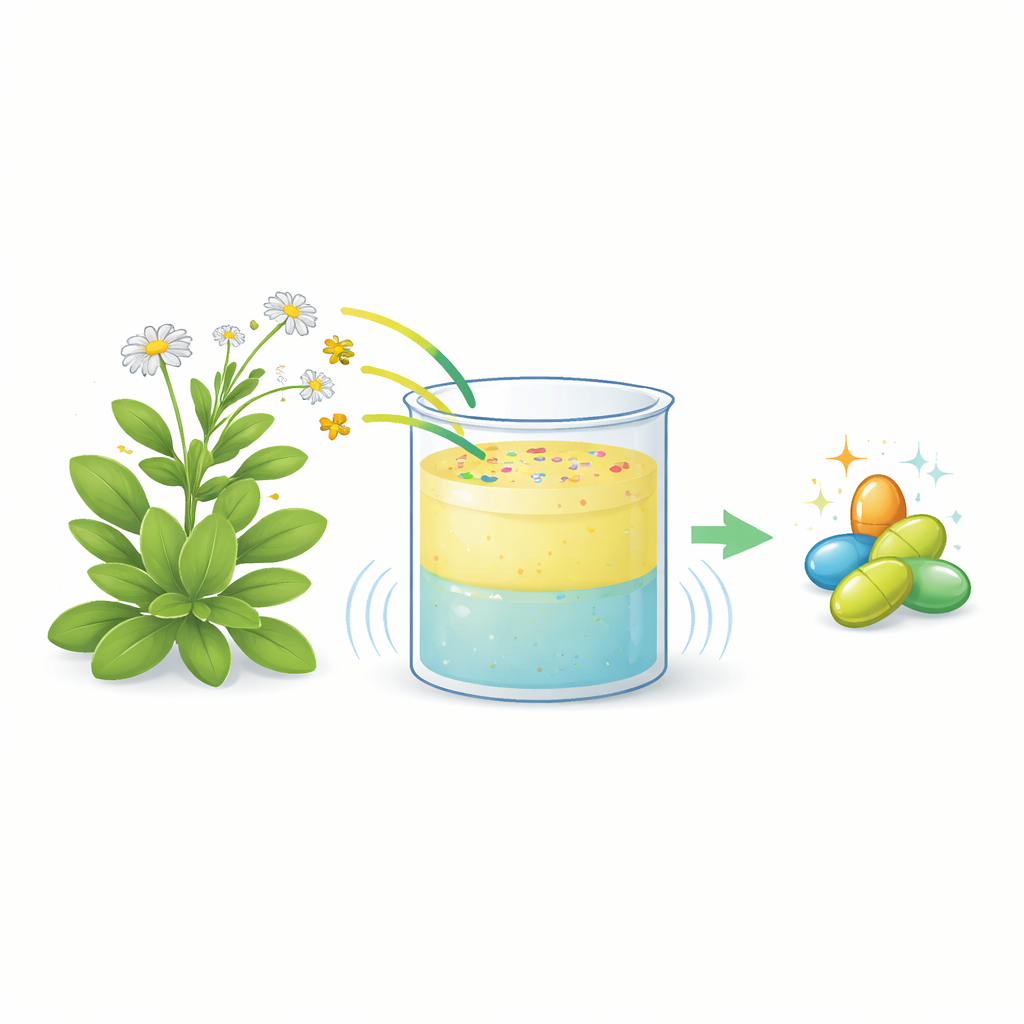
From folk remedy to gentle green extraction
The team began with a simple question: how can we best extract helpful flavonoids from Erigeron breviscapus without harsh solvents or wasteful processes? They combined two ideas. First, an “aqueous two-phase” system, where water is split into two liquid layers by mixing a polymer (PEG2000) and a common salt ((NH₄)₂SO₄), so that target compounds naturally prefer one layer. Second, ultrasound, whose tiny pressure waves help break plant cells and speed up the release of interior contents. By carefully tuning the amount of polymer and salt, the time of ultrasound treatment, and the ratio of liquid to plant material, they aimed to concentrate the flavonoids efficiently into the upper phase of this gentle, water-based system.
Fine-tuning the recipe for maximum yield
To avoid trial-and-error guesswork, the researchers used a statistical approach called response surface methodology. They varied four key factors—polymer fraction, salt fraction, ultrasound time, and liquid-to-solid ratio—across 29 experiments and built a mathematical model that predicts how much flavonoid can be obtained under different settings. The optimized conditions were a PEG2000 fraction of 16%, ammonium sulfate at 14%, an ultrasound treatment of about 41 minutes, and a liquid-to-solid ratio of 35 mL per gram of dried plant. Under these conditions, the total flavonoid content reached 48.53 milligrams per gram of plant, and the model’s prediction closely matched reality, showing that the process is both efficient and reliable.
Who is in the mix and how strong is the antioxidant punch?
Getting a high yield is not enough; one must also know what is in the extract. Using an advanced separation and detection method (UPLC-Q-TOF-MS/MS), the team cataloged 28 different flavonoids in the extract, including well-known compounds such as scutellarin, baicalin, quercetin, and rutin. Many of these have been linked to beneficial effects on the brain, blood vessels, and inflammation in earlier studies. The researchers then tested how well the combined flavonoid extract could neutralize hydroxyl radicals—highly reactive molecules that can damage DNA, proteins, and fats. The extract showed a steadily increasing ability to quench these radicals as its concentration rose, reaching about 60% scavenging at the highest tested dose, although it was less potent than pure vitamin C. 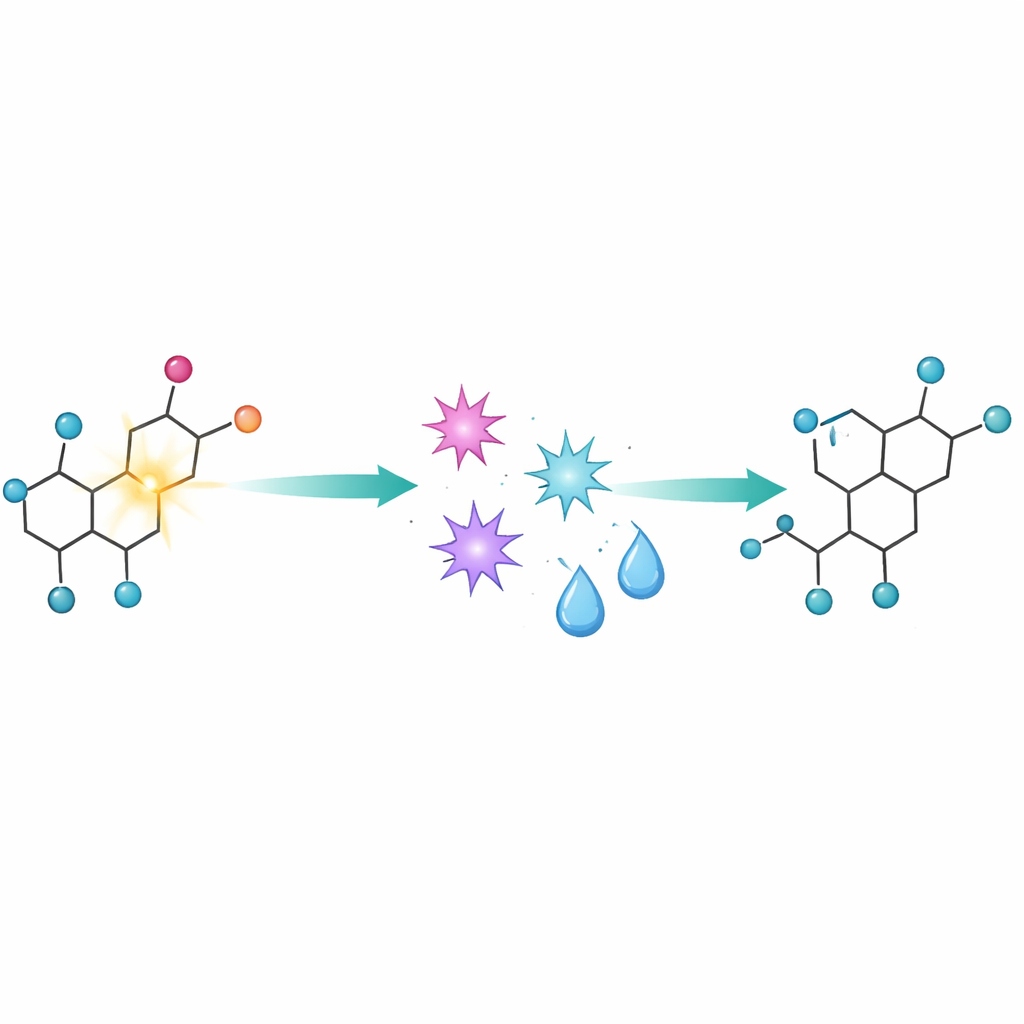
Zooming down to the hot spot on a single molecule
Intriguingly, the team went beyond measuring antioxidant strength and asked where, exactly, on one key molecule the action happens. Scutellarin, the main flavonoid in the herb, has several positions where it can donate a hydrogen atom to neutralize a hydroxyl radical. Using computer-based quantum chemistry (density functional theory), they simulated how easily different hydrogen atoms on scutellarin’s structure can be given up and how stable the resulting “spent” molecule would be. A combination of energy calculations and electron distribution maps pointed to one specific position, called the 6-OH site, as the most favorable spot for this reaction. This site has the lowest energy barrier for bond breaking and produces a particularly stable, harmless radical, explaining why it is the core active site.
What this means for natural antioxidant development
For non-specialists, the takeaway is that this study links an eco-friendly extraction process with a detailed picture of how a traditional brain herb fights harmful reactive molecules. The researchers have shown that Erigeron breviscapus can be processed using water-based, ultrasound-assisted methods to yield a rich mixture of flavonoids, and that this extract offers moderate protection against one of the most aggressive forms of oxidative damage. At the same time, by pinpointing the 6-OH position on scutellarin as the key “defense point,” they provide guidance for designing improved plant-based antioxidants or related drugs. While these tests were carried out in test tubes rather than living organisms, the work lays a foundation for future studies in cells and animals, moving a long-used folk remedy closer to precise, science-guided applications.
Citation: Qian, H., Wang, M., Xu, H. et al. Ultrasound-assisted aqueous two-phase extraction of flavonoids from erigeron breviscapus: process optimization, structural characterization, antioxidant study, and DFT calculation. Sci Rep 16, 11831 (2026). https://doi.org/10.1038/s41598-026-41556-6
Keywords: Erigeron breviscapus, flavonoids, natural antioxidants, ultrasound extraction, scutellarin