Clear Sky Science · en
The SEWAbility system: a video-based job analysis framework for understanding task-specific job demands
Why this matters for workers and employers
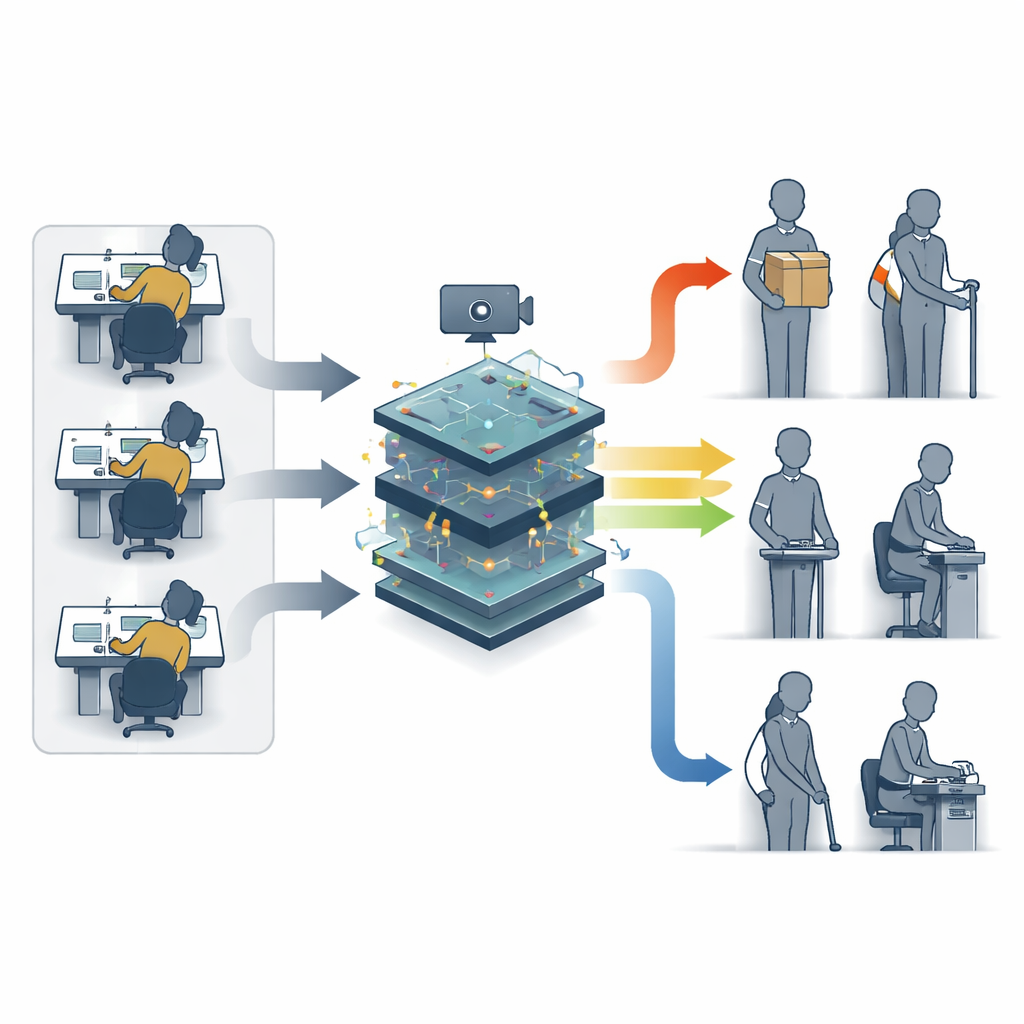
Many people with health problems want to work but struggle to find jobs that truly match what their bodies can handle. At the same time, factories need reliable ways to understand what each job physically demands from workers. This study presents SEWAbility, a new video-based system that uses artificial intelligence to read ordinary factory camera footage and translate sewing work into clear, measurable descriptions of how the body moves. The long-term goal is to help match people—especially those with disabilities—to jobs that fit their abilities more safely and fairly.
From factory cameras to useful job information
Traditional job analysis often depends on experts watching workers, taking notes, running focus groups, and interviewing managers. This process is slow, subjective, and not detailed enough to capture the exact movements and efforts a job requires. In a Chinese sewing factory, the research team saw these limits first-hand: workers could say they were sewing bedsheets or school uniforms but could not describe each step in a clear, measurable way. Vocational rehabilitation professionals could point out repeated arm movements or bending, yet they had no precise numbers on how fast or how far the joints moved. SEWAbility was created to fill this gap by turning overhead workplace videos into objective motion data that can be analyzed consistently.
Breaking sewing work into smaller building blocks
SEWAbility focuses on how sewing workers use their arms and upper body. It starts with top-down camera views that protect privacy by not showing faces. The system tracks the shoulders, elbows, and wrists frame by frame, then summarizes how these joints move over time using 88 motion features, such as speed, direction, and range of movement. First, the system groups videos into broad task types—like sewing tops, beddings, or bottoms—based only on movement patterns. In tests on 21 real factory videos, this automatic grouping correctly matched task type in about 86 percent of cases, showing that different sewing jobs really do leave distinct motion “signatures” on camera.
Finding repeated cycles and tiny repeated motions
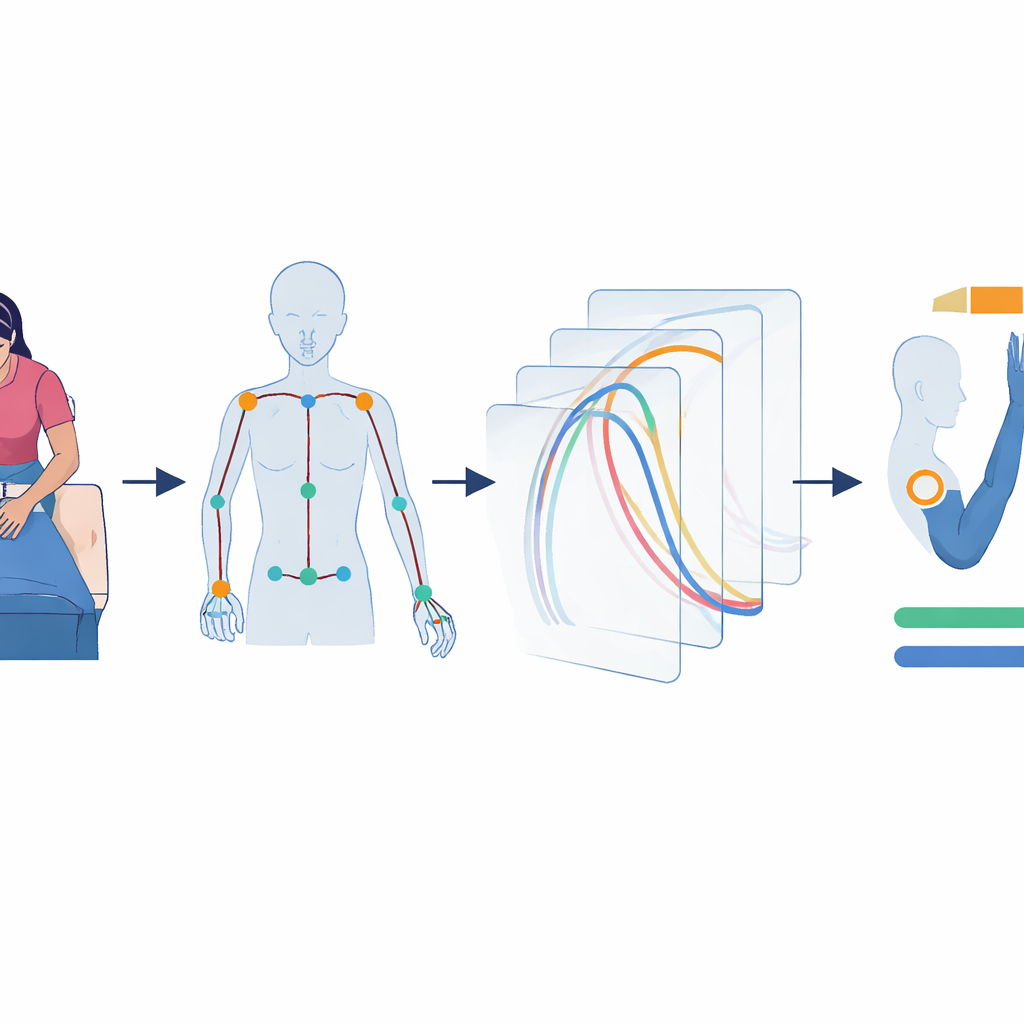
Once a task type is identified, SEWAbility zooms in. It detects work cycles, such as sewing one entire bedsheet from start to finish. In sewing, a clear cue is the moment when the worker bends down to remove finished fabric and pick up a new piece. By tracking where the hand appears near the edge of the table, the system marks the start and end of each cycle. Within each cycle, it then slices the video into many short, overlapping one-second segments and clusters them to find the most common movement pattern. A second, more precise step uses the up-and-down peaks of wrist motion to carve that dominant pattern into very small work elements—the basic repeated motions, like pushing fabric forward through the needle.
Turning motion into numbers that describe job demands
For these repeated work elements, SEWAbility calculates detailed “repetitive motion pattern” features. These include how far each joint travels, how fast it moves, and how much the elbow and shoulder angles change. In one sewing-top video, the system identified seven clear work cycles and, in the first cycle alone, 18 stable repetitive work elements lasting just over a second each. For selected examples, it showed that the worker’s arms moved far more in the horizontal direction than vertically, matching what you would expect when sliding fabric through a sewing machine. By scaling movements relative to shoulder width, these features can be interpreted in real-world centimeters and degrees, making them easier for clinicians and ergonomists to use as benchmarks.
What this could mean for fairer and safer work
Although this initial study focused on a single sewing worker with a physical disability, the SEWAbility framework shows that it is technically possible to build rich, task-specific profiles of how demanding a job is, using only workplace videos. As more workers and more tasks are added, these motion profiles could support data-driven employment recommendations, helping match people’s physical capacities with the true demands of factory jobs. Compared with traditional, more subjective job analysis, SEWAbility offers a scalable way to monitor repetitive work over long periods, paving the way for fairer hiring, better vocational rehabilitation planning, and more informed workplace design.
Citation: Hu, H., Ding, Z., Fu, E.Y. et al. The SEWAbility system: a video-based job analysis framework for understanding task-specific job demands. Sci Rep 16, 10370 (2026). https://doi.org/10.1038/s41598-026-41536-w
Keywords: vocational rehabilitation, sewing factory work, video-based motion analysis, job demands, workplace ergonomics