Clear Sky Science · en
An efficient uncertainty integrated aggregation scheme for water quality detection and longitudinal carbon offset estimation in the Yamuna River
Why this river story matters
The Yamuna River is a lifeline for millions of people and farms in northern India, but decades of sewage and industrial waste have left long stretches dangerously polluted. This study looks beyond simple pass or fail scores for water quality and asks a deeper question: how can we judge the river’s health, including its ability to soak up carbon, when our measurements themselves are uncertain and conditions change from place to place?
Following the river from source to city
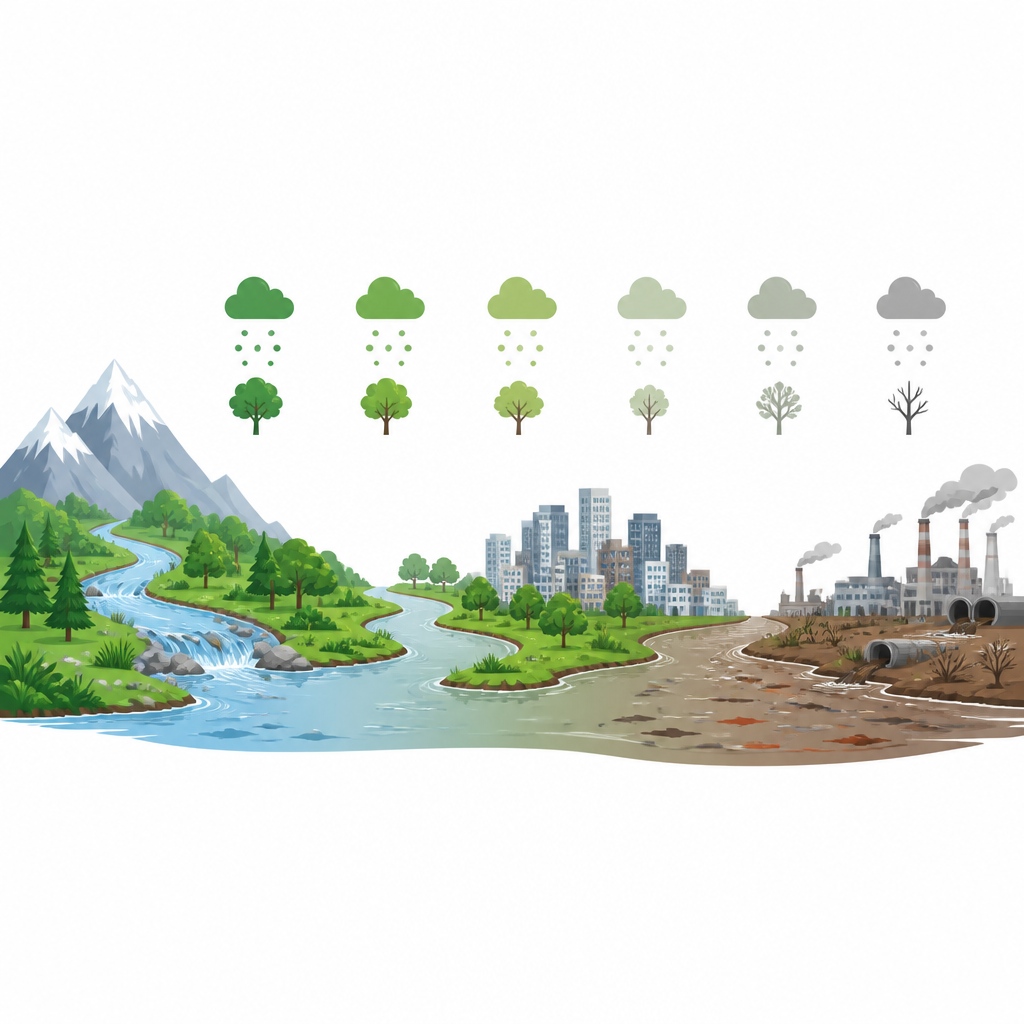
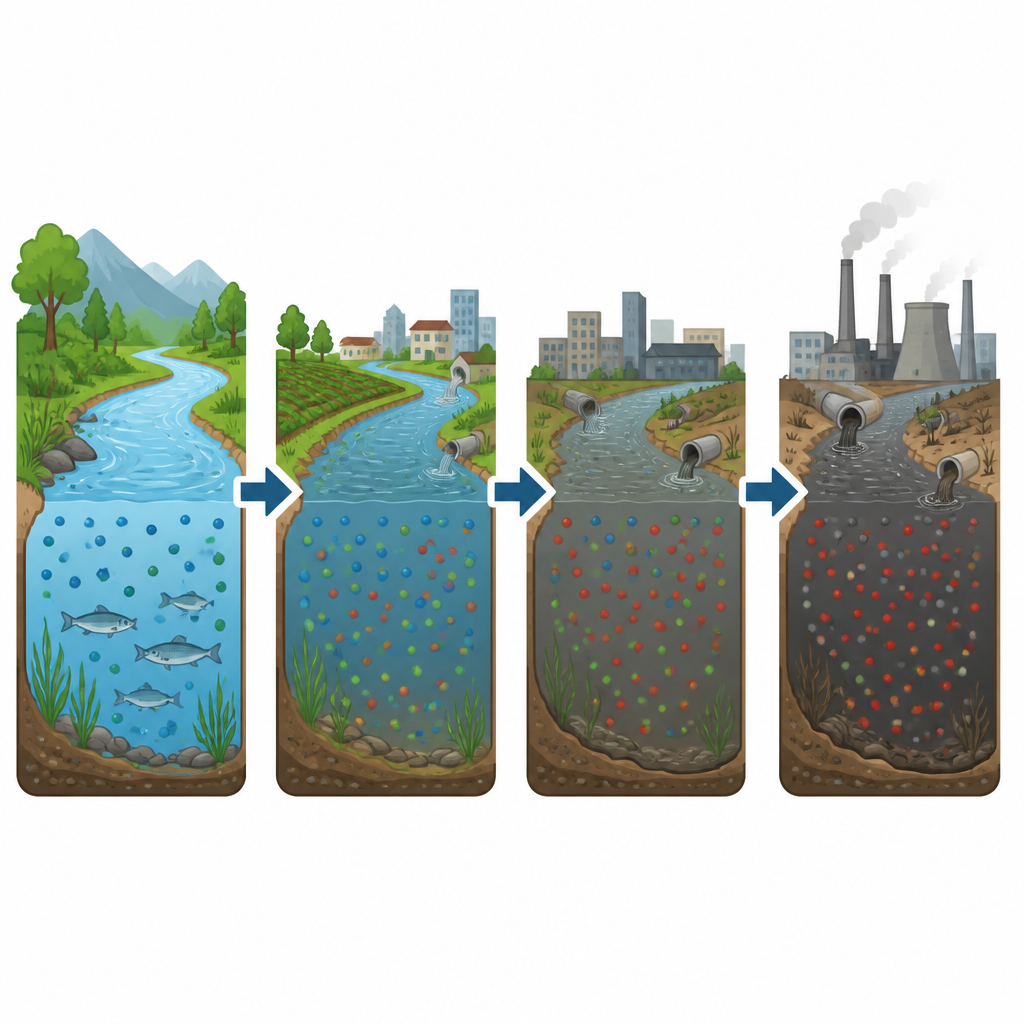
Researchers focused on 25 monitoring stations along the Yamuna, from its clean mountain headwaters to heavily used urban and industrial stretches downstream. They examined eight basic indicators that together paint a picture of river health: temperature, acidity, dissolved salts, oxygen levels, organic waste, nutrients, and two types of bacteria that signal sewage. Upstream sites in the hills showed cool, oxygen rich water with very little organic pollution or microbial load, suggesting a near natural state. As the river passed through towns, farms, and factories, oxygen dropped while organic waste, salts, and bacteria surged, especially near large population centers and industrial zones.
Making sense of noisy data
Standard water quality indices often treat each measurement as if it were precise and equally reliable, even though some readings are far more uncertain than others. For example, temperature is easy to measure, but counts of bacteria can swing widely depending on when and how samples are taken. The authors tackle this problem by representing each measurement as a small three dimensional shape that encodes three ideas at once: how strongly it points toward good conditions, how much doubt surrounds it, and how strongly it suggests poor conditions. Importantly, this shape can stretch more along the “uncertain” direction for jumpy indicators like bacteria, and stay tight for steadier ones like pH or temperature. This lets the model mimic the real behavior of river data rather than forcing a one size fits all view of error.
Two lenses on river stress
To turn this cloud of uncertain measurements into practical scores, the team built two mathematical “lenses.” One combines information in a way that reflects average behavior across all parameters, giving a smooth picture of overall river condition. The other behaves more like a “worst case” detector: when even one key factor such as organic waste or fecal bacteria becomes extreme, the combined score plunges. Applied to the Yamuna, both lenses show a clear decline in health from upstream to downstream, but the worst case lens collapses near zero at the most polluted locations. This sharp drop flags stretches where the river is not just degraded but under severe ecological strain, with oxygen depletion and heavy microbial loads that can disrupt normal life in the water.
Connecting water health to carbon balance
The study then links these river health scores to a simple estimate of how much carbon the river can process along its course. Where the new indices are high, conditions support oxygen rich, aerobic breakdown of organic matter, which underpins stable carbon cycling. Where the indices fall, especially under the worst case lens, the river shifts toward oxygen poor conditions that slow natural processing and may increase the risk of climate warming gases such as methane. Although the authors use a basic linear conversion rather than a detailed carbon model, this step reframes pollution as a loss of ecosystem service: a dirty river is not only unsafe for people and wildlife, it also does less work for the climate.
What this means for river care
In simple terms, the study offers a smarter scoreboard for river health that keeps track of both uncertainty and hidden extremes. For the Yamuna, it confirms what many observers already fear: while its mountain reaches are still resilient, long urban and industrial stretches are so overloaded with waste that their ecological functions are close to collapse. By highlighting exactly where and how conditions tip from manageable to critical, and by tying water quality to carbon handling, the framework can help planners decide which stretches most urgently need cleanup, how to protect healthier reaches, and how river restoration can support broader climate and sustainability goals.
Citation: Sandhiya, M., Bhavithra, H.A., Sharmila, S.L. et al. An efficient uncertainty integrated aggregation scheme for water quality detection and longitudinal carbon offset estimation in the Yamuna River. Sci Rep 16, 15527 (2026). https://doi.org/10.1038/s41598-026-41525-z
Keywords: Yamuna River, water quality, river pollution, carbon offset, ecosystem services