Clear Sky Science · en
Analysis of influencing factors on the plastic zone width and stability of aeolian sand-based backfill strips
Protecting Land Above Hidden Mines
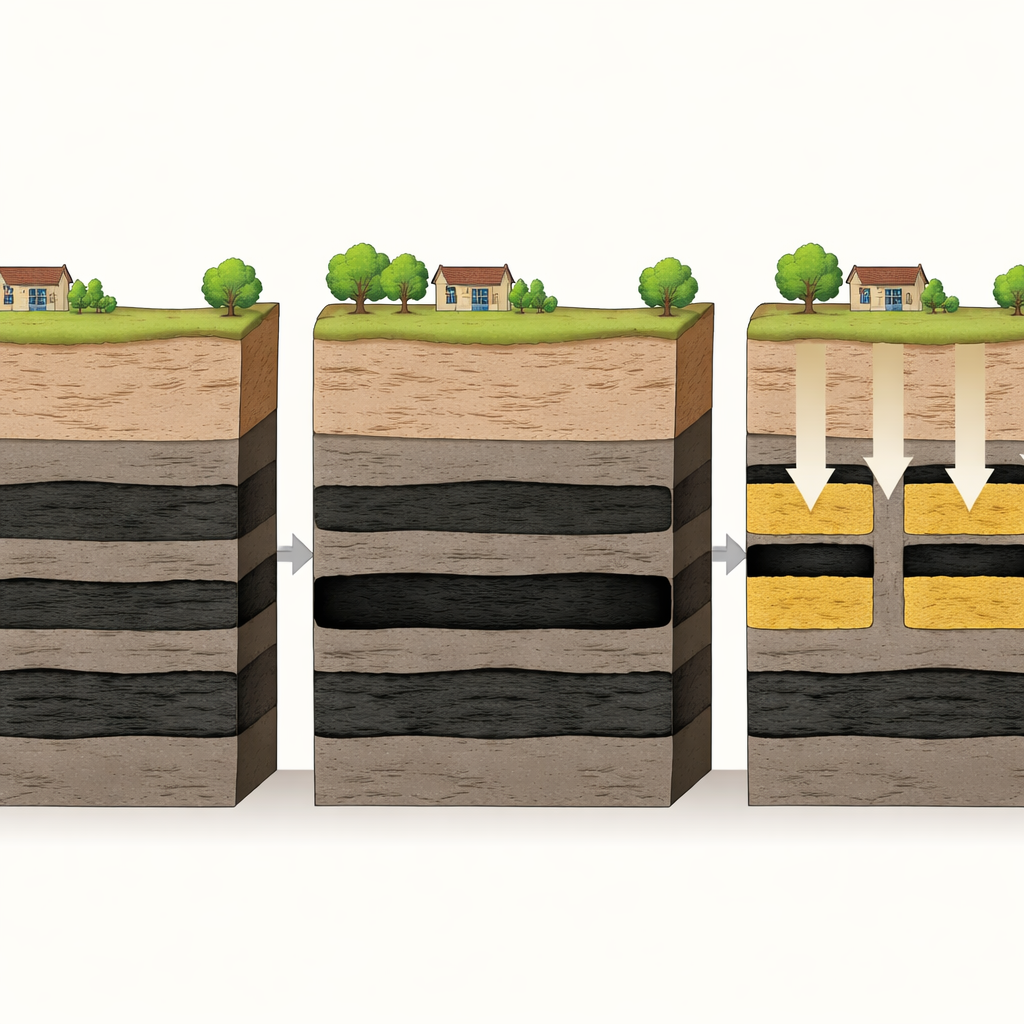
Many coal mines lie directly beneath villages, roads and farmland. When coal is removed, the rock layers overhead can sag and the ground surface may sink, cracking buildings and disturbing ecosystems. This study explores a way to support those underground voids using a special sand-based filling material, so that coal can still be mined while keeping the land and structures above as safe and steady as possible.
Turning Desert Sand into Underground Support
The researchers began by developing a new backfill material using aeolian sand—fine sand deposited by wind in desert areas—as the main ingredient. In western China, this sand is abundant, easy to collect and cheap. They combined it with industrial waste fly ash that was chemically activated with lime and gypsum so it would harden into a solid mass. Tests showed that the resulting slurry flows easily through pipes and then sets into a reasonably strong rock-like body, making it practical to pump into mined-out spaces underground.
How the Sand Backfill Behaves Under Pressure
To understand how this material would perform deep underground, the team made cylindrical samples and squeezed them from all sides in a powerful testing machine. By changing the surrounding pressure, they could mimic different depths in a mine. As the pressure around the sample increased, the backfill became stronger and deformed less before breaking. From these experiments, the scientists calculated key strength properties that engineers need, such as how much shear stress the material can resist. These values were then used to estimate how strong a strip of backfill would be when supporting the weight of hundreds of meters of rock above it.
Mapping the “soft edge” around backfill strips
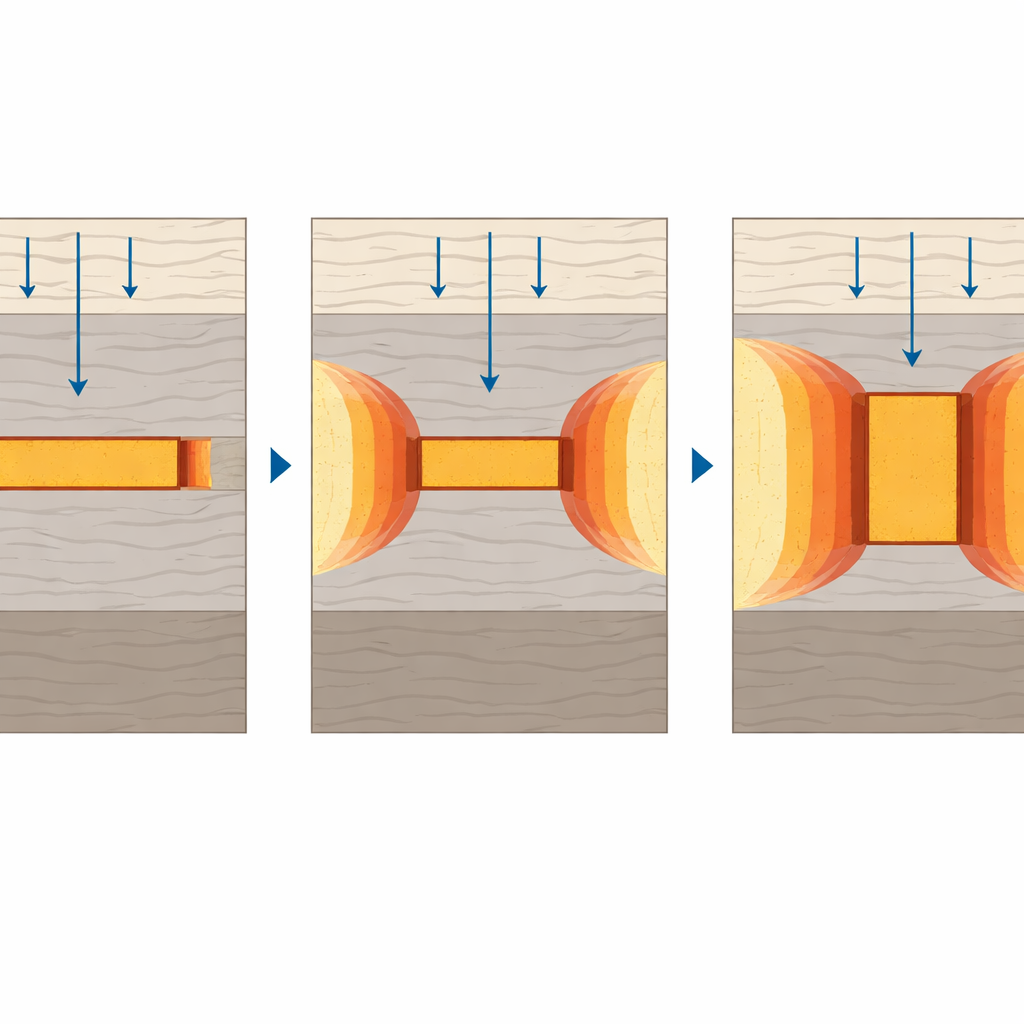
In strip backfill mining, the working face is mined in long bands, leaving alternating solid strips that act like underground beams to hold up the roof. Instead of leaving these strips entirely as coal, this method builds some of them from the sand-based backfill. Using computer simulations of a real mine in Shaanxi Province, the team studied what happens inside a backfill strip as the roof settles. They found that each strip develops a strong central core surrounded on both sides by “plastic” zones where the material has yielded and lost much of its strength. The width of these softened zones grows as the mining height and depth increase, but shrinks when a larger fraction of the mined-out area is filled.
A Simple Rule Linking Mining Conditions and Strip Safety
Because the soft edge width depended on several factors at once, the researchers used statistical fitting to build an equation that links it to mining depth, mining height and the fraction of the panel that is refilled. This allowed them to plug the plastic-zone width into an established theory that treats each strip as having a strong core and weak sides, and to adapt a second theory that describes how the weight of the overlying rock is shared between filled and unfilled areas. Combining these ideas produced, for the first time, a clear mathematical expression for how stable a sand-based backfill strip will be under given mining conditions.
Putting the Method to the Test in a Real Mine
The new design method was then applied at a working coal face about 300 meters deep beneath scattered houses. Based on limits for how much the ground surface was allowed to move, the engineers computed how wide the unfilled gaps and filled strips should be. They chose 56-meter-wide backfill strips separated by 46-meter-wide mined-out spaces and installed a modular support system to place and hold the backfill as it hardened. Over nearly three years of monitoring, the maximum surface subsidence and ground strains all stayed within the strict targets, and no damage occurred to the buildings above.
What This Means for Greener Coal Mining
This work shows that fine desert sand, combined with industrial waste fly ash, can become a reliable structural material for supporting underground openings. By carefully relating mining depth, seam height and filling ratio to the soft-zone width and overall strip strength, engineers can design backfill strips that safely carry the rock above while using less material than full backfilling. In practical terms, the method offers coal producers in sandy regions a way to recover resources more efficiently, protect communities on the surface and recycle waste, moving underground coal mining a step closer to truly “green” operation.
Citation: Li, R., Zhao, H., Liu, P. et al. Analysis of influencing factors on the plastic zone width and stability of aeolian sand-based backfill strips. Sci Rep 16, 14444 (2026). https://doi.org/10.1038/s41598-026-41520-4
Keywords: backfill mining, aeolian sand, ground subsidence, coal mine stability, paste backfill