Clear Sky Science · en
Beam shape effect on enhanced laser wakefield acceleration of electrons driven by 10-fs mJ-class pulses
A New Way to Shrink Powerful Particle Accelerators
Particle accelerators that probe matter and generate medical X‑rays usually stretch for many meters or even kilometers. A fast‑moving alternative, called laser wakefield acceleration, can boost electrons to high energies over distances smaller than a grain of rice. This study explores how reshaping the laser beam itself can make these compact accelerators more powerful and stable, opening the door to tabletop sources for research, imaging, and therapy.
Riding the Waves in a Plasma
In laser wakefield acceleration, an intense laser pulse plows through a thin gas that has been turned into a plasma, pushing electrons aside and leaving behind a bubble of positive charge. This bubble creates an electric field thousands of times stronger than those in conventional machines, capable of hurling electrons forward like surfers on an ocean wave. But there is a catch: as the electrons gain energy, they tend to outrun this wave, and the laser that drives the process quickly loses strength. These effects limit how much energy the electrons can ultimately reach in a single stage.
Why Beam Shape Matters
Most experiments use a standard laser profile known as a Gaussian beam, which is tightly focused at one point and then rapidly spreads out. The authors ask what happens if the beam is reshaped into a so‑called Bessel–Gauss pattern, which has a bright central core surrounded by concentric rings. With a special mirror called an axiparabola, this beam can keep its narrow core over a much longer distance, like a flashlight whose spot refuses to defocus. Using advanced computer simulations that capture the full three‑dimensional physics, the team compares these two beam shapes while keeping the total laser energy and pulse duration fixed at technologically realistic values: 40 millijoules and 10 femtoseconds. 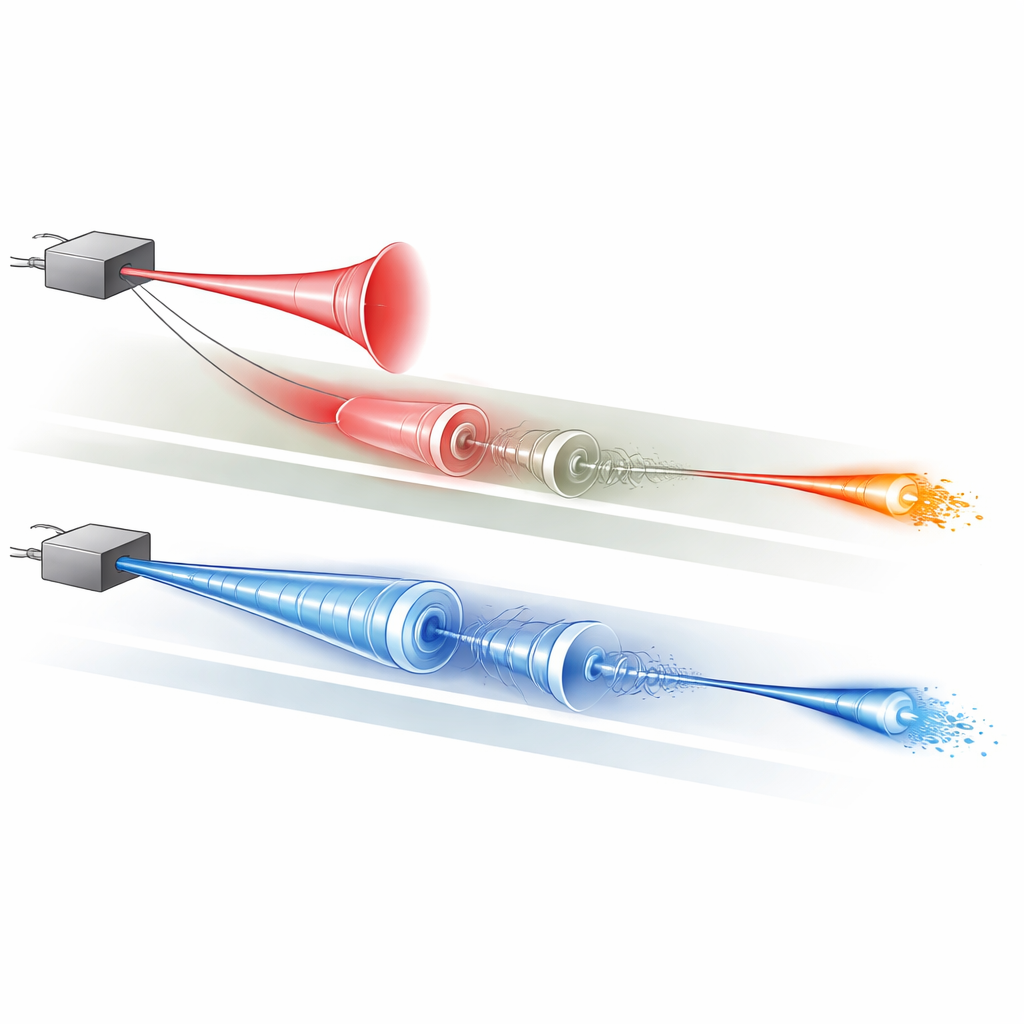
Simulating Compact High‑Rate Accelerators
The simulations track how each type of laser pulse evolves as it travels through the plasma and how effectively it accelerates electrons. The plasma contains mostly hydrogen with a small amount of nitrogen; inner electrons from the nitrogen atoms are released only near the peak of the laser field, providing a controlled way to inject electrons into the wake. For Gaussian beams, the tight focus required at these modest energies causes the laser to diffract and reshape quickly. Its intensity falls sharply after a few hundred micrometers, the wakefield weakens, and electrons start to drift into regions where they are slowed instead of sped up. As a result, the electron energy plateaus around 100–125 mega‑electron‑volts, and stronger initial laser fields actually make the outcome worse by draining the pulse too rapidly.
A Longer Push with Ringed Beams
Bessel–Gauss beams behave differently. Their outer rings continually feed energy into the central core, so the on‑axis intensity decays much more slowly than in the Gaussian case. This extended high‑intensity region lets electrons stay in the accelerating part of the wake for a longer distance before dephasing or depletion takes over. In the most favorable configurations, the simulations show maximum electron energies of about 150–160 mega‑electron‑volts—roughly 20–27 percent higher than the best Gaussian setups using the same laser power. The electron bunches remain relatively narrow in angle, and their energy spread stays below about 30 percent when the laser strength is kept at moderate levels. 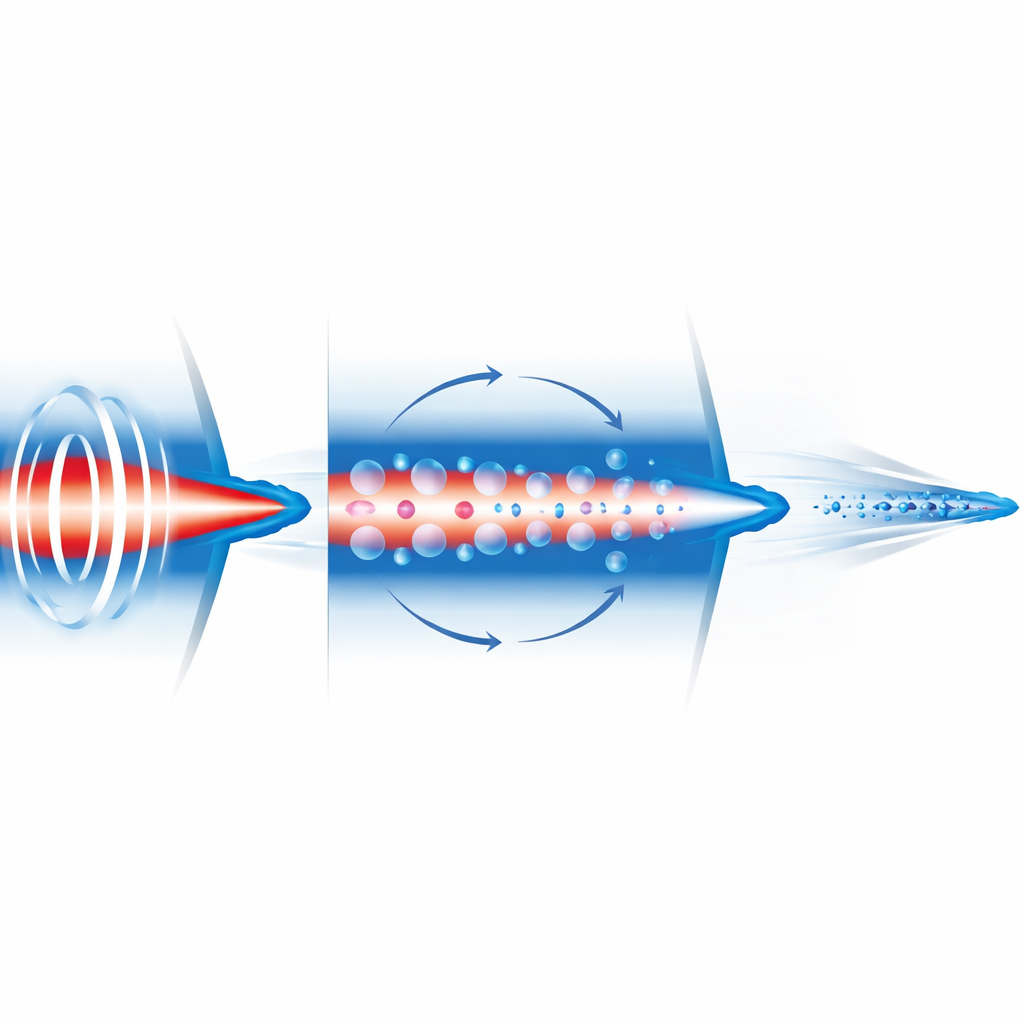
Limits and Practical Payoffs
Even with the improved beam shape, the laser pulse cannot accelerate electrons indefinitely. Over distances of 300–500 micrometers, nonlinear evolution of the pulse still reduces its intensity by more than a factor of two, capping the achievable energy. Yet the work demonstrates that carefully structured beams can squeeze substantially more performance out of small, high‑repetition‑rate laser systems operating below 0.1 joule per pulse. For a lay reader, the key message is that by sculpting the light—turning a simple spot into a ringed structure—researchers can make miniature accelerators that are more efficient and reliable, potentially bringing powerful radiation sources and advanced imaging tools from large facilities into ordinary laboratories and clinics.
Citation: Abedi-Varaki, M., Tomkus, V., Girdauskas, V. et al. Beam shape effect on enhanced laser wakefield acceleration of electrons driven by 10-fs mJ-class pulses. Sci Rep 16, 11188 (2026). https://doi.org/10.1038/s41598-026-41516-0
Keywords: laser wakefield acceleration, plasma accelerator, Bessel beam, compact electron source, high repetition rate lasers