Clear Sky Science · en
Comprehensive identification and parametric uncertainty assessment in the dynamic modelling of a 3D crane system
Why understanding crane motion matters
Cranes are the workhorses of modern industry, lifting heavy loads in shipyards, factories, and construction sites. Yet every move of a crane sets its payload swinging like a pendulum, and small changes in height or friction can turn a smooth lift into a risky maneuver. This paper takes a close look at a three-dimensional (3D) laboratory crane and asks a practical question: how can we capture its real behavior, including its quirks and uncertainties, in a model that engineers can actually use to design safer, more reliable automatic control systems?
A tabletop stand-in for real cranes
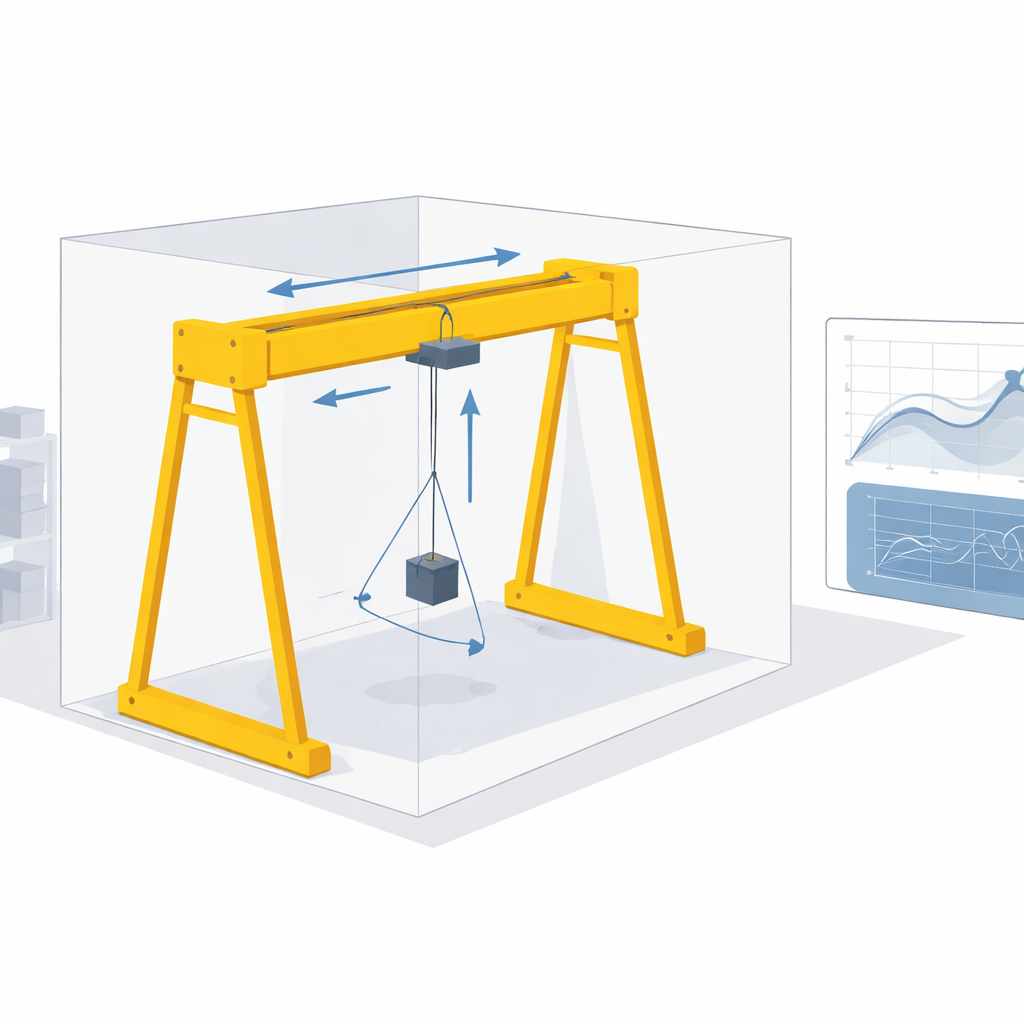
The researchers worked with a compact 3D crane system that mimics the motions of full-scale equipment. Three electric motors move a small cart in the horizontal X and Y directions and raise or lower the payload along the Z axis. A 200-gram weight hangs from a cable, free to swing forward–back and side-to-side. Precise position and angle sensors record how the payload and cart respond when the motors receive carefully chosen electrical signals. By varying the height of the payload and applying step-like and impulse-like inputs, the team built a detailed dataset capturing both how far and how fast the cart moves and how the payload swings in response.
Turning motion into a usable model
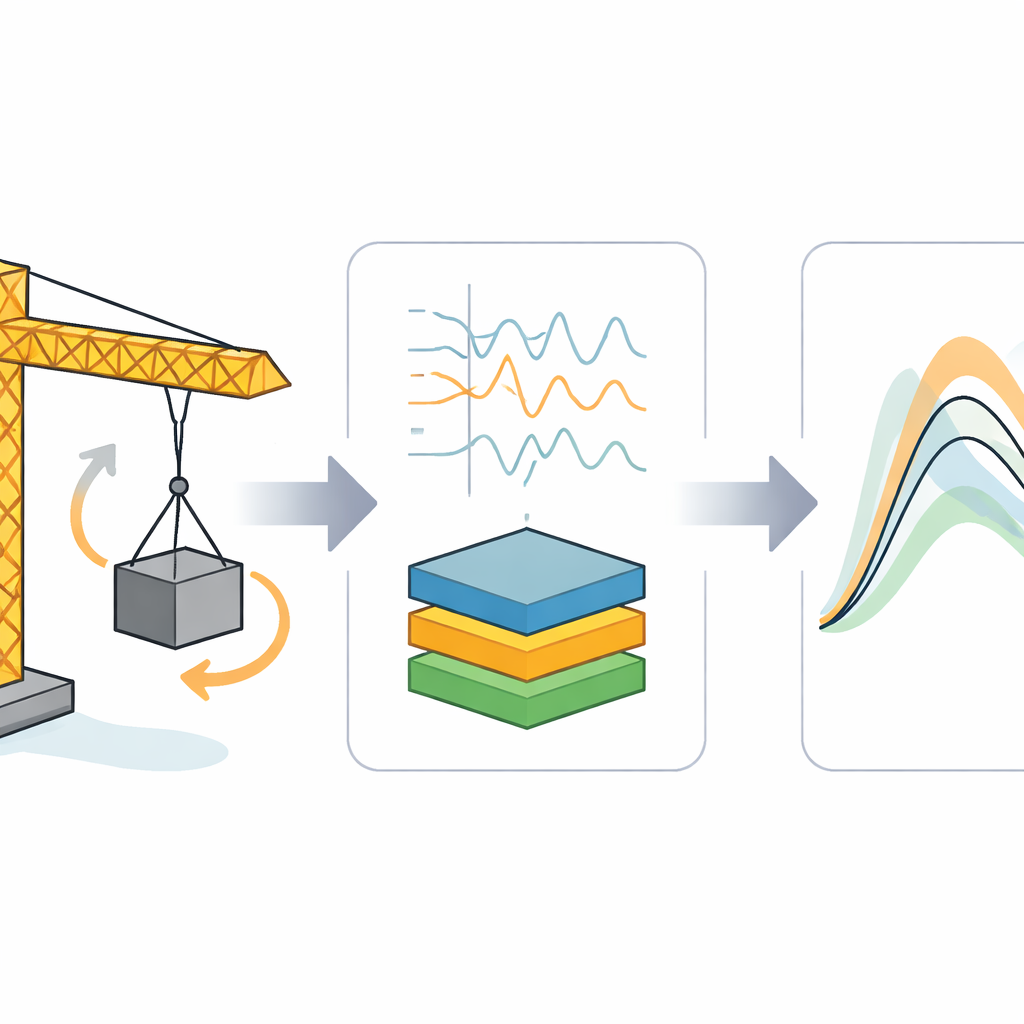
To turn raw motion data into something designers can work with, the authors built a mathematical description of the crane that focuses on cause and effect: input voltage in, position and swing out. They used standard curve-fitting techniques to find simple formulas that reproduce the behavior of each motion axis, summarized by a few key numbers such as how strongly the system reacts to input (gain), how quickly it responds (time constants), and how quickly swinging dies out (damping ratios. Importantly, they did not settle for a single best number for each quantity. Instead, by repeating experiments at different payload heights and input levels, they mapped out realistic ranges—intervals that capture how these parameters drift with configuration and operating conditions.
Revealing hidden quirks and couplings
Real machinery rarely behaves in a perfectly smooth, symmetric way, and this crane was no exception. The team found an asymmetric “dead zone” in each motor: small input voltages simply failed to move the cart because of friction and mechanical resistance, and the threshold differed for forward and backward motion. They quantified these dead zones for all three axes so they could be included explicitly in the model. The experiments also showed that changing the vertical position of the payload alters how quickly the cart responds and how strongly the payload swings, especially along one horizontal axis. At high payload positions, oscillations in the main swing angle became much more pronounced, underscoring that height and swing are tightly linked and must be considered together when designing control strategies.
Checking against factory and full-physics models
To judge how useful their compact model really is, the authors compared it with two other descriptions supplied by the manufacturer: a detailed nonlinear simulation based on the full physics of a swinging mass, and a simpler “nominal” linear model with fixed parameters. In head-to-head tests against experimental data, the newly identified model—with its parameter ranges and measured dead zones—tracked the real crane’s responses closely across many scenarios. The nominal factory model tended to be too conservative and too slow, while the full nonlinear model could overestimate swinging in extreme cases. By contrast, the uncertainty-aware model struck a practical balance: simple enough for standard control design tools, yet rich enough to reflect the spread of behaviors observed in the lab.
What this means for safer, smarter cranes
For a non-specialist, the key outcome is that the study delivers a realistic yet compact description of a 3D crane that openly acknowledges uncertainty instead of hiding it. Engineers can now design controllers that are not just tuned to one ideal set of parameters, but robust to the range of gains, time constants, damping, and dead zones that actually occur as the payload height and conditions change. While the work is based on a laboratory system and assumes moderate speeds and small swing angles, it lays a foundation for smarter control strategies in real cranes used in construction, logistics, and automated warehouses, ultimately helping to keep loads steady, operations predictable, and workers safer.
Citation: Shaikh, I., Matušů, R., Wendimu, A.A. et al. Comprehensive identification and parametric uncertainty assessment in the dynamic modelling of a 3D crane system. Sci Rep 16, 11158 (2026). https://doi.org/10.1038/s41598-026-41515-1
Keywords: 3D crane dynamics, system identification, parametric uncertainty, payload oscillation, robust control