Clear Sky Science · en
Impacts of air pollution on farmers’ subjective satisfaction in China’s ore and agricultural zone
Why Dusty Skies Matter for Country Life
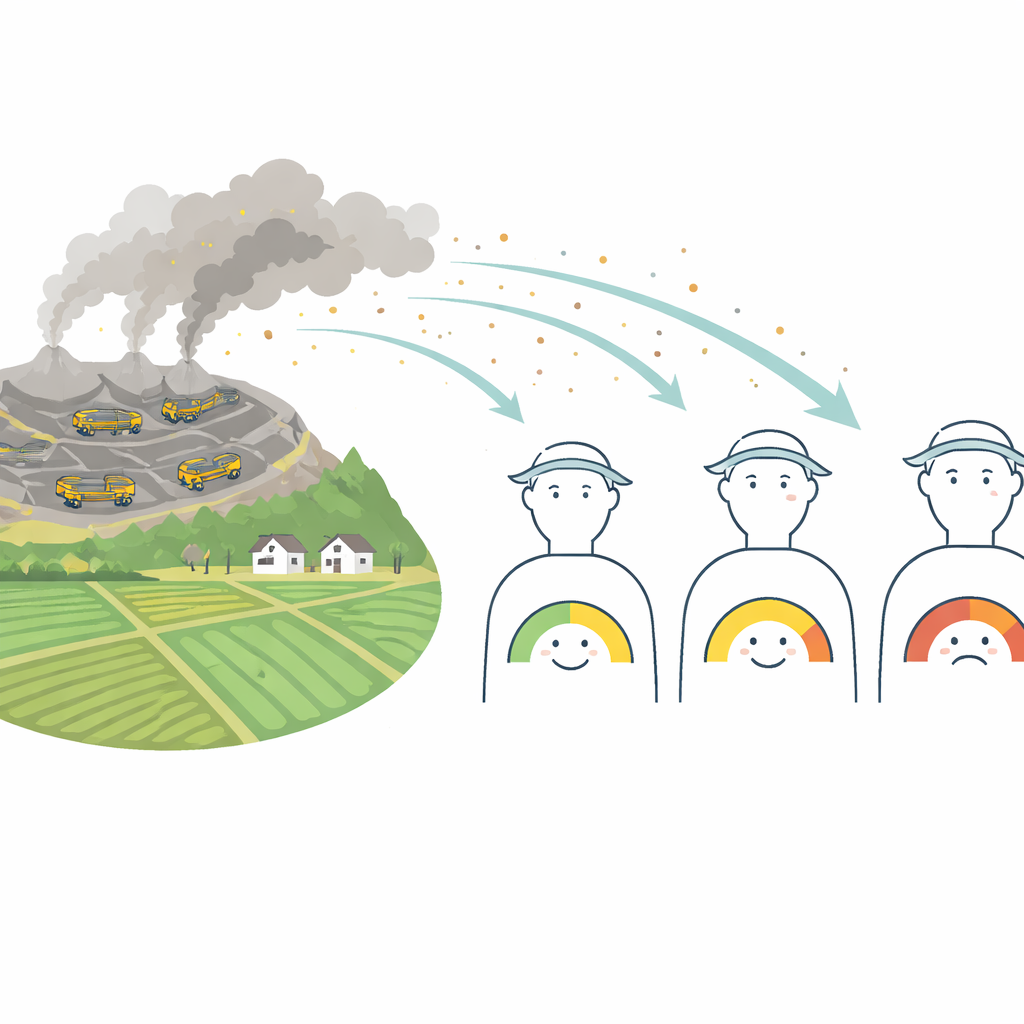
Across northern China, coal mines sit side by side with farm villages. The same activity that powers cities also kicks up dust and smoke that drift over fields and homes. This study asks a simple but vital question: how does that polluted air actually make farmers feel about their lives, their surroundings, and the local officials who govern them? By listening directly to 600 farmers and comparing their answers with detailed air quality data, the researchers show that bad air quietly erodes rural well-being—and that the timing and persistence of pollution matter as much as how dirty the air is on any one day.
Life Between Mines and Fields
The research focuses on an “ore–agriculture zone” in the middle reaches of the Yellow River Basin, covering parts of Shaanxi and Shanxi provinces. Here, some of China’s largest coal mines operate amid fragile landscapes and traditional farming communities. Dust from open pits, coal trucks, and loading sites mixes with other pollutants to form a persistent haze. To understand how this affects everyday life, the team carried out face-to-face surveys in 19 villages located within 2 kilometers of coal mines. The questionnaire asked farmers to rate three things on a five-point scale: their overall life satisfaction, their satisfaction with the air around them, and their satisfaction with local government services.
Three Kinds of Satisfaction
The study treats satisfaction as more than a single feeling. Instead, it builds a three-part picture. “Life satisfaction” covers income, health, and social relationships. “Air environment satisfaction” captures how people judge the cleanliness and comfort of the air they breathe. “Government satisfaction” reflects how well residents think public authorities are doing in providing services and managing problems such as pollution. Together, these three views link the personal, environmental, and political aspects of well-being into one loop: daily experience, the state of the surroundings, and trust in institutions all feed into how farmers judge their own situation.
Short Whiffs Versus Lasting Smog
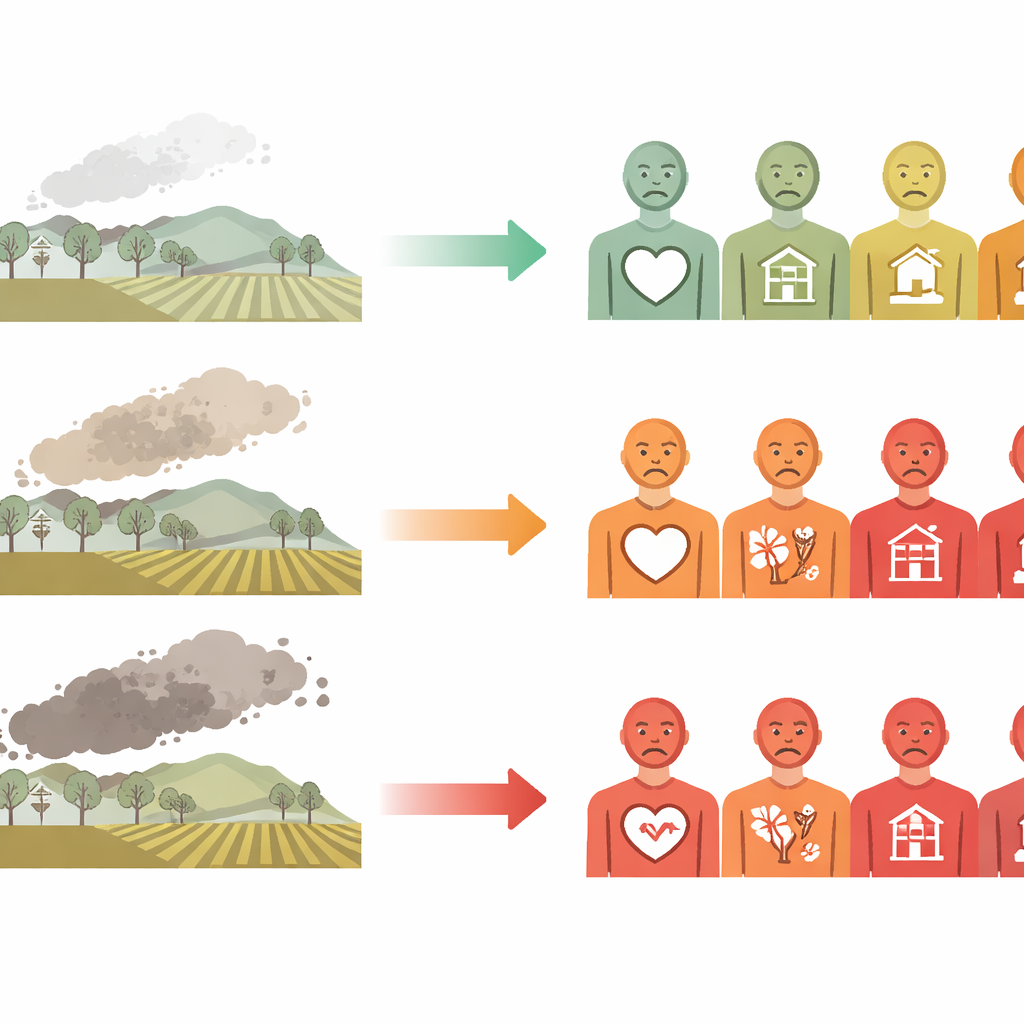
To tease out how timing matters, the researchers matched each farmer’s interview date with air quality index (AQI) and fine particle (PM2.5) readings from nearby monitoring stations. They looked at four windows: the day of the survey, the week before, the three months before, and the year before. Using standard statistical models that also accounted for weather, income, age, health, housing, water, medical care, and transport, they found a clear pattern. Brief spikes in pollution—on the day of the survey or over a few days—had little or only weakly negative influence on any of the three satisfaction measures. In contrast, medium-term exposure over about three months had the strongest and most consistent negative impact, with long-term yearly averages also harmful but slightly less so. The same pattern appeared whether pollution was measured by overall AQI or by PM2.5 alone.
How Bad Air Shapes Feelings and Trust
The authors explain this timing effect using the idea of environmental perception. Air pollution first hits the senses as dust, smell, or irritation, then is processed in the mind, and finally shows up in judgments about life and society. When pollution lasts for a season rather than a day, it stops feeling like a passing nuisance and starts to define the “normal” environment. Farmers may cough more, tire more easily, or lose work days in the fields, lowering their sense of a good life. Constant haze becomes a visible sign of a damaged landscape, reducing satisfaction with the local environment. At the same time, steady pollution signals that authorities are not managing the problem well, eroding confidence in government. Over many years, however, people may adapt somewhat—by adjusting expectations or changing routines—which can blunt, but not erase, the impact seen at the medium-term scale.
Beyond Air: Homes, Roads, and Health
Not all farmers experience pollution in the same way. Older, better-educated, and higher-income respondents tended to report higher life satisfaction, while households with more sick members were less satisfied. Stronger labor capacity and better income supported higher satisfaction with both air and government. Living conditions also played a key role: sturdier housing, good crop harvests, cleaner water, accessible medical services, and better roads all boosted satisfaction. In these mining–farming communities, improvements in water quality and transportation often go hand in hand with dust control and other pollution measures, so physical infrastructure and environmental quality reinforce each other in people’s minds.
What This Means for Rural Futures
The study concludes that air pollution clearly drags down how farmers feel about their lives, their surroundings, and their local leaders—and that medium-term, season-long smog does the most damage. For rural revitalization to be genuine, cleaning up the air around mines and transport routes cannot be an afterthought; it must be a central task. Targeting the sources of sustained pollution over key three-month periods, while at the same time improving housing, water, health care, and roads, would not only protect farmers’ bodies but also lift their spirits and restore some of their trust in the institutions meant to serve them.
Citation: Turhun, M., Shi, X. Impacts of air pollution on farmers’ subjective satisfaction in China’s ore and agricultural zone. Sci Rep 16, 11801 (2026). https://doi.org/10.1038/s41598-026-41510-6
Keywords: air pollution, rural China, coal mining, life satisfaction, environmental governance