Clear Sky Science · en
Sustainable composite insulator for thermal, moisture, and electromagnetic shielding using recycled waste polymers/bimetallic MOF-grown porous carbon
Turning Trash into High-Tech Protection
Modern life runs on wireless signals and plastic. Both have hidden costs: discarded packaging piles up in landfills, while invisible electromagnetic waves from electronics can interfere with devices and may raise health concerns. This study explores a way to tackle both problems at once by transforming common plastic waste into a smart coating for buildings that blocks unwanted radiation, keeps heat inside, shrugs off moisture, and is safer in a fire.
Why Wireless Noise Is a Growing Problem
Every phone call, Wi‑Fi connection, and satellite link depends on electromagnetic waves. As these signals multiply, they can leak into nearby equipment, causing glitches and instability. Traditional shielding relies on metals or specialty materials that can be heavy, costly, and difficult to recycle. Engineers are therefore looking for lightweight, affordable options that can be built directly into walls, enclosures, or casings—ideally from ingredients that do not create new environmental burdens.
Giving Old Plastics a New Life
The researchers started with two of the most familiar plastics: polystyrene, used in foams and packaging, and PET, used in drink bottles. Instead of burning or landfilling these wastes, they broke PET down into a simple building block that can bind metal atoms into a highly porous framework, and converted other PET scraps into sponge-like carbon. Together with recycled polystyrene, these ingredients form a new composite: a solid plastic matrix filled with tiny carbon structures coated by a copper–nickel network. The team even used d-limonene, a citrus-derived solvent from orange peels, to dissolve the polystyrene, keeping the process relatively green. Thin sheets just a few millimeters thick were made by casting the mixture from solution and pressing it into test samples. 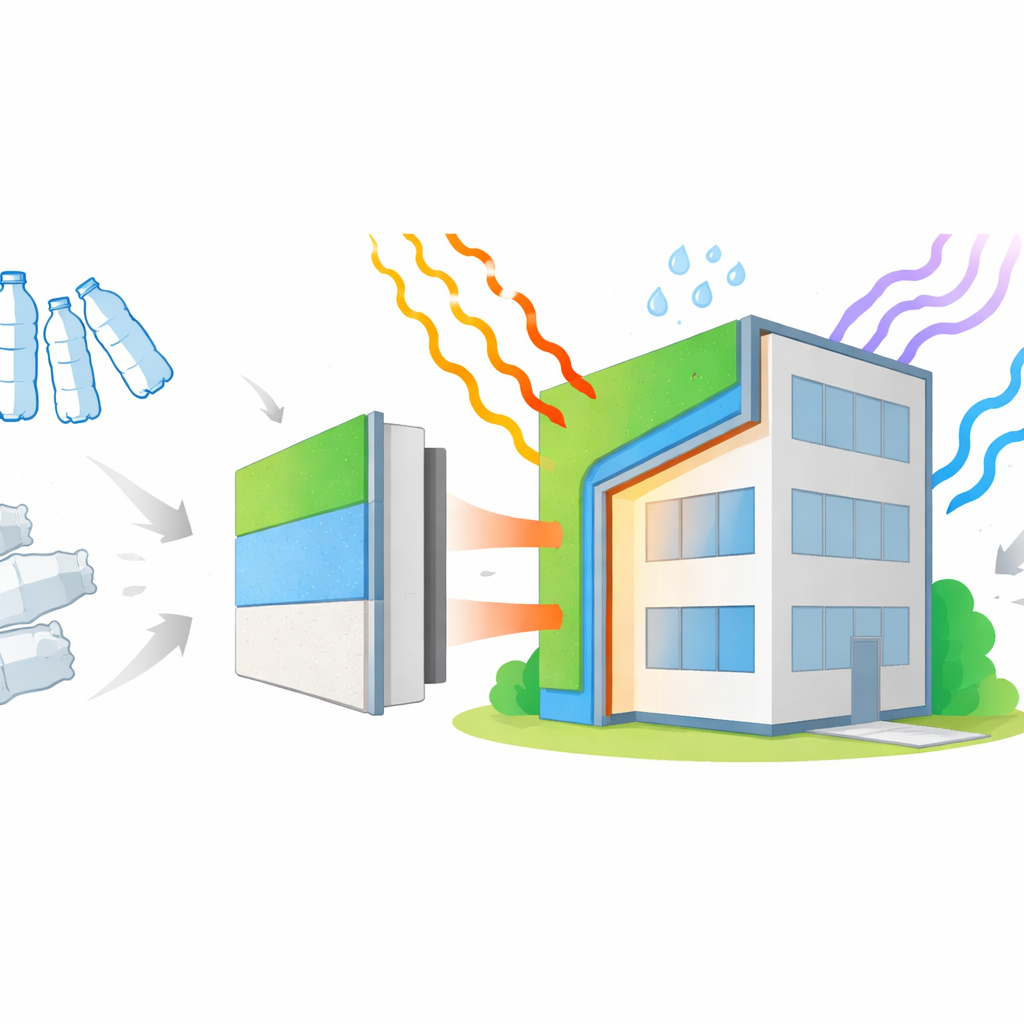
How the Smart Coating Tames Heat and Waves
Inside the material, the copper–nickel framework and porous carbon create a maze of pockets and pathways. When high-frequency electromagnetic waves hit this maze, they are repeatedly scattered, reflected, and converted into tiny amounts of heat instead of passing straight through. Measurements in the same frequency band used by radar and many communication systems showed that the best version of the composite—containing 15 percent of the active filler—blocked about 99.94 percent of incoming radiation, even at only 2 millimeters thick. At the same time, the many pores and interfaces disrupt the flow of heat, lowering thermal conductivity by about 27.5 percent compared with plain recycled polystyrene. That means the coating not only shields electronics, it also helps keep buildings better insulated.
Built to Resist Water and Fire
For an outdoor wall coating to be practical, it must stand up to rain, humidity, and heat. The new composite surface is naturally water-repellent: droplets bead up with a contact angle above 100 degrees, and test pieces absorbed only about 0.6 percent water after a full day under water. The material also maintained its strength, with mechanical tests showing that adding the copper–nickel–carbon network slightly reduced but largely preserved the toughness of the recycled plastic. In fire tests, the composite ignited more slowly, dripped burning material for a shorter time, and burned for a significantly shorter total period than plain polystyrene. A carbon-rich char layer forms on the surface, helping to shield the underlying material from further damage. 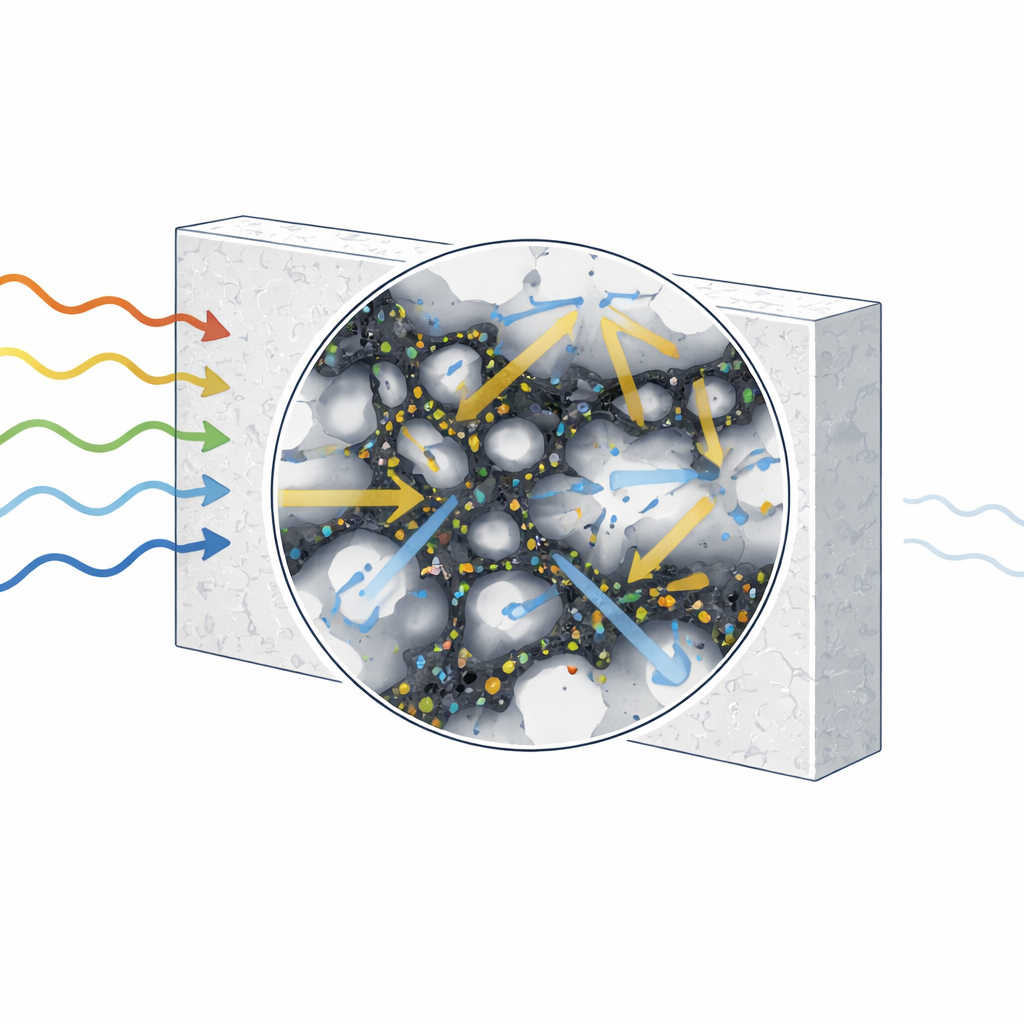
A Step Toward Smarter, Greener Buildings
By weaving metals, carbon, and recycled plastics into a single structure, the authors created a thin, lightweight coating that blocks most incoming electromagnetic waves, slows heat loss, resists water, and shows better behavior in a flame. To a non-specialist, the bottom line is straightforward: waste plastics can be upgraded into advanced protective skins for buildings and electronic housings, cutting both energy use and electronic noise while keeping more trash out of the environment. This approach suggests a future where everyday structures quietly serve as both insulation and high-tech shields, built from yesterday’s bottles and foam.
Citation: Mahdavinia, M., Kiani, G., Ghavidel, A.K. et al. Sustainable composite insulator for thermal, moisture, and electromagnetic shielding using recycled waste polymers/bimetallic MOF-grown porous carbon. Sci Rep 16, 11252 (2026). https://doi.org/10.1038/s41598-026-41505-3
Keywords: electromagnetic shielding, recycled plastics, building insulation, metal-organic frameworks, porous carbon