Clear Sky Science · en
Exact soliton, lump, and breather solutions of the (3 + 1)-dimensional Jimbo-Miwa equation via the bilinear neural network method
Waves That Refuse to Behave
From tsunamis and plasma bursts to optical data streams, many of nature’s most dramatic events are carried by waves that do not spread out smoothly. Instead, they sharpen into solitary humps, collide, or pulse in place like a beating heart. This paper explores such complex waves in a high‑dimensional setting and shows how a new kind of “equation‑aware” neural network can reveal hidden patterns that traditional math often misses.
A High-Dimensional Wave Playground
At the center of the study is the Jimbo–Miwa equation, a mathematical model that describes how nonlinear waves evolve in three spatial directions plus time. This equation can capture, in one framework, effects important to plasma physics, shallow‑water waves, nonlinear optics, and even quantum field theory. Because it is both nonlinear and high‑dimensional, its solutions can represent localized lumps, long shallow fronts, or intricate wave packets that interact in space and time. Finding exact formulas for these behaviors is valuable: they act like fingerprint solutions that help scientists interpret experiments, design devices, and test numerical simulations.
Blending Classic Math with Neural Ideas
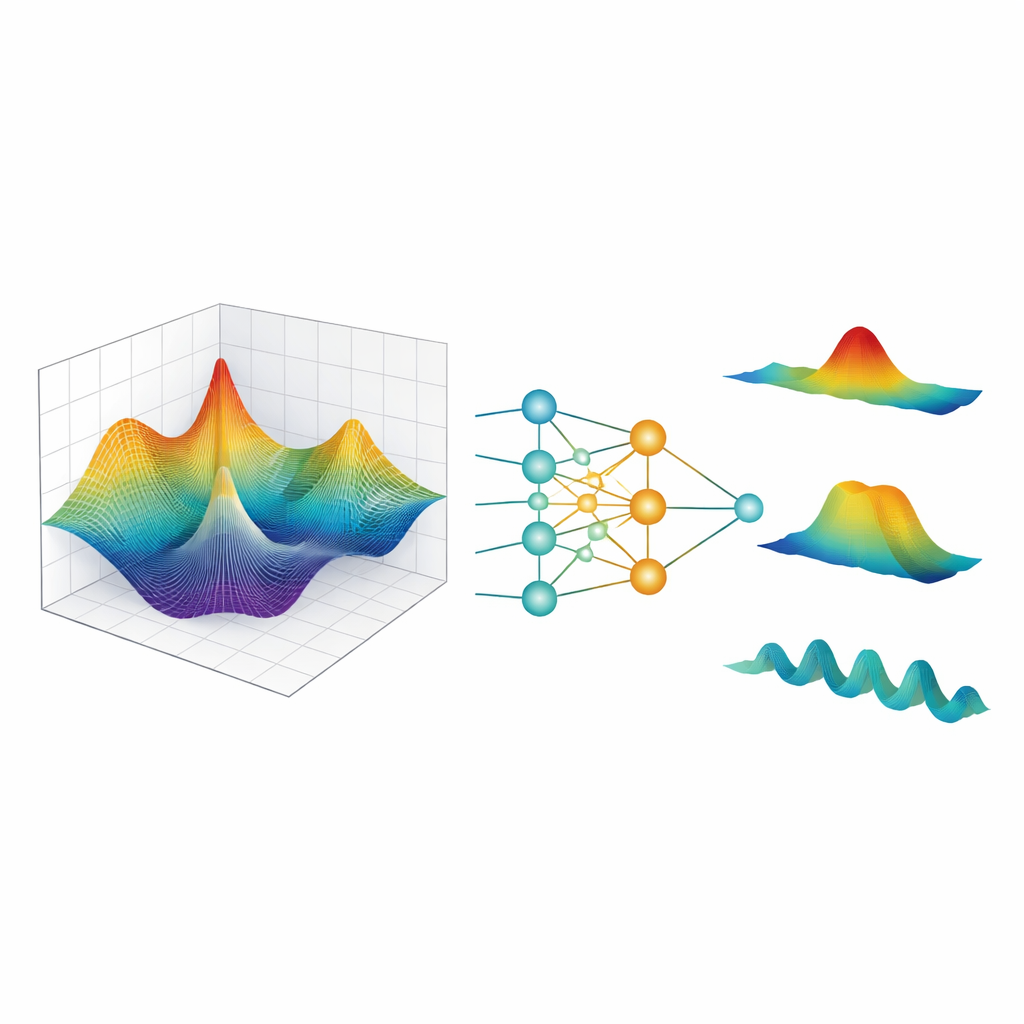
To tackle this challenging equation, the authors do not train a neural network in the usual data‑driven sense. Instead, they borrow the layered structure of neural networks as a clever way to guess the shapes of possible solutions. They start by rewriting the Jimbo–Miwa equation in a “bilinear” form using a standard mathematical trick called the Cole–Hopf transformation, closely related to Hirota’s well‑known method for building soliton solutions. Once in this friendlier form, the solution is expressed through a network‑like ansatz: simple linear combinations of space and time feed into nonlinear functions (such as squares, exponentials, sines, and cosines), which are then recombined into a final wave profile. By choosing different small architectures—4‑2‑1, 4‑3‑1, 4‑4‑1, and a deeper 4‑2‑2‑1 layout with various activation functions—the authors systematically scan through families of candidate solutions and keep only those that satisfy the equation exactly.
From Single Humps to Colliding Wavefronts
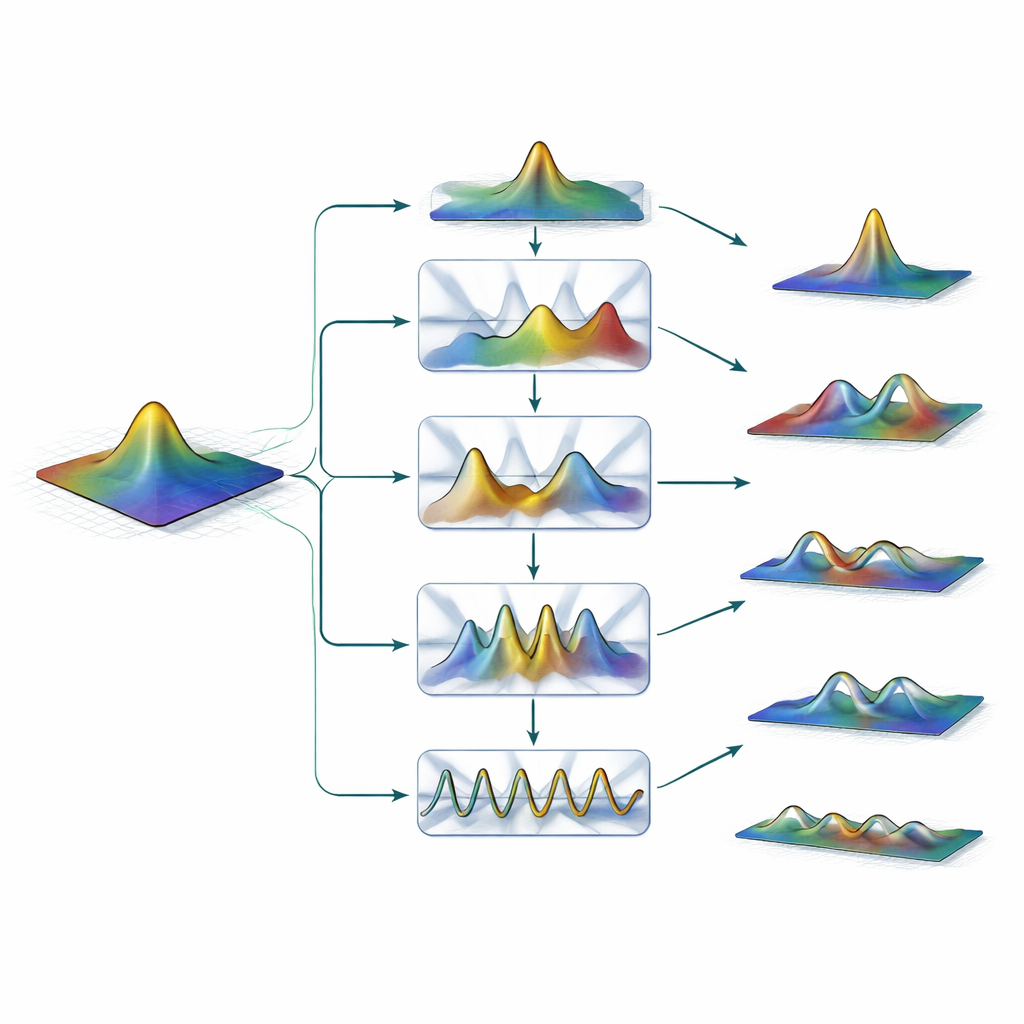
The first set of architectures produces lump solutions, which are localized peaks that stand out sharply against a flat background and then fade smoothly away. These lumps can travel without changing shape, making them ideal analogues for solitary pulses in fluids or plasmas. By mixing polynomial and exponential responses in the network, the authors then construct interactions between a lump and one or two soliton‑like fronts. In space‑time plots, these appear as sharp ridges, step‑like transitions, and hybrid patterns where a localized peak rides on or collides with a broader wave. The mathematical form reveals how linear, quadratic, and exponential contributions compete to create steep fronts, asymmetric propagation, and transient bursts before the system relaxes back to a steady state.
Breathing and Resonant Wave Patterns
Another family of network designs introduces trigonometric and hyperbolic functions, enabling the construction of “breather” waves—localized structures whose amplitude oscillates in time, as if the wave were inhaling and exhaling. The resulting formulas combine oscillatory and exponentially localized pieces, giving rise to pulses that grow, shrink, and move in a controlled way. The deeper 4‑2‑2‑1 model goes further by nesting sine, cosine, and exponential layers, generating richly modulated periodic patterns. In visualizations, these appear as clean traveling wave trains, long‑lived resonant collisions, and higher‑order structures where several localized features interact before settling into plateaus or repeating cycles.
Why These Patterns Matter
For non‑specialists, the key takeaway is that this hybrid bilinear neural‑network framework offers a powerful new lens on complex waves. Rather than relying only on numerical approximations, it yields exact or near‑exact formulas for a broad spectrum of behaviors: stable lumps, sharp kinks, multi‑wave collisions, breathing pulses, and persistent periodic trains. Such solutions help researchers understand how extreme events like rogue waves or intense optical bursts can form, interact, and either dissipate or persist. By showing that a neural‑inspired symbolic approach can systematically uncover new wave patterns in a difficult high‑dimensional equation, the work points toward future tools that blend human‑designed mathematics with machine‑like structural exploration to better map the landscape of nonlinear phenomena.
Citation: Hussein, H.H., Mekawey, H. & Elsheikh, A. Exact soliton, lump, and breather solutions of the (3 + 1)-dimensional Jimbo-Miwa equation via the bilinear neural network method. Sci Rep 16, 11617 (2026). https://doi.org/10.1038/s41598-026-41485-4
Keywords: nonlinear waves, solitons, bilinear neural network, Jimbo–Miwa equation, breather solutions