Clear Sky Science · en
Using a two-stage D-Optimal mode to select equipment for flexible manufacturing systems
Why this matters for modern factories
Across the world, manufacturers are racing to automate their production lines with robots, smart machines, and computerized transport systems. But how much automation is really worth paying for? This paper explores that question in a real electronics factory and finds a surprising answer: the best-performing system is not fully automated, but carefully balanced between machines and people. Using advanced computer experiments and simulations, the authors show how to choose the right mix of equipment to cut waste, speed up production, and avoid overspending on technology.
Factories as living, flexible systems
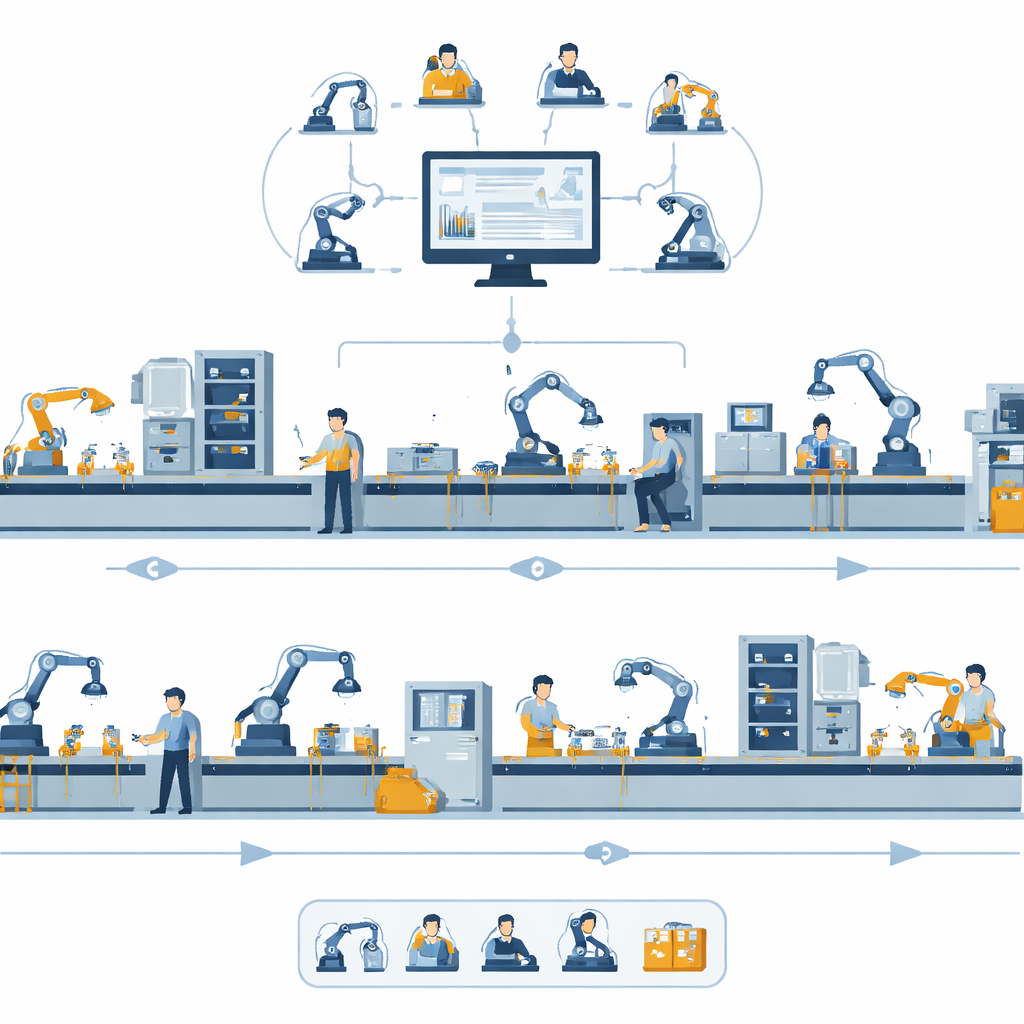
The study focuses on a flexible manufacturing system, or FMS, where different types of machines, robots, storage units, and transport devices are all coordinated by a central computer. In the case company, two parallel lines build low-voltage and high-voltage electrical products, each passing through five main stages from incoming inspection to final packaging. Management wants these lines to respond quickly to changing customer orders, but must work within strict limits on how many machines and workers they can deploy. Rather than simply adding more automation, the researchers ask: what combination of automated and manual resources gives the best overall performance under these constraints?
Testing thousands of “what if” scenarios on a virtual line
Instead of experimenting directly on the real shop floor, the team builds a detailed computer model of the factory using discrete-event simulation. This virtual line reproduces how parts arrive, how long each operation takes, how often defects appear, and how machines and workers become busy or idle. They then link this model to a computer-aided design of experiments tool that plans which equipment combinations to test. A special two-stage “D-Optimal” design is used to cover a huge range of possibilities with as few simulation runs as possible, all while respecting a fixed total capacity of 84 resource units shared between automated and manual equipment.
Finding the sweet spot between people and machines
To judge whether a particular setup is good or bad, the authors combine several practical measures into a single score. These include how many products are made per day, how long items stay in the system, how much work-in-progress is waiting between stations, how much scrap is produced, how heavily machines and workers are utilized, and what the output rate looks like. Managers from the company help assign relative importance to these indicators using a structured comparison method, giving extra weight to making more good products quickly and less (but still some) weight to keeping inventories and waste low. Each simulated configuration then receives a composite score that reflects the factory’s real priorities.
Why full automation is not the winner
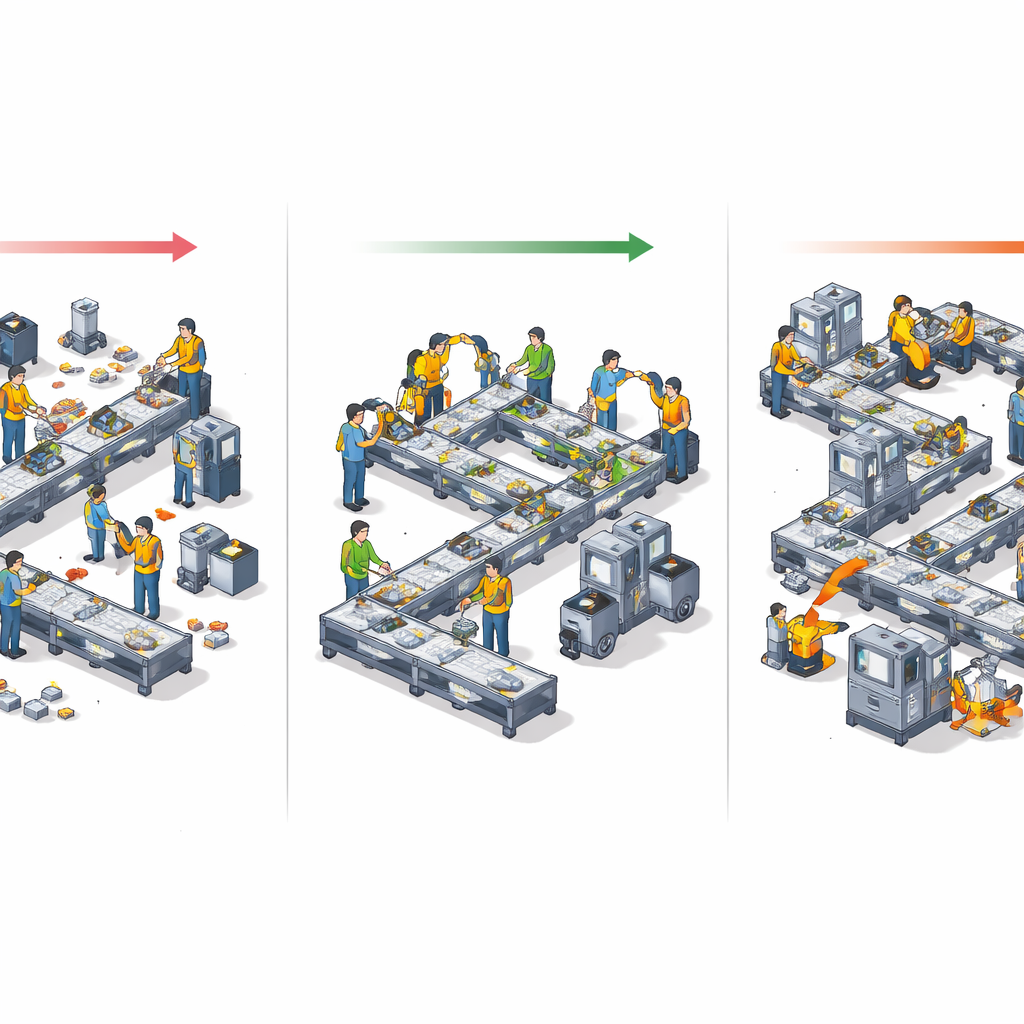
In the first stage, the D-Optimal plan scans a broad landscape of automation levels, pointing to promising regions. In the second stage, the method zooms in on those regions and tests many finer-grained equipment combinations. The results show a strongly non-linear pattern: performance improves as automation rises from the current modest level, peaks when about 92.8% of resources are automated, and then declines again as the line approaches near-total automation. At that optimum point, the factory can increase its daily production rate by about two-thirds, reduce scrap by roughly 40%, shorten cycle and production times, and raise equipment utilization, all while only slightly increasing the average amount of work waiting in the system.
What this means for industry decision-makers
The key message for non-specialists is straightforward: “more automation” is not automatically better. In this real-world electronics plant, chasing full automation would have cost more while delivering worse overall performance than a carefully tuned mix in which a small but essential share of work remains manual. The two-stage computer-aided method developed here gives managers a practical way to test thousands of what-if scenarios on a digital twin of their production line, under realistic limits on budget, staff, and equipment. By adjusting the performance measures and constraints, the same approach can guide equipment choices in other sectors, helping factories find their own sweet spot between people and machines instead of blindly aiming for 100% automation.
Citation: Yu, X., Mi, J., Liu, J. et al. Using a two-stage D-Optimal mode to select equipment for flexible manufacturing systems. Sci Rep 16, 11136 (2026). https://doi.org/10.1038/s41598-026-41466-7
Keywords: flexible manufacturing systems, automation level optimization, discrete-event simulation, equipment selection, Industry 4.0